
VinFast Hasn’t Given Up On Its US Ambitions — Despite Delays, Betting On Long-Term Strategy
Support CleanTechnica's work through a Substack subscription or on Stripe.
VinFast’s decision to resume construction of its North Carolina manufacturing plant by April of this year is an indication that the “war” for brand recognition isn’t over for the Vietnamese automaker.
“The US remains a long-term strategic pillar for VinFast,” VinFast Le Thi Thu said during the company’s earnings call earlier this month. She framed the adjustments as part of a deliberate long-term strategy rather than a retreat, emphasizing that the company is building its global operations in stages to ensure sustainability and efficiency.
The long-term commitment to the United States is evident with the announcement because despite the various difficulties (uncertainties might be a more appropriate word) of doing business in the US under the current administration, VinGroup recalibrates amid its own financial pressures while pursuing global expansion challenges.
First announced in 2022 as a $4 billion investment, the North Carolina project was envisioned as a cornerstone of VinFast’s entry into the highly competitive US electric vehicle market. At the time, the plan promised 7,500 jobs and positioned the company as a potential new manufacturing anchor in the American Southeast. The groundbreaking happened a year later and marked a milestone not only for VinFast but also for Vietnam’s ambitions to establish a global industrial footprint.
Four years later, the project reflects a more measured trajectory. In its full-year 2025 financial results released March 16, 2026, VinFast reported a $3.9 billion net loss and a $235.6 million impairment charge related to the North Carolina facility. The company has since adopted what it describes as a “disciplined” and “phased” approach to capital deployment, pushing the start of production to 2028 while reducing the plant’s footprint and workforce projections.
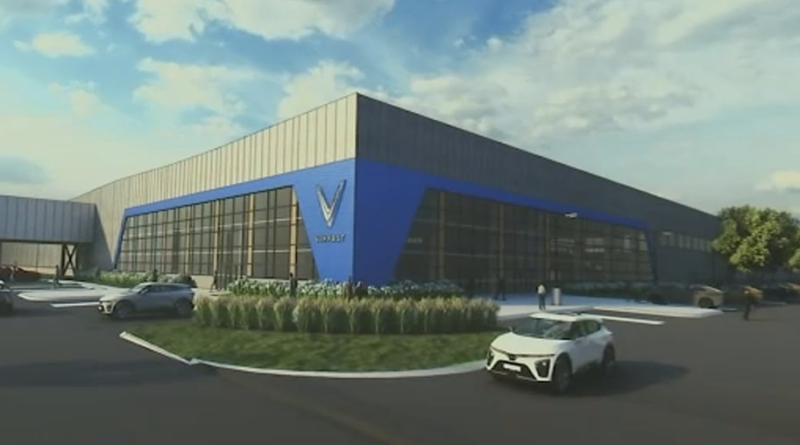
The revised plan reduces the projected workforce to about 1,400 employees and scales down the facility to roughly 780,000 square feet. While these figures fall well below initial expectations, they align with a broader industry trend in which emerging EV manufacturers are prioritizing capital discipline amid rising costs, supply chain volatility, and evolving demand.
VinFast’s entry into the global EV market has been rapid. Founded in 2017, it initially focused on domestic production before pivoting aggressively toward electrification and international expansion. In 2022, it dropped ICE manufacturing, and by 2023, it had begun deliveries in North America and listed on the Nasdaq, signaling its ambitions to compete with established automakers and new EV entrants alike.
The North Carolina plant remains central to that ambition. Local production is critical for qualifying for federal incentives under the Inflation Reduction Act, a key factor in pricing competitiveness in the US market. Despite delays, VinFast maintains that establishing a manufacturing base in the United States is essential to its long-term positioning.
At the same time, the company is accelerating growth in emerging markets. Thuy highlighted expansion in Southeast Asia, including Indonesia and the Philippines, as well as ongoing development of an integrated EV facility in Tamil Nadu, India. These markets offer lower operating costs and faster adoption growth, providing near-term opportunities to stabilize revenue while larger investments like the US plant mature.
The recalibration also places VinFast under scrutiny from North Carolina officials, particularly regarding a $315 million incentive package tied to job creation and investment targets. State authorities have indicated they are monitoring progress closely and may revisit the terms of the agreement as construction resumes.
For now, activity at the Chatham County site is expected to restart in early April 2026, with initial work focused on foundational development. While the scale has been reduced, the project’s continuation signals that VinFast is not abandoning its US ambitions but reshaping them.
“Our approach is to grow responsibly while laying the groundwork for long-term success,” Thuy said in a LinkedIn message, reinforcing the company’s message that patience and phased investment are key to navigating a rapidly evolving global EV landscape.
Sign up for CleanTechnica's Weekly Substack for Zach and Scott's in-depth analyses and high level summaries, sign up for our daily newsletter, and follow us on Google News!
Have a tip for CleanTechnica? Want to advertise? Want to suggest a guest for our CleanTech Talk podcast? Contact us here.
Sign up for our daily newsletter for 15 new cleantech stories a day. Or sign up for our weekly one on top stories of the week if daily is too frequent.
CleanTechnica uses affiliate links. See our policy here.
CleanTechnica's Comment Policy

