
Unlocking Hidden Capacity in the Grid With Advanced Conductors
Support CleanTechnica's work through a Substack subscription, on Patreon, or on Stripe. Help us produce all of the high-quality, original content we publish week after week despite the challenges of content-scraping AI, antisocial media, inflation, and other hurdles.
Electricity demand is rising as transport, heating, and industry electrify, with additional growth coming from data centers and expanding industrial loads. The transmission network that moves electricity was built over many decades, but expanding it has become increasingly difficult. Building new transmission lines often takes ten to fifteen years once permitting, environmental review, and litigation are included. That reality is pushing engineers to ask a practical question. How much more electricity can we move through the transmission system we already have?
Preparing to speak to engineers at GE Vernova during Engineering Week at the request of Cornelis Plet, CTO of GE Vernova Grid Systems Integration, brought that question into focus again. Grid enhancing technologies offer several answers. Power flow control and FACTS devices address stability and flow distribution. Another category focuses on the physical wire itself. Advanced conductors allow existing transmission towers to carry far more electricity without rebuilding the corridor.
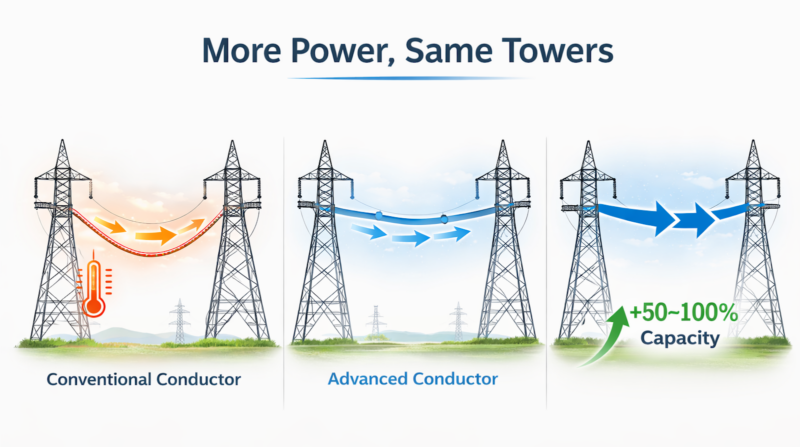
Every transmission line has a physical limit. Electricity flowing through a conductor produces heat because of resistance in the metal. That heating increases the temperature of the wire. As the temperature rises the conductor expands and sags. Transmission systems must maintain minimum ground clearance to avoid safety risks. When sag approaches those limits the line cannot carry more current. Engineers define a thermal rating that keeps the conductor temperature within safe limits. That rating often determines how much electricity a line can carry. The key observation for engineers studying existing networks is that towers often have more mechanical capacity than the conductors strung between them. The steel structures and foundations may support heavier loads than the original wires require. That mismatch creates an opportunity to increase capacity by replacing the conductor while leaving the towers in place.
The idea behind advanced conductors is simple. Replace the existing wire with a design that carries more current and sags less when hot. The process is called reconductoring. The towers remain in place. The right of way remains unchanged. The substations stay the same unless terminal equipment limits the upgrade. Only the conductor is replaced. Because thermal limits dominate many transmission ratings, the improvement can be large. In many cases reconductoring increases line capacity by 50% to 100% or more depending on the original conductor and clearance constraints. The upgrade often requires only a short outage and avoids the long process of building a new transmission corridor.
Most transmission systems historically used aluminum conductor steel reinforced wire, known as ACSR. The design combines aluminum strands around a steel core. The aluminum carries the electrical current while the steel provides tensile strength. ACSR became standard because it balances conductivity, strength, and cost. Aluminum conducts electricity well and weighs less than copper. Steel supports long spans between towers. The design has worked for more than a century and remains common across global transmission networks. But the materials introduce limitations. Steel expands with heat and contributes to sag at higher temperatures. Aluminum begins to lose mechanical strength when temperatures rise above roughly 90°C to 100°C depending on alloy composition. These characteristics force operators to keep line temperatures relatively low. As demand grows those limits begin to constrain power flows.
Advanced conductors address those limits through several engineering approaches. Many fall into the category known as high temperature low sag conductors, often abbreviated HTLS. These designs allow conductors to operate at temperatures of 150°C or higher while controlling sag. The improvement comes from stronger cores, materials with lower thermal expansion, and conductor shapes that pack more aluminum into the same diameter. Several families of designs appear in modern grids. Examples include aluminum conductor composite core designs known as ACCC, aluminum conductor composite reinforced designs known as ACCR, aluminum conductor steel supported designs known as ACSS, gap conductors that change mechanical behavior at higher temperatures, and conductors using Invar alloys that expand less with heat.
Composite core conductors replace the steel core with materials such as carbon fiber and glass fiber composites embedded in resin. These materials provide high tensile strength and low thermal expansion. Because the composite core expands far less than steel, the conductor maintains lower sag when heated. The design also allows engineers to increase the amount of aluminum in the outer strands because the core carries less weight. More aluminum cross section means lower electrical resistance and higher current capacity. Case studies illustrate the effect. American Electric Power completed reconductoring projects in Texas on 345 kV lines using composite core conductors. Engineering reports referenced by utilities indicate capacity increases of roughly 75% on some circuits. Southern California Edison projects used trapezoidal aluminum strands around composite cores, increasing aluminum cross section by about 28% within the same conductor diameter according to case studies compiled by the Electric Power Research Institute.
Other designs address the problem differently. Gap conductors maintain a steel core but introduce a mechanical gap between the aluminum strands and the core. At lower temperatures the aluminum carries both electrical current and mechanical load. At higher temperatures the load transfers primarily to the steel core. This change reduces the rate at which sag increases with temperature. Invar core conductors use an iron nickel alloy known for extremely low thermal expansion. Invar expands roughly one tenth as much as steel over the same temperature range. When used in the core of a conductor it limits the overall expansion of the wire as it heats. These approaches provide different balances between cost, installation complexity, and performance.
Real world projects demonstrate how these technologies translate into higher capacity. A Northern Ireland Electricity project replaced an existing conductor on a 110 kV line with an Invar based design. The upgrade increased the line rating from about 109 MVA to about 186 MVA. That represents a roughly 70% increase in capacity without changing towers or right of way. A project in Nevada upgraded a line originally rated for about 300 A to roughly 1000 A after reconductoring with advanced composite core conductors. That change increased current carrying capability by more than a factor of three. In China, upgrades on a 330 kV corridor increased a constrained segment from about 650 MW to about 1016 MW after reconductoring according to engineering reports cited by EPRI case studies. In Bangladesh, upgrades on a 132 kV double circuit increased the current rating from about 646 A to about 852 A on each circuit. These results vary because each line has different tower structures, conductor types, and clearance margins. But the pattern remains consistent. Replacing the conductor often unlocks significant capacity.
The scale of deployment varies by region. India represents one of the largest adopters of HTLS conductors. Government and academic reports indicate that tens of thousands of circuit kilometers of high temperature low sag conductors have been installed across the country. The upgrades address congestion in fast growing regions where electricity demand is rising quickly and where building new corridors is difficult. The thousands of kilometers of reconductoring projects have unlocked tens of gigawatts of additional transfer capability on the grid, equivalent in practical system terms to adding multiple large transmission corridors without building entirely new lines.
Pakistan and Bangladesh have deployed similar upgrades on congested corridors linking generation and urban demand. In Southeast Asia and parts of the Middle East utilities are adopting HTLS conductors during refurbishment cycles when aging lines require maintenance. In Europe and North America reconductoring is growing as transmission systems built in the twentieth century approach replacement age.
Advanced conductors also appear in new transmission projects. Engineers sometimes choose these designs from the start when building new lines in constrained environments. Bangladesh provides examples where more than 240 km of 400 kV lines were built using composite core conductors. Malaysia has deployed ACCC conductors on new 275 kV lines connecting industrial regions. The advantage is that towers can remain smaller while still carrying higher electrical capacity. For a given corridor width, engineers can move more power without increasing the physical footprint of the infrastructure.
Despite these benefits advanced conductors are not universal solutions. Towers have structural limits. If the original structures cannot support heavier conductors or higher tension, upgrades may require tower reinforcement or replacement. Insulators and hardware must also handle higher temperatures. Substation equipment such as breakers and connectors may limit current before the conductor does. Costs can be higher than traditional ACSR conductors, although those costs often remain small compared with the cost of constructing a new transmission line. Advanced conductors also do not solve every constraint in the grid. They increase thermal capacity but do not address voltage stability or power flow distribution. Those problems require devices such as STATCOMs or power flow controllers described in earlier discussions of grid enhancing technologies.
Understanding how these technologies fit together helps clarify their role in modern grids. Transmission limits arise from several different constraints. Thermal limits arise from heating of conductors. Voltage stability limits arise from reactive power shortages or long line effects. Flow distribution limits arise when electricity divides unevenly across parallel paths. Advanced conductors address the first constraint by raising thermal capacity. FACTS devices address the second by stabilizing voltage and reactive power. Power flow control devices address the third by steering electricity across multiple lines. Dynamic line rating systems provide another tool by adjusting ratings based on weather conditions such as wind cooling. Together these technologies allow engineers to extract more capacity from existing infrastructure before resorting to building entirely new corridors.
Another factor shaping adoption is public acceptance. Transmission lines are visible infrastructure. Communities often oppose new corridors because of visual impact, land use concerns, or environmental effects. Permitting processes in many countries involve years of review and public consultation. Reconductoring often avoids these conflicts because the towers already exist and the work occurs within the established right of way. Utilities can increase capacity without changing the landscape. That advantage reduces project risk and accelerates deployment.
From a systems perspective advanced conductors illustrate a broader engineering principle. The global electricity network represents trillions of dollars in infrastructure built over more than a century. Expanding that network will remain necessary in many places. But a large portion of the required capacity increase can come from making existing assets perform better. Replacing an ACSR conductor with a composite core design can turn a 1,300 MW corridor into a 2,000 MW corridor without new towers. When multiplied across hundreds of lines, these upgrades add gigawatts of transfer capability.
The change resembles improvements in other infrastructure networks. Railways built in the nineteenth century carried lighter trains on steel rails designed for that era. Modern rail systems use stronger alloys that support heavier loads without rebuilding the entire network. Transmission systems are undergoing a similar transition. The towers and rights of way remain the same. The conductor materials evolve. By replacing the wires with stronger designs that expand less and carry more current, engineers can move far more electricity across landscapes that have supported power lines for generations.
This article has been archived at TFIE Strategy Briefing, where Michael Barnard maintains the canonical archive version of his analysis. Read the maintained version here:
Advanced Conductors Let Old Corridors Carry More Power
For more of Michael’s work on energy, industry, transportation, infrastructure, and climate-tech reality checks, subscribe to TFIE Strategy Briefing.
Sign up for CleanTechnica's Weekly Substack for Zach and Scott's in-depth analyses and high level summaries, sign up for our daily newsletter, and follow us on Google News!
Have a tip for CleanTechnica? Want to advertise? Want to suggest a guest for our CleanTech Talk podcast? Contact us here.
Sign up for our daily newsletter for 15 new cleantech stories a day. Or sign up for our weekly one on top stories of the week if daily is too frequent.


CleanTechnica uses affiliate links. See our policy here.
CleanTechnica's Comment Policy

