
When 70% Of Stations Go Dark: The Fragility Of California’s Hydrogen System
Support CleanTechnica's work through a Substack subscription, on Patreon, or on Stripe. Help us produce all of the high-quality, original content we publish week after week despite the challenges of content-scraping AI, antisocial media, inflation, and other hurdles.
The recent pressurized hydrogen tanker truck explosion in Colton, California, is first and foremost a human tragedy. One worker lost his life and another was seriously injured. Their families, friends, and co workers are living with the consequences, and that matters more than any infrastructure debate. Hydrogen systems operate at high pressures and, in some cases, cryogenic temperatures. When something fails, the consequences can be severe, but while my thoughts are with the survivors, this is not an article that’s fear mongering about hydrogen’s dangers, but about logistics. Following the explosion, compressed hydrogen delivery operations tied to the incident were paused while investigations proceeded. In a small and tightly coupled fuel network, even a temporary logistics stoppage can ripple outward.
The Colton incident occurred at a hydrogen storage and handling site in Colton, California, where a compressed hydrogen trailer exploded while work was being performed on or near the vehicle. The trailer was owned by Pilot Company, a major North American truck stop and fuel distribution operator expanding into hydrogen logistics. The hydrogen involved was part of compressed gas delivery operations serving refueling infrastructure for fuel cell vehicles in Southern California, rather than on site industrial production. Following the explosion, which resulted in one fatality and one serious injury, compressed hydrogen delivery operations associated with the site were paused during the investigation, tightening supply into an already thin retail refueling network.
This is not the first time a hydrogen incident has disrupted refueling at scale. In 2024, an explosion at a Linde facility in Leuna, Germany halted hydrogen trailer supply into the retail network. No one was injured in that case, which was fortunate. The operational consequences were significant. Roughly a quarter of Germany’s hydrogen refueling stations were affected as deliveries were suspended. The disruption lasted for weeks, not days. Germany’s hydrogen refueling network is larger than California’s, even as major operators like H2 Mobility cut 22 stations, yet it was still sensitive to a single upstream incident. The lesson was not about safety culture. It was about architecture. Centralized production combined with truck delivery creates fragility when redundancy is limited.
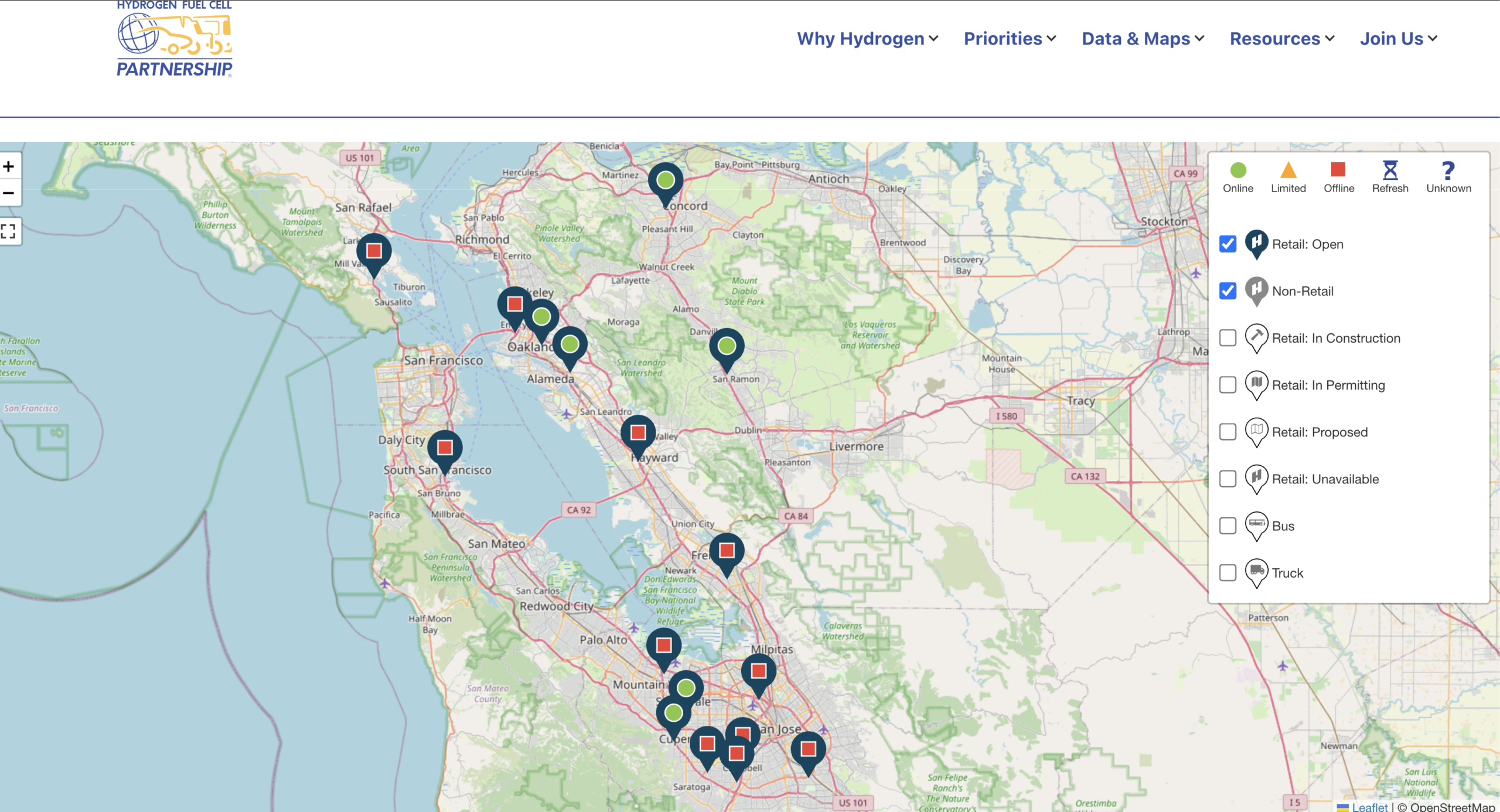
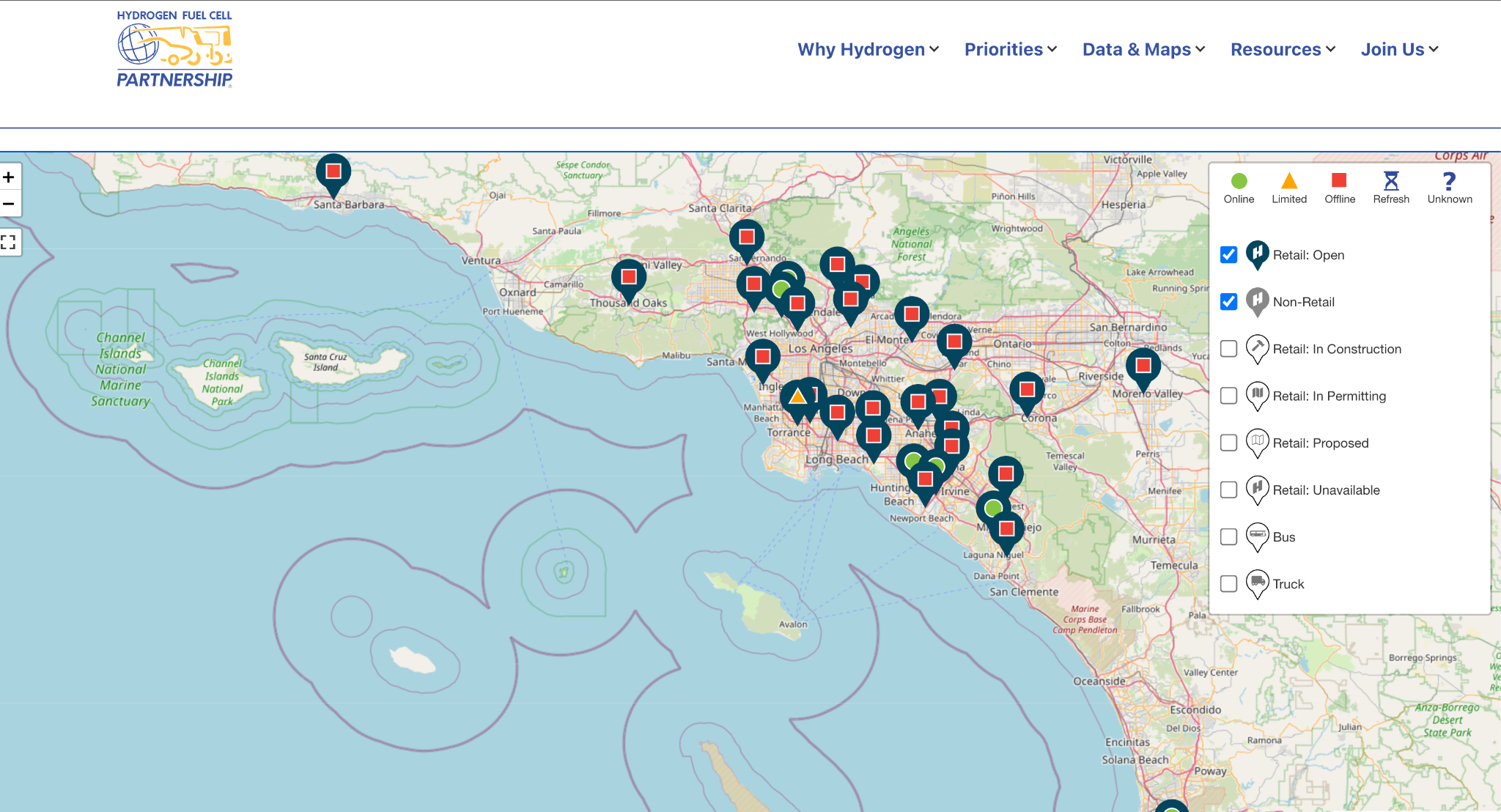
Back in California, the current station map tells a similar story about system sensitivity. As of this writing, 35 retail hydrogen stations are out of service. California has roughly 50 publicly accessible stations in total. That means only about 15 are operational. Availability is near 30%. In most retail fuel networks, 70% downtime would be described as a crisis. Breaking down the 35 offline stations shows that about 40% are explicitly out of fuel. Around 15% are offline without a stated reason. The remainder cite unexpected mechanical incidents, with only one reported as offline for planned upgrades. If 14 stations are out of fuel in a network of 50, more than a quarter of the total retail network is unavailable because hydrogen is not present at the pump. If 20 or more stations are offline for mechanical failures, that’s even more startling. That this isn’t headline news and that I had to go and look to find out is telling.
The structure of the hydrogen supply chain explains why this matters. Hydrogen is typically produced centrally, either from steam methane reforming or electrolysis. It is then compressed or liquefied, loaded into trailers, and trucked to stations. At the station, it is stored, compressed again to above the 350 or 700 bar requirements for the vehicle and dispensed. Each step adds equipment and potential failure points. Most stations do not hold large inventories relative to throughput. A missed delivery can take a site offline within days. By contrast, gasoline is refined at multiple facilities, moved through pipelines, stored in large regional tanks, and delivered through a dense distribution network. Electricity is distributed through meshed grids with redundancy. Hydrogen in California remains thinly distributed and truck dependent.
Mechanical complexity compounds the logistics issue. In a January 2024 article, I examined National Renewable Energy Laboratory data on California’s hydrogen stations. Over a six month period in 2021, 55 stations collectively logged roughly 11,700 hours of maintenance and repair. During that same period, they dispensed about 540,000 kg of hydrogen. That averages to about 54 kg per station per day, roughly equivalent to 54 gallons of gasoline. A typical light duty fuel cell vehicle takes about 3 kg per fill. That equates to roughly 18 refuelings per station per day on average, which is very low. Stations were spending more time being repaired than fueling vehicles. The ratio was not close. Maintenance hours exceeded fueling hours by about 20%.
This isn’t unusual. The hydrogen refueling station in Quebec City that was built to support the provincial government’s hydrogen sedan fleet over a four year pilot was out of service for mechanical problems for a full third of the total hours of the four years. The hydrogen cars, as a result, were rarely used except in the department that had a third party service paid to refuel them. Employees just avoided them. At the end of the four years, the pilot has quietly abandoned and all hydrogen cars returned to Toyota and Hyundai.
The cost implications are large. Many hydrogen cost models assume station operations and maintenance expenses at 3% to 4% of capital expenditure annually. The empirical data suggests something closer to 30% of capex per year once real world maintenance is included. A $2 million station operating at 30% of capex implies $600,000 per year in O&M before the cost of hydrogen itself is counted. At 54 kg per day, that is about 19,700 kg per year. Dividing $600,000 by 19,700 kg yields over $30 per kg just to cover station O&M. That figure does not include capital recovery, hydrogen production, transportation, or electricity. Even if throughput doubled, the cost per kg would remain high because the equipment itself is maintenance intensive at high pressure.
Aberdeen provides an independent confirmation. According to council records examined in a March 2026 article on the city’s abandoned hydrogen bus fleet, the Kittybrewster refueling station cost about £1 million to build and incurred roughly £325,000 per year in operating costs. That is about 30% of capex annually in O&M. The station served a fleet of 25 hydrogen double deck buses. When the buses were retired and the program wound down, the economics were laid bare. The station was designed to serve light vehicles that never arrived as well as the buses. This was not a California anomaly. It was a recurring pattern when high pressure hydrogen infrastructure was deployed at modest utilization levels.
Low utilization and high maintenance feed into each other. When stations see few vehicles per day, revenue per site is limited. High fixed O&M costs then consume a larger share of revenue. In my assessment of British Columbia’s hydrogen refueling stations at the beginning of last year, the busiest station might be seeing $39,000 in revenue annually against operations and maintenance expenses in the low hundreds of thousands of dollars. It’s no wonder that Shell has exited the hydrogen refueling business and stations are closing down in California and Europe, rather than expanding.
Under such extreme mismatches of revenue to operating expenses, operators face pressure to defer maintenance or limit staffing, which can increase downtime. Downtime reduces driver confidence. Lower confidence reduces vehicle sales. Lower vehicle counts reduce throughput further. This is a reinforcing feedback loop. The current California station outages are not only a logistics problem. They sit on top of a cost structure that was already strained when stations were fully staffed and supplied.
Europe shows a similar dynamic. Hydrogen bus deployments in Europe peaked in 2025 and are very likely to decline, per a recent analysis I did of the fleet counts and growth. Planned station expansions outside of South Korea have been delayed or canceled. California’s own projections for station counts have been revised downward compared to earlier targets of 200 stations by the mid 2020s. With fewer stations, each outage has a larger impact. Redundancy declines. If one station in a cluster goes offline, vehicles can reroute. If three out of four in a region are down, the network becomes discontinuous. A 30% availability rate is not a minor inconvenience. It changes the calculus for fleet operators.
The parked hydrogen garbage trucks in a small German city provide a concrete example. Seven hydrogen refuse trucks are sidelined because their nearest refueling station closed, with the next closest one 180 km away. The vehicles are mechanically functional. The capital is already spent. Yet without fuel, they are stranded assets. If each truck cost $1 million, that is $7 million of equipment sitting idle. Municipal budgets are tight. Public works departments are risk averse. When a technology leaves vehicles parked for months, confidence erodes quickly.
In late 2024, a hydrogen powered city bus exploded at a public refueling station in Chungju, South Korea, shortly after completing a fueling session and starting its engine. Three people were injured, including the driver and a station worker. Authorities immediately suspended operations of all 18 hydrogen buses in the city while the Korea Gas Safety Corporation and other agencies investigated the cause. While there were no reported fatalities, the incident triggered a full safety review of the station and its associated fleet.
The refueling station was effectively taken offline for an extended period during the investigation. Although officials did not publish a precise timeline for reopening, the grounding of the entire hydrogen bus fleet indicates that this was not a brief interruption. In a network serving a defined fleet with limited alternative fueling options, taking one station out of service can immobilize all dependent vehicles. As seen in Germany after the Linde incident and in California with multiple stations offline, hydrogen systems with concentrated supply and limited redundancy are sensitive to single point failures.
There is also a tipping point dynamic at work. Fuel cell vehicle adoption depends on minimum viable station density and predictable uptime. If drivers cannot rely on finding fuel within reasonable distance, the option drops off consideration lists. Automakers respond to sales signals. If sales decline, investment in new models slows. Station operators see lower throughput and close sites. This is not a linear decline. Network technologies often face cliff effects. Above a certain density, growth feeds on itself. Below it, contraction accelerates.
The Colton explosion may prove to be a temporary shock. It’s unlikely to cause as long a hydrogen shortage as the Linde incident because it was at a logistics depot, not a hydrogen manufacturing facility. Investigations will conclude. Delivery operations will likely resume. Some of the 35 offline stations will return to service. The structural questions remain. The network is centralized, truck dependent, maintenance intensive, and financially non-viable. Empirical data from California and Aberdeen shows O&M near 30% of capex annually. Utilization remains low. When 70% of a retail network can be offline at once and there aren’t screaming headlines about it, the system is both not resilient and barely used.
Energy infrastructure that scales tends to be boring. It runs consistently, with high uptime and predictable costs. Hydrogen refueling in California never reached that state. The tragedy in Colton deserves respect and careful investigation. The operational pause that has followed exposes once again how sensitive hydrogen refueling is to shocks. The statistics from California’s stations make it clear that even if hydrogen distribution was robust, the stations themselves aren’t, something confirmed by Aberdeen’s experience and the South Korea incident.
Sign up for CleanTechnica's Weekly Substack for Zach and Scott's in-depth analyses and high level summaries, sign up for our daily newsletter, and follow us on Google News!
Have a tip for CleanTechnica? Want to advertise? Want to suggest a guest for our CleanTech Talk podcast? Contact us here.
Sign up for our daily newsletter for 15 new cleantech stories a day. Or sign up for our weekly one on top stories of the week if daily is too frequent.


CleanTechnica uses affiliate links. See our policy here.
CleanTechnica's Comment Policy

