The US Can Still Make Tidal Energy Happen
Support CleanTechnica's work through a Substack subscription, on Patreon, or on Stripe. Help us produce all of the high-quality, original content we publish week after week despite the challenges of content-scraping AI, antisocial media, inflation, and other hurdles.
Humans began harnessing the kinetic energy of ocean tides at least 1,500 years ago. That form of clean power fell out of fashion when combustible fuels took up the reins of commerce and industry. Now the global decarbonization movement of the 21st century has turned the tide, so to speak. New opportunities to harvest carbon-free electricity are emerging in the tidal energy field, and the US is in the running.
Tidal Energy Earns A Seat At The “American Energy Dominance” Table
The sharp U-turn in federal energy policy suggests that innovation in the domestic tidal energy field has nowhere to go but down. Or not, as the case may be. Although President Trump’s energy emergency declaration of 2025 left the US wind and solar industries out in the cold, other renewable energy resources made the cut, including tidal energy.
“The power coursing through oceans and rivers equates to nearly 60% of the United States’ total electricity needs,” the Energy Department continues to insist on its website.
“Even if only a small portion of this technical resource potential is captured, marine energy could make significant contributions to the nation’s energy needs and provide millions of Americans with locally sourced, clean, and reliable energy,” they emphasize.
Why tidal energy deserves such lavish praise is no mystery. White House policy favors “reliable” energy resources, meaning power generation facilities that offer 24/7 dispatch-ability regardless of the weather, the season, or time of day. Reliability is the lever that prioritizes fossil-fueled power plants and nuclear energy, too. The same rationale also supports the domestic biomass, geothermal energy, and hydropower industries, all three of which have been tapped for federal support.
Although the President did not name-check tidal energy in the initial declaration, Energy Secretary Chris Wright has interpreted the President’s hydropower directive to include various forms of marine energy. As noted by the Energy Department, marine energy specifically refers to the kinetic motion of water, encompassing ocean waves, tides, and currents, as well as energy harvesting devices designed for inland waterways.
A New Tool For Tidal Energy Developers
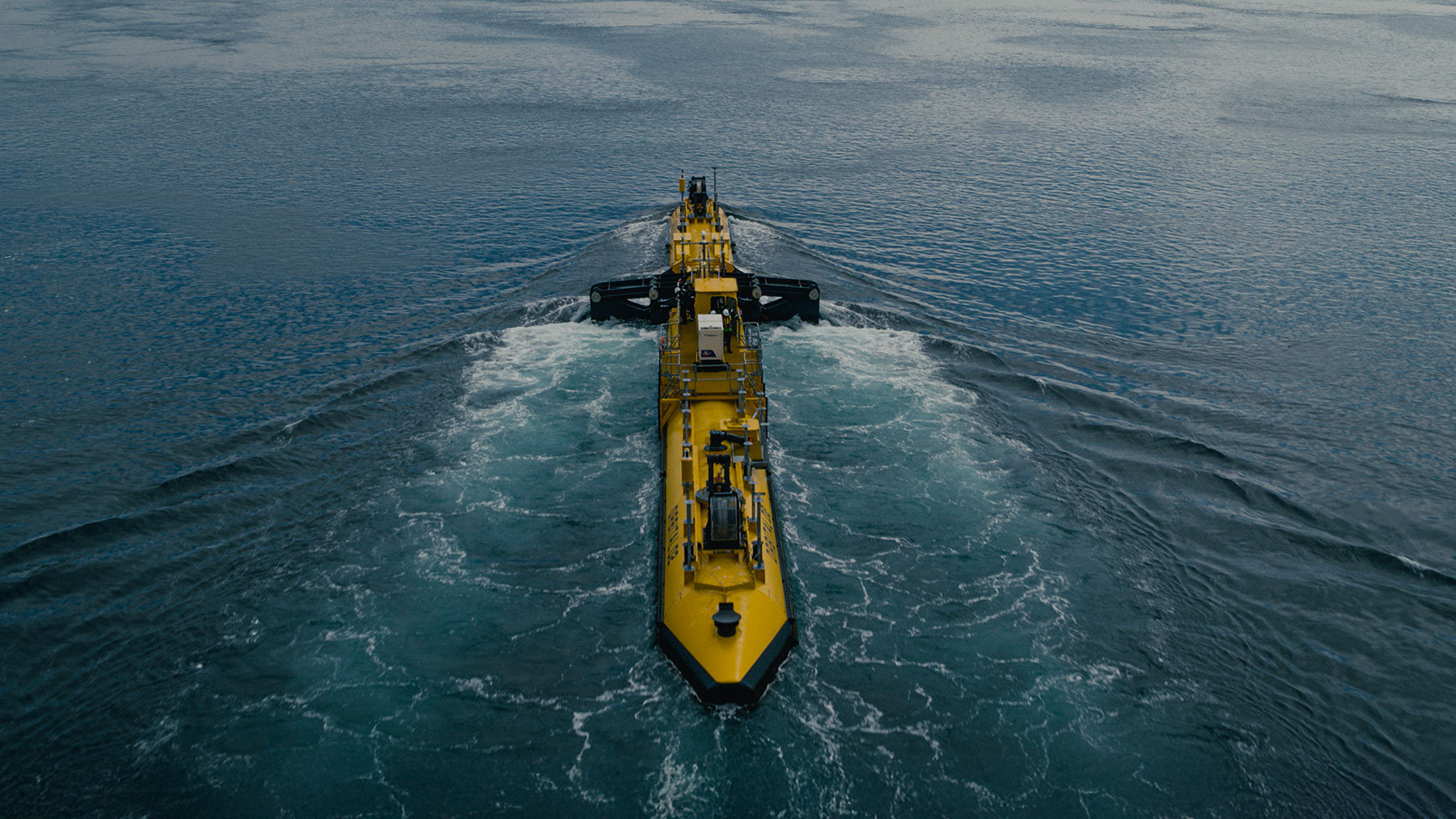
The UK and other key markets are already racing ahead in the marine energy field. In contrast, the US has been slow on the draw. One project to watch comes under the wing of the Washington State utility OPALCO, which is currently applying for a federal license to demonstrate a tidal turbine from the Scottish firm Orbital Marine Power.
Meanwhile, the Energy Department has been supporting other tidal energy projects with little to show aside from a demonstration project in New York City under the wing of the startup Verdant Power. The company’s turbine design resembles a bank of small underwater wind turbines. The site of the project is the East River, which is a tidal waterway connecting Long Island Sound to the New York Harbor and not an actual river. With the East River project, Verdant and the Energy Department have tested a unique turbine mounting system and advanced materials, both aimed at cutting costs.
In the latest news from Verdant, the company has partnered in a tidal energy research project with the Advanced Energy Research and Technology Center at Stony Brook University in New York. The goal is to design a new “digital twin” system for tidal turbines. The precision, 3-D modeling tool will enable tidal energy innovators to assess designs with confidence before engaging in a costly, time consuming effort to place a prototype in water.
“Our model doesn’t just simulate water and turbine interactions. It also tracks how sediments move around and how the topography of the Sound might change,” emphasizes Stony Brook Associate Professor Ali Khosronejad. “This allows us to evaluate environmental impacts early in the design phase, well before deployment.”
As noted by Stony Brook, the digital twin project represents the work of many hands. “The research builds on Khosronejad’s role in the Atlantic Marine Energy Center (AMEC), a U.S. Department of Energy-funded consortium of universities advancing marine renewable energy technologies,” the school explained in a press release dated December 1, 2025.
“Through AMEC, Stony Brook collaborates with Lehigh University, the University of New Hampshire and Coastal Studies Institute of North Carolina to study, among others, devices that harness energy from tides, waves and ocean currents,” Stony Brook elaborated. “The Verdant Power collaboration aligns with AMEC’s mission to accelerate the development and deployment of marine energy systems along the U.S. East Coast.”
Meanwhile, Across The Pond
Keep an eye out for the launch of the new modeling system later this year. Work began early last year and is expected to continue through the summer.
Meanwhile, the global tidal energy industry has not been sitting on its hands. The latest development involves the HydroWing Tidal Energy Projects branch of the UK firm Inyanga Marine Energy Group. HydroWing is moving forward with its Ynni’r Lleuad Project at Morlais in Wales. After securing initial funding for a 20 megawatt facility, last week the company announced that the addition of another 10 megawatts in funding.
That’s a big step forward, though it’s going to take some time. “The Phase 3 project is scheduled for delivery in 2030 and will make the HydroWing Morlais Project the largest tidal energy project in the world,” HydroWing notes, adding that the fully completed project will deploy 18 turbines, each with a capacity of 1.67 megawatts.
Both Verdant and HydroWing deploy turbines in free-flowing waters. Another type of tidal energy system is also emerging in the form of low dams called barrages, which channel tidal flows into turbines. City planners in Liverpool, for example, have proposed a new barrage project that will serve as a new city park and transportation corridor, in addition to generating clean power.
Stay tuned for more on the OPALCO project, too. Energy Department funding for the next stage of feasibility assessment was assigned to OPALCO last year, though as of December the utility was still waiting on the funds to make their way through the pipeline.
Image: A new round of tidal energy activity is beginning to surface in the US, including a plan to install slim, powerful tidal turbines from the Scottish firm Orbital Marine Power in Washington State (cropped, courtesy of OMP)
Sign up for CleanTechnica's Weekly Substack for Zach and Scott's in-depth analyses and high level summaries, sign up for our daily newsletter, and follow us on Google News!
Have a tip for CleanTechnica? Want to advertise? Want to suggest a guest for our CleanTech Talk podcast? Contact us here.
Sign up for our daily newsletter for 10–15 new cleantech stories a day. Or sign up for our weekly one on top stories of the week if daily is too frequent.


CleanTechnica uses affiliate links. See our policy here.
CleanTechnica's Comment Policy