
Op-Ed: Manila Doesn’t Need Dutch Micromobility — It Needs Dutch Thinking
Support CleanTechnica's work through a Substack subscription or on Stripe.
The original title of this piece was “Will Dutch Mobility Work in the Philippines?” And immediately, the answer is no. There are too many nuances in how the Netherlands managed its small footprint, pedaled and motored mobility as well as a collective effort that didn’t shrug off any road user.
Stop de Kindermoord
While much of the world spent the 20th century choking its cities with asphalt and exhaust, the Netherlands took a radical detour. Today, the country boasts a staggering 32,000 km (nearly 20,000 miles) of protected cycling infrastructure, but this wasn’t an accident of geography—it was a hard-fought revolution.
In the late 19th century, Dutch bike lanes were the exclusive playground of the wealthy. But as the post-war era ushered in a wave of car-centric urban planning, the bicycle was nearly pushed to the curb. Like the rest of the West, the Netherlands began prioritizing the “mighty” automobile, leading to a spike in traffic congestion and, tragically, a soaring death toll.
The 1970s marked a definitive “enough is enough” moment. Following a wave of traffic-related fatalities involving children, the “Stop de Kindermoord” (Stop the Child Murder) movement took to the streets. These weren’t just protests; they were a demand for a fundamental redesign of the human habitat.
Combined with the pressure of the 1973 oil crisis, the Dutch government pivoted. They didn’t just paint lines on the road; they built a safety-focused, separated system that prioritized the most efficient and sustainable form of transit ever invented.
Ban the e-bike
Roughly 7,000 miles from Amsterdam, Metro Manila wrestles with a transportation crisis of existential proportions. EDSA, the capital’s infamous 23-kilometer artery, routinely degenerates into a near-static parking lot. Single-occupant vehicles—sedans, SUVs, pickup trucks—consume enormous road space while moving one person at a time. Air quality suffers, productivity erodes, and commuters lose hours each day to congestion. The geometry of the problem is painfully simple: too many large vehicles carrying too few people.
Recent moves to ban, impound, and restrict e-trikes and light electric vehicles on Metro Manila streets have drained much of the optimism surrounding micromobility in the Philippines. The promise that better last-mile systems—supported by proper infrastructure, enforcement, and balanced regulation—could meaningfully improve urban mobility now feels increasingly distant.
That loss is more than policy frustration; it is deeply disappointing in a country where public transportation can feel as outdated and inefficient as using a Commodore 64 to run ChatGPT. In that context, electric micromobility is not a lifestyle choice or niche experiment—it is a pro-people necessity.
Purposeful inclusion
This is where lessons from the Netherlands become instructive, not as templates to copy wholesale, but as provocations to think differently. Dutch cities demonstrate that mobility success is not simply about cleaner engines, but about right-sizing vehicles to trips. Fully enclosed micro-vehicles and small EVs complement bikes, trams, and buses by filling precise gaps in the transport ecosystem. They exist because policymakers recognized that not every trip requires a two-ton machine.
In the Philippines, this middle ground is especially relevant for inclusion. Persons with disabilities navigate an urban environment where sidewalks are obstacle courses and public transport offers limited accommodation. Full-sized disability vans are expensive, cumbersome, and ill-suited to narrow neighborhood streets. Compact, enclosed micro-EVs—designed from the outset for independence and accessibility—could dramatically expand dignified mobility options without demanding massive infrastructure overhauls. The technology already exists. The need is clear. What is missing is the imagination to move beyond traditional automotive categories.
It’s been done…and done well
The country has, in practice, already embraced parts of micromobility.
Electric bikes fill subdivisions, and handle parcel and food deliveries. Food arrives still warm as riders weave efficiently through traffic. Yet a clear gap persists between these exposed, low-protection options and the insulated comfort of enclosed vehicles. Four-wheeled micro-EVs could occupy that space: weather-protected, zero-emission, safe at urban speeds, and far less demanding of road and parking space.
Local proof points show that micromobility works when treated as enduring policy rather than a temporary fix.
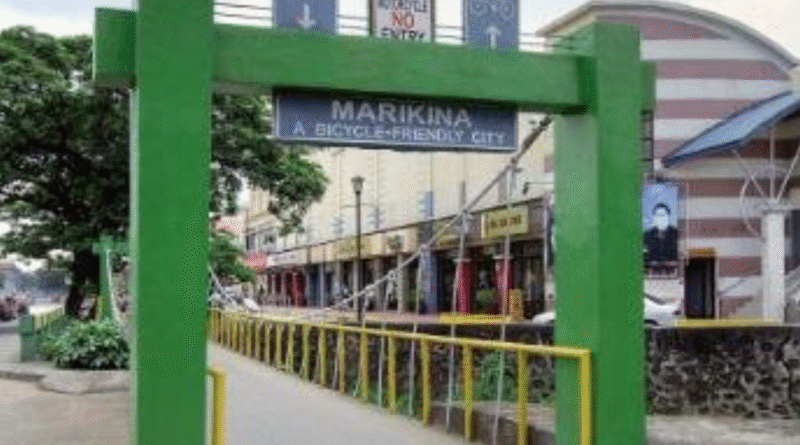
Marikina City earned its reputation as the country’s most bike-friendly city through decades of consistency. Beginning in the early 2000s, it institutionalized cycling via continuous bike lanes, integration with the Marikina River Park system, traffic education, and enforcement. Cycling there is not recreational branding; it is a practical, everyday mode of transport. Predictability and continuity—hallmarks of mature cycling cultures—have made confidence possible.
It is important to note, however, that infrastructure already in place in Marikina City was designed primarily for bicycles, not for four-wheeled micro-EVs. Yet this distinction does not make adaptation impossible. Many of Marikina’s lanes are wide, continuous, and physically predictable—qualities that already meet several of the baseline requirements for low-speed, lightweight micro electric vehicles.
With calibrated regulations, speed limits, and vehicle size standards, these corridors could be selectively adapted to accommodate enclosed micro-EVs without undermining cyclist safety.
Iloilo City, meanwhile, demonstrates how a provincial city can leapfrog car-centric planning. Protected bike lanes integrated into broader urban renewal projects, including the Iloilo River Esplanade, have normalized cycling as part of daily life. The lanes are wider, more consistently protected, and better connected to public spaces than many Metro Manila counterparts. As a result, micromobility is visible, socially accepted, and functional.
In Dumaguete, micromobility thrives less because of formal infrastructure and more because the city’s scale naturally favors it. Short travel distances, a compact urban core, and relatively slower traffic make bicycles, e-bikes, and e-trikes practical and socially normalized modes of transport. Streets are shared rather than dominated, and micromobility users are a visible, accepted part of daily life rather than edge cases navigating hostile roads. Dumaguete illustrates a key lesson often overlooked in Metro Manila: micromobility does not always require expensive, bespoke infrastructure to succeed. In the right urban context, it flourishes simply because it aligns with how people live, move, and interact with the city.
Naga City, on the other hand, represents a more intentional approach, combining scale with governance. Long known for progressive urban planning and citizen-focused policies, Naga has consistently supported active transport through street design, traffic calming, and public engagement. While its bike lanes and micromobility facilities may not yet form a fully protected network, the city’s planning philosophy prioritizes walkability, safety, and accessibility—conditions under which micromobility naturally expands. Naga demonstrates that even without the density or resources of major metros, political will and coherent planning can create environments where small, efficient vehicles make sense.
This provincial strength reinforces your core thesis: micromobility succeeds when it is designed to match context and scale, not when it is forced into hostile environments. Metro Manila’s failure is not proof that micromobility doesn’t work—it is proof that oversized roads, oversized vehicles, and inconsistent governance suppress it. The provinces demonstrate what Dutch cities understood decades ago: when trips are short, streets are human-scaled, and vehicles are right-sized, micromobility becomes the default. In that sense, the Philippines doesn’t need to learn micromobility from scratch—it already practices it outside the capital. The real challenge is whether Manila can relearn what the rest of the country already knows.
The contrast with Metro Manila underscores a critical point: infrastructure alone is insufficient. In the Netherlands, micromobility success is the result of continuity, national coordination, stable funding, strict enforcement, and cultural reinforcement beginning at a young age. Bike lanes flourished briefly during the pandemic—often as emergency measures tied to mobility restrictions—then faltered as traffic volumes returned and priorities shifted. Without long-term commitment, micromobility remains vulnerable to erasure.
As the country accelerates its electric vehicle transition, the conversation must widen. The issue is not merely replacing combustion engines with electric motors in the same oversized vehicle formats. It is about questioning what sizes of vehicles belong on city streets, whose mobility needs remain unmet, and whether Filipino engineers and policymakers can design a truly diverse transport ecosystem—one that ranges from e-bikes to buses, with thoughtfully engineered micro-vehicles filling the gaps in between.
The silent micro-EVs gliding through Amsterdam offer a challenge that’s also a blueprint.
What if the future of urban mobility in Philippine megacities lies not in making existing vehicles marginally cleaner, but in making them smarter, smaller, and better matched to how people actually move? Metro Manila’s streets groan under the weight of oversized vehicles making undersized trips. The wisdom of the small—electric, accessible, efficient—may be precisely what the city needs. The remaining question is whether the Philippines will choose to design for it.
Sign up for CleanTechnica's Weekly Substack for Zach and Scott's in-depth analyses and high level summaries, sign up for our daily newsletter, and follow us on Google News!
Have a tip for CleanTechnica? Want to advertise? Want to suggest a guest for our CleanTech Talk podcast? Contact us here.
Sign up for our daily newsletter for 15 new cleantech stories a day. Or sign up for our weekly one on top stories of the week if daily is too frequent.
CleanTechnica uses affiliate links. See our policy here.
CleanTechnica's Comment Policy

