
Latin America EV Sales Report: Over 100,000 Units Sold in Q4!
Support CleanTechnica's work through a Substack subscription or on Stripe.
Or support our Kickstarter campaign!

Thanks to ZEMO, we are back with our second report on Latin America! This time, with over 110,000 registrations in the fourth quarter of 2025, EV sales have reached a new record in our region!
This result pulls 24% ahead of the previous records (Q4 2024 and Q3 2025, which were almost identical). Nearly all growth came from BEVs (+47%), whereas PHEVs (+5%) barely bulged. For the effects of this report, we include EREVs in the PHEV segment, as some countries do not report them separately.
Even though we see a similar trend in China, it would be a mistake to conclude from this that we have reached peak PHEV in Latin America: not only is it far too early to say so, but we can also track the PHEV blues to a specific country: Mexico. As we will see, Mexico’s PHEV sales fell starkly YoY after an over-the-top Q4 2024, and had it not been for this one country, EV sales would’ve risen an impressive 56%.
Through 2025, EV sales surpassed 350,000 units in Latin America (54% BEV, 46% PHEV), and even including Q4, we find that PHEVs (+53% YoY) grew slightly more than BEVs (+47% YoY). Market share increased to 5.6%, up from 4% through 2024.
Market overview: sales & countries
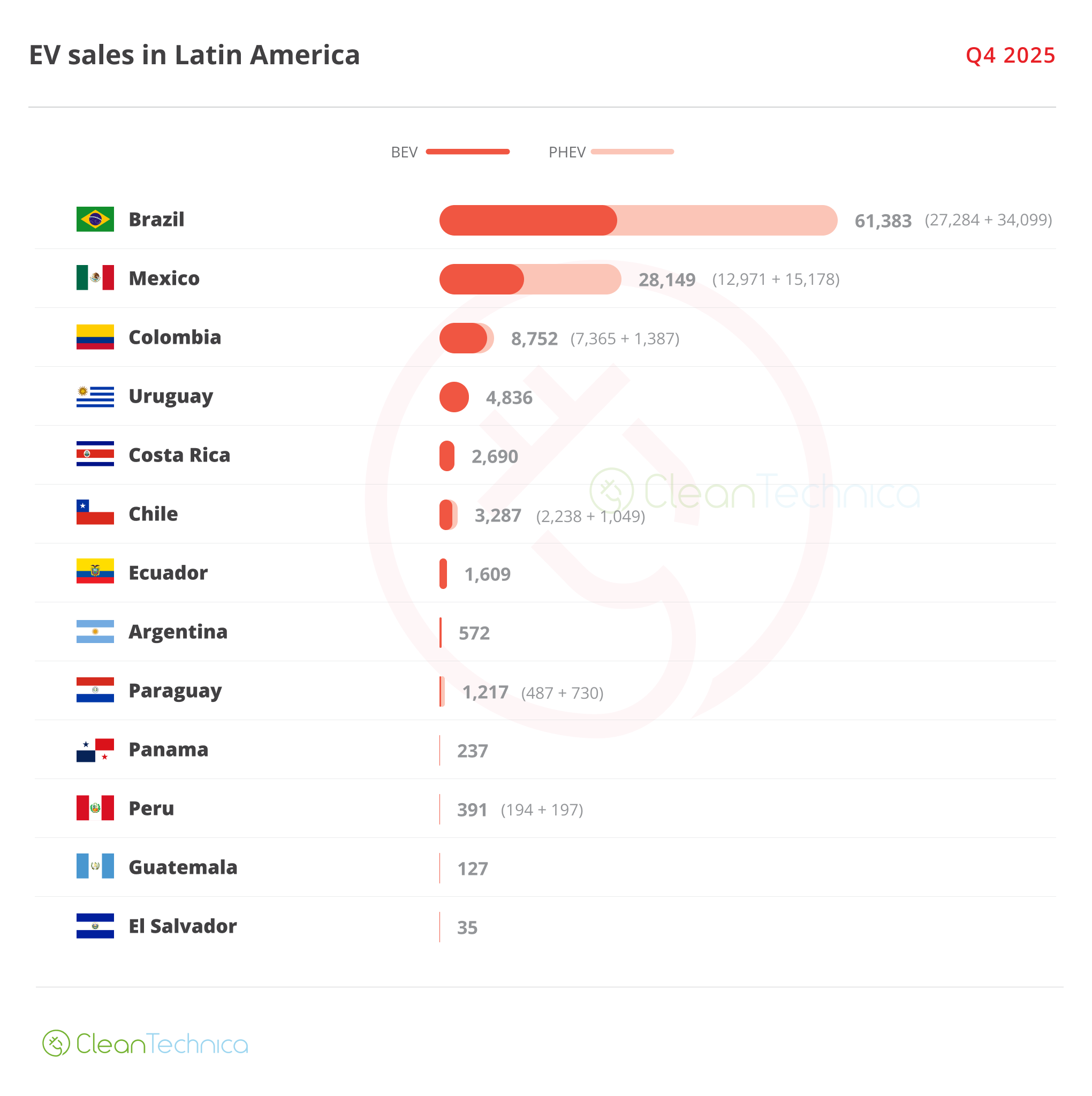
Sales increased steadily through 2025, just as they did in 2024, and surpassed the 90,000 mark in Q3 and the 100,000 mark in Q4. BEVs and PHEVs remain largely equal — though, as we will see, this greatly varies within markets:

EV sales were greatly concentrated in the two largest markets (Brazil and Mexico), which together accounted for an impressive 80% of sales throughout the region. However, these two countries are also the most PHEV-intensive markets, meaning a lot of that difference came from plug-in hybrids. If we focus only on BEVs, they “only” account for 66% of regional sales, more in tune with the overall size of their markets. Meanwhile, they account for around 95% of regional PHEV sales.
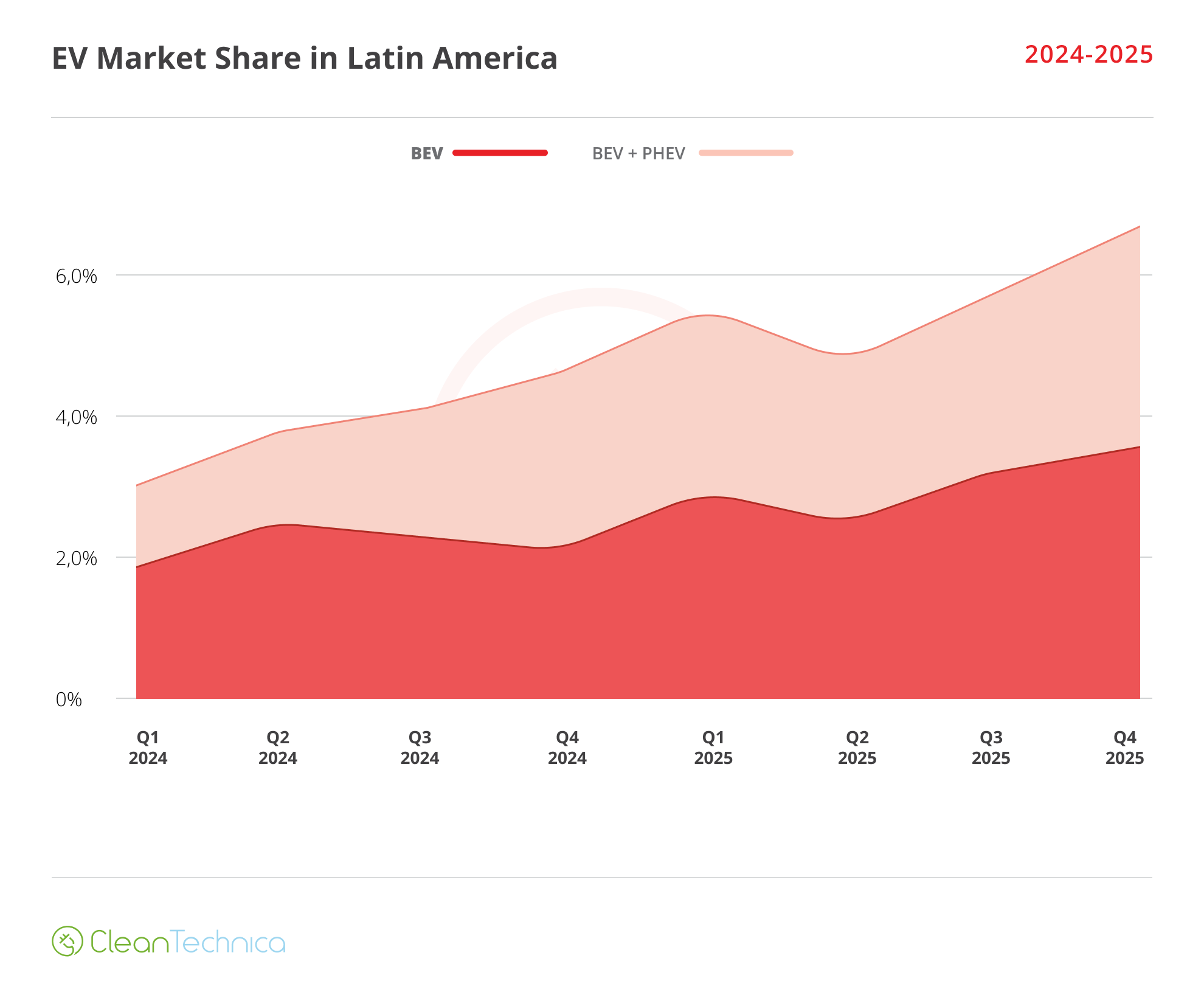
Market share likewise kept rising, reaching 6.6% in Q4 (3.6% BEV), and 5.6% throughout the whole year.
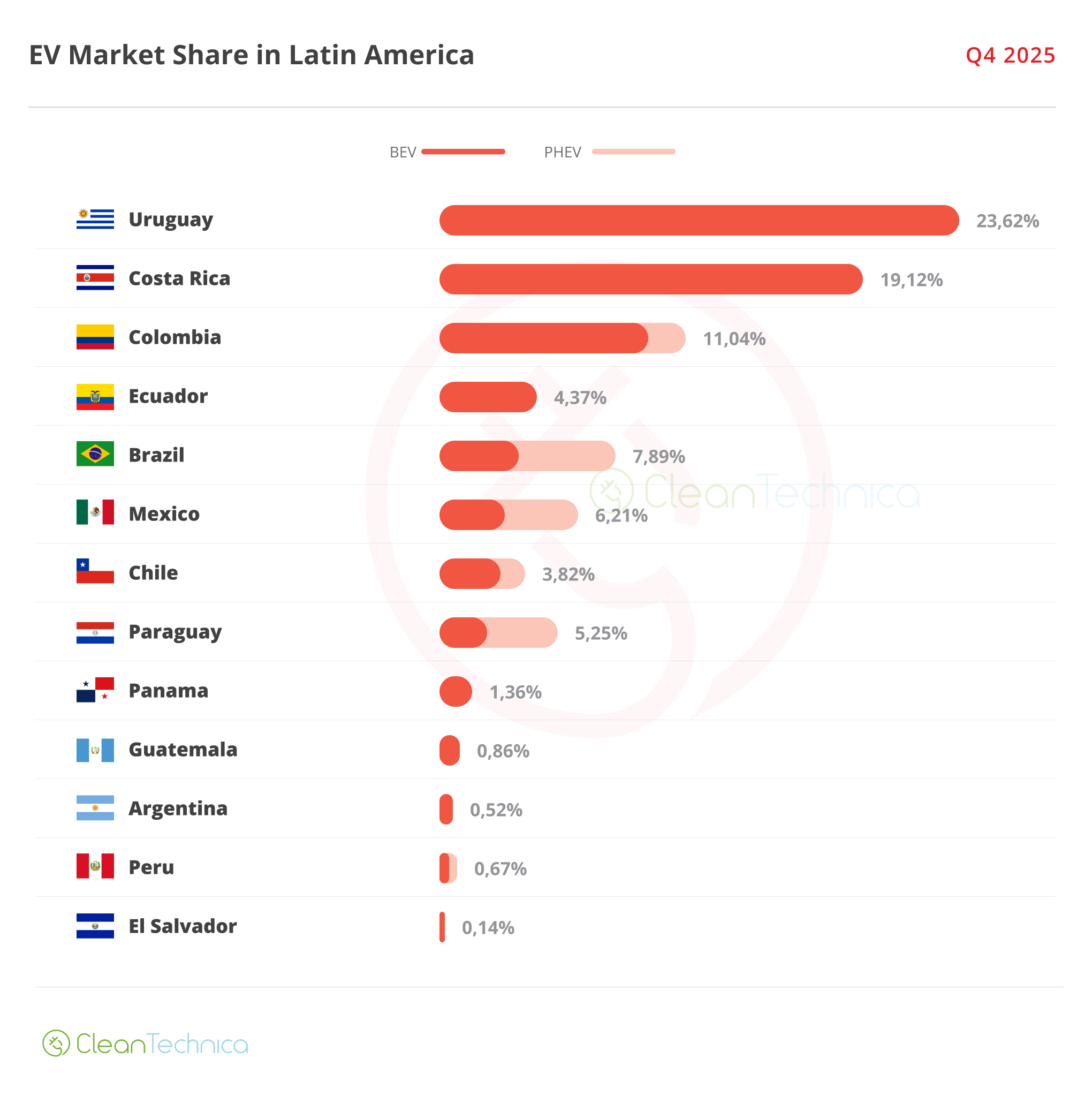
As we’ve seen, the market share variation within countries is substantial. The leaders, Uruguay and Costa Rica, boasted 23% and 19% BEV market share respectively in Q4, whereas El Salvador, Peru, Argentina, and Guatemala remain below 1%. Notable mention to Colombia, the third country in the region to surpass 10% EV market share (assuming Bolivia isn’t there yet, which, well, it could be).
Something notable in the region is that, in general, countries ahead in the transition are growing at faster rates than those still behind. Colombia, Uruguay, Paraguay, and Ecuador all grew at rates above 100% YoY in 2025 (close to 200% for Ecuador), whereas Brazil and Mexico did so at around 40–50%. Further down, we find Panama, Guatemala, and El Salvador growing below 22% YoY despite their very low base.
There are some exceptions, of course. Costa Rica, the former regional leader, grew by only 9% in 2025, thus losing the primacy to Uruguay. Peru grew by 92% YoY, whereas Argentina increased significantly by around 120% — though, both are yet to reach 1% market share. In general, though, the trend is for leading countries to increase the gap with the laggards.
Notable mentions
This is a general report, but it’s worth it to look at what’s going on in some countries at a deeper level of detail.
I’m still trying to work out exactly what’s making such a difference between Costa Rica and Uruguay. Both countries are wealthy, both lack transit restrictions for ICEVs, both have relatively affordable EVs by now, starting at around USD$17,000 for the cheapest models, both have expensive gasoline, and both have affordable, reliable electricity. The only difference is that Uruguay’s charging infrastructure is somewhat better than Costa Rica’s … but I don’t think that’s enough of an explanation, so if any of our readers has an idea, I’m all ears. The good news is: Costa Rica is finally increasing its charging network (which barely grew in 2025), so hopefully it will have a more dynamic 2026.
I expected Colombia’s market to stagnate after Tesla’s arrival at extremely competitive prices, because I thought people would rather wait. Well, I was wrong: the market is booming. EVs reached an all-time high record in December, and they kept strong in January, still over 10% market share. That same month, the first 13 Teslas were registered, meaning in February we should get an idea of the impact these models will have on the local market. Though, I’d wait a couple more months before drawing any conclusions. It is also important to mention that in all segments, except for city-cars and sub-compact hatchbacks/sedans, BEVs are already at price parity with ICEVs, and that the recent arrival of the MG S5 at 95 million COP (around $26,000) means the most affordable vehicle in the most popular segment in the country (midsize SUVs) of any powertrain is an EV.
Brazil also had a very strong end of year, reaching 10% market share in December for the first time, with increasing sales for locally made BYD and Haval (GWM) models. The country is the largest market in the region by far and it exports to many countries in South America, so this is as good news as one may get: normally, bigger ships take the longer to turn, but Brazil is pivoting to EVs at rather fast speed, even if it still prefers PHEVs over BEVs.
Mexico, the other “big ship,” is not moving as fast. BEV sales grew slightly in Q4 as PHEVs sales fell steeply (-23%), and since new tariffs are being enacted in 2026, we don’t know yet that growth will remain strong. Local media considers that margins for Chinese brands are big enough to maintain current prices (which, to be fair, aren’t as cheap as in other countries), so there’s hope here, but 2026 looks uncertain overall, more so as Olinia, the project for a mass-market, Mexican-made BEV, seems to now be delayed.
Chile presented decent growth overall in 2025 (+79%), but it is leading by a huge margin in the e-bus segment, with +563% growth YoY and a truly impressive 35% market share for e-buses within the country. It’s also the first country in our region (and probably on the continent) to have a city, Copiapó, with 100% electric buses.
Gasoline subsidies were lifted in two countries in 2025: Ecuador and Bolivia. Both countries have increasing the presence of EVs (even though we don’t have full data on Bolivia), with Ecuador growing by an impressive 191% through 2025, even though market share still hovers around 3%. In both cases, conditions are set for further improvements in 2026.
Paraguay is also showing impressive growth, clocking at 122% through 2025, and it remains the only small country with an appetite for PHEVs as big as Brazil and Mexico (as plug-in hybrids made up 55% of EV sales last year). Market share rose above 5% through the year, making Paraguay one of the most interesting countries to follow, and also quite a mysterious one, as I would expect a small country with unlimited renewable energy would rather pivot directly to BEVs. But, hey, Paraguayans always do their own thing, and that’s cool.
At last, Argentina is a country that for a very long time has stood as the last frontier for EVs, but it’s now finally growing exponentially. After selling around 1,500 BEVs throughout 2025 (+124% YoY), it sold 533 in only January 2026, +620% YoY! This is the kind of growth one expects from a laggard country, and even if Argentina remains slightly below 1% market share, we now have hopes that the third largest market in our region will — finally — start its path towards electrification.
Final thoughts
Not so long ago, EVs were extremely expensive in our region, easily tripling the cost of equivalent ICEVs. Ever since the Geometry E triggered the first price war in Costa Rica in 2024, the region has seen ever more affordable vehicles arrive one after another, all of them from China, most of them from Chinese brands, a few from the likes of Kia, Renault, Chevrolet, and Volkswagen. Now, we’re seeing price parity all over the board in several markets, including Ecuador, Colombia, and Costa Rica (and, presumably, Bolivia), and as a result, Legacy Auto is rapidly losing market share — and, in some cases, it’s losing sales in absolute terms, though for now this is masked by the overall increase in the market, which went from 5.8 million units in 2024 to 6.2 million in 2025 (+6%). This also means we’re still far from peak combustion in Latin America.
It’s important to remember that, unlike China, Europe, and the US, Latin America has a transition largely market-driven, with only one country so far (Chile) imposing efficiency norms, and with only a few cities in the region (Bogotá, Medellín, Santiago, and Mexico DF, plus a few other smaller ones) imposing traffic restrictions for pollution on ICEVs. In this sense, as EVs get more affordable and infrastructure improves, we should see the market grow — but, conversely, the current weakness in oil prices (plus the added weakness in USD prices, that brings oil further down) is translating into cheaper gasoline all over the region, disincentivizing EV adoption. A good thing is that there are no subsidies to finish, so we shouldn’t see the market stagnate, like happened in China (2019–2020), Europe (2023–2025), and the US (2025–?).
One last thing: except for Uruguay and perhaps Chile, charging networks remain insufficient, something that could hinder adoption (arguably, this is already happening in Costa Rica). I don’t see most governments making a lot of effort here, so it will fall on the private sector to make stations, and luckily a lot of companies are already doing so. Though, deployment will probably lag adoption, as this serves the interests of the stations’ owners, who will thus see higher occupancy rates and better profits.
Overall, 2026 points to sustained momentum in the transition, and growth should remain strong, but the extent of it remains to be seen. I’m hoping for 10% EV market share this year. What do you guys think?
Support CleanTechnica via Kickstarter

Sign up for CleanTechnica's Weekly Substack for Zach and Scott's in-depth analyses and high level summaries, sign up for our daily newsletter, and follow us on Google News!
Have a tip for CleanTechnica? Want to advertise? Want to suggest a guest for our CleanTech Talk podcast? Contact us here.
Sign up for our daily newsletter for 15 new cleantech stories a day. Or sign up for our weekly one on top stories of the week if daily is too frequent.
CleanTechnica uses affiliate links. See our policy here.
CleanTechnica's Comment Policy

