
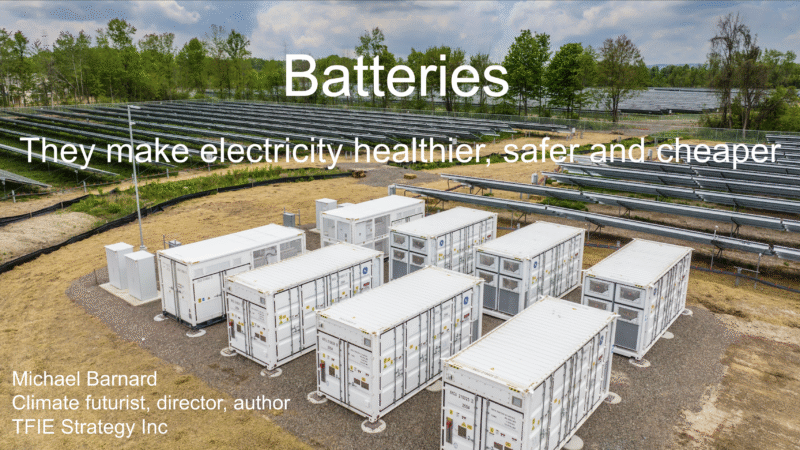
From Peak Load to Public Health: What Batteries Are Already Doing for Power Grids
Support CleanTechnica's work through a Substack subscription, on Patreon, or on Stripe. Help us produce all of the high-quality, original content we publish week after week despite the challenges of content-scraping AI, antisocial media, inflation, and other hurdles.
Being invited to speak (virtually) at an upcoming hybrid Ottawa Lunch and Learn on peak grid load and battery energy storage provided an opportunity to extend several ongoing lines of analysis. This article is an extension of the brief remarks I will be making at that event, written to unpack ideas that can only be sketched in a live setting and to place them in a broader Ontario and global context.
It is a privilege to be speaking alongside Dr. Kristen Schell of Carleton Engineering, whose work grounds these discussions in rigorous power systems analysis, and Devashish Paul of BlueWave-ai, who brings a clear perspective on how forecasting and control software are increasingly intertwined with physical grid assets. The conversation is framed deliberately as an infrastructure discussion rather than a climate pitch, because electricity systems are ultimately judged on cost, reliability, and safety, outcomes people already care about deeply. The hosting and moderation by Angela Keller-Herzog of CAFES Ottawa will be appreciated. I’ll be relying on Angela to keep my remarks brief.

Ontario is not new to thinking about electricity storage. Sir Adam Beck Pump Generating Station at Niagara Falls has for decades required grid operators to think in terms of state of charge, time shifting electricity from low demand periods to peaks, and dispatching storage as a system asset rather than as generation. Pumped hydro has taught Ontario how to manage stored electricity across hours and days, how to coordinate pumping and generating with system needs, and how to treat storage as part of the reliability backbone of the grid. That lived experience matters, because grid scale batteries are not a conceptual leap. They apply the same operational logic, but on faster timescales, in smaller increments, and closer to where electricity is consumed.
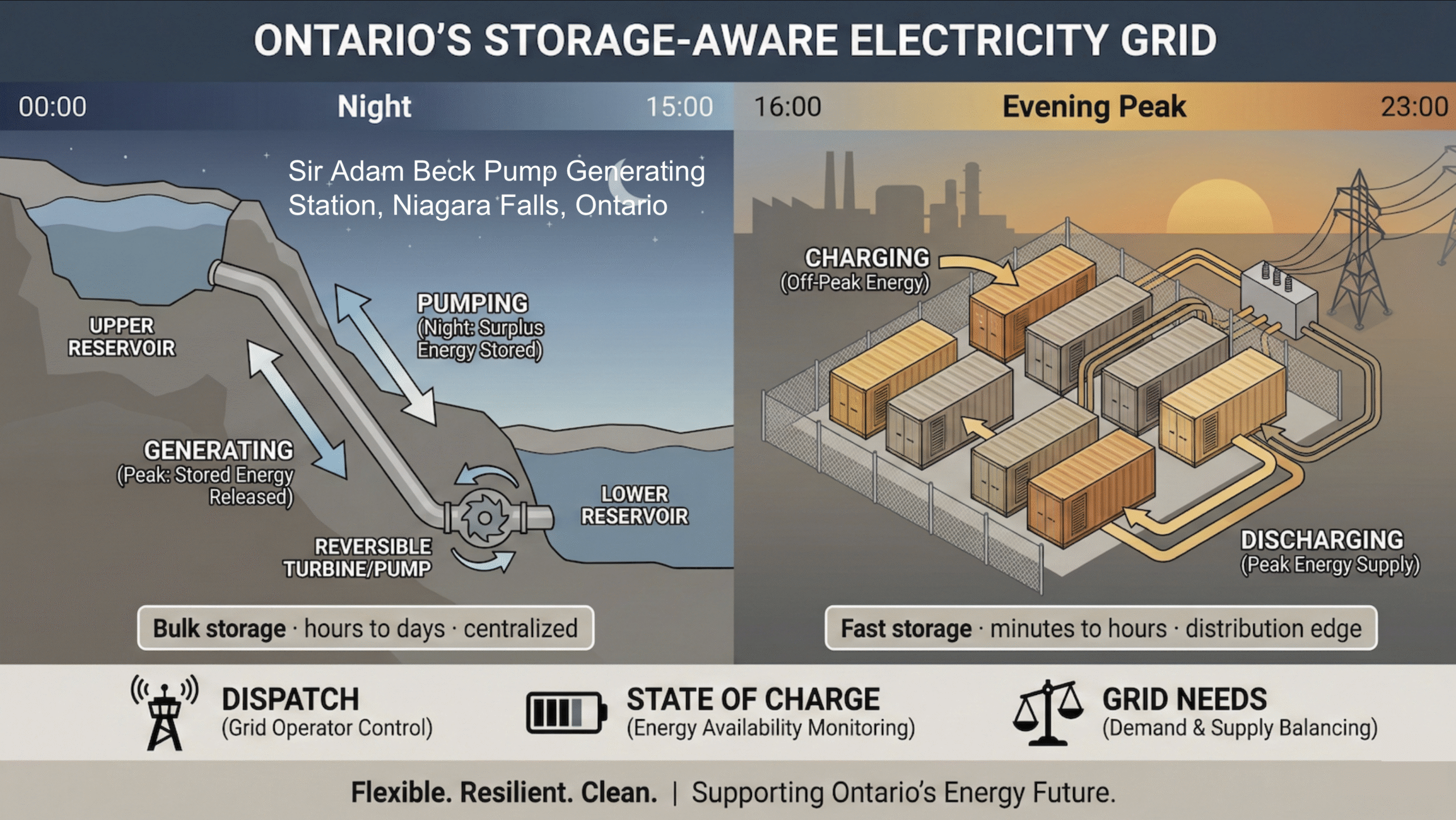
The distinction between pumped hydro and batteries is not philosophical, it is practical. Pumped hydro provides bulk energy storage measured in hours to days and is centralized, while batteries provide fast storage measured in minutes to hours and can sit at the distribution edge. Both are dispatched by grid operators, both have a measurable state of charge, and both respond to grid needs. The difference is that batteries can respond in milliseconds and can be placed where congestion and peaks actually occur, rather than only where geography allows reservoirs. For Ontario, which already understands storage as a normal grid function, batteries extend familiar thinking rather than disrupting it.
Peak demand is the central driver of grid costs, far more than annual energy consumption. Transmission lines, substations, and distribution feeders are sized for the highest load they will ever see, even if that load only occurs for a few dozen hours each year. Those capital assets then sit underused most of the time, but ratepayers still pay for them every hour of every day. Flattening demand curves by shifting electricity across time allows the same wires to deliver more electricity over the year, lowering the cost per kWh for everyone connected to the system. Batteries do this directly by charging during low demand periods and discharging during peaks, reducing the need to build new infrastructure that would otherwise be idle most of the time.
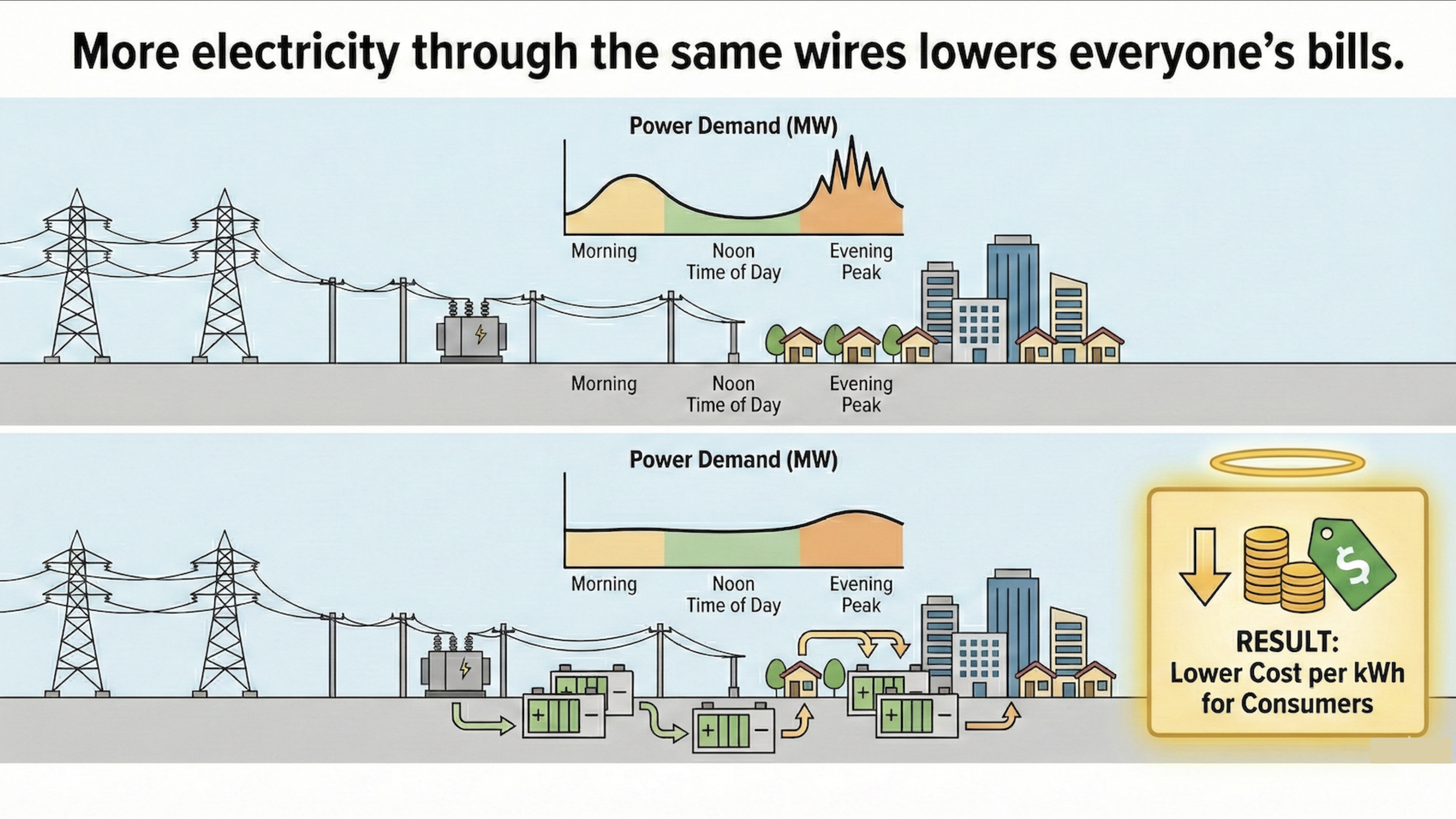
This is not an abstract benefit. Ontario generates roughly 139,000 GWh of electricity per year, which averages to about 380 GWh per day or roughly 16 GWh per hour. Peak hours drive a disproportionate share of grid spending. Batteries turn time into capacity, allowing existing assets to do more work rather than pouring more concrete and steel into the ground. That capital efficiency matters in a province where electricity infrastructure has multi decade lifetimes and where affordability is a persistent public concern.
Batteries are often described as energy sources, but they are not. They are time shifting devices. They absorb electricity when it is abundant and inexpensive and release it when it is scarce and expensive. That simple function has profound system effects. Batteries provide frequency control, ramping support, and peak shaving in ways that conventional generators struggle to match, particularly as solar and wind penetration increases. This is where Devashish Paul’s contribution to the panel will be important, because batteries reach their full value when paired with forecasting and control systems that anticipate demand and generation patterns and dispatch storage accordingly.
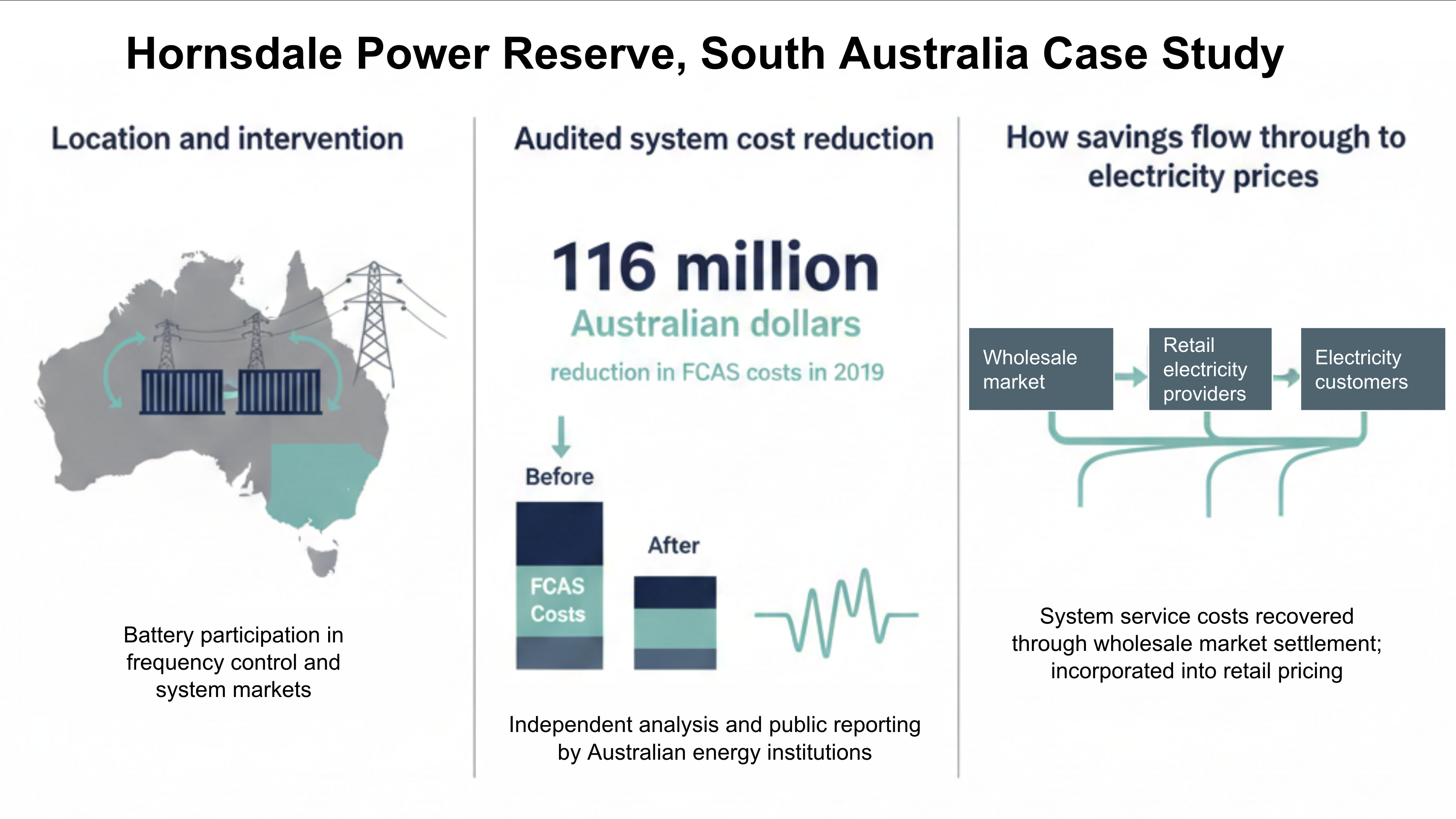
One of the case studies that will be discussed during the session is South Australia’s Hornsdale Power Reserve. Hornsdale was not built as a pilot project or a demonstration plant. It was designed to participate in real electricity markets, including frequency control ancillary services. Independent analysis by Australian energy institutions found that in 2019 alone, Hornsdale reduced system service costs by $116 million AUD. These are not hypothetical savings. FCAS costs are recovered through wholesale market settlement and incorporated into retail pricing. When system costs fall, pressure on electricity bills falls with them. The mechanism is straightforward and auditable, and it is directly relevant to any jurisdiction that operates competitive or regulated wholesale markets.
Batteries increasingly compete directly with natural gas by providing the same grid services, particularly evening peak supply and fast response. Globally, liquefied natural gas demand for power generation is already softening as batteries shift daytime solar generation into evening hours. In modern power systems, the choice is often not batteries and gas, but batteries or gas, because the grid still needs flexibility, ramping, and reliability.
Safety and public health will be part of the discussion as a result, particularly in light of high profile battery incidents in California. I have previously examined one such battery fire in detail, looking at what happened, how authorities responded, and what the actual public health implications were. The incident was serious and warranted scrutiny, and evacuations were precautionary and appropriate. There were no confirmed long term public health impacts. The facility involved older chemistries and indoor configurations that are no longer representative of modern grid scale battery deployments. And the system displaced the natural gas peaker plant that formerly operated on the same site.
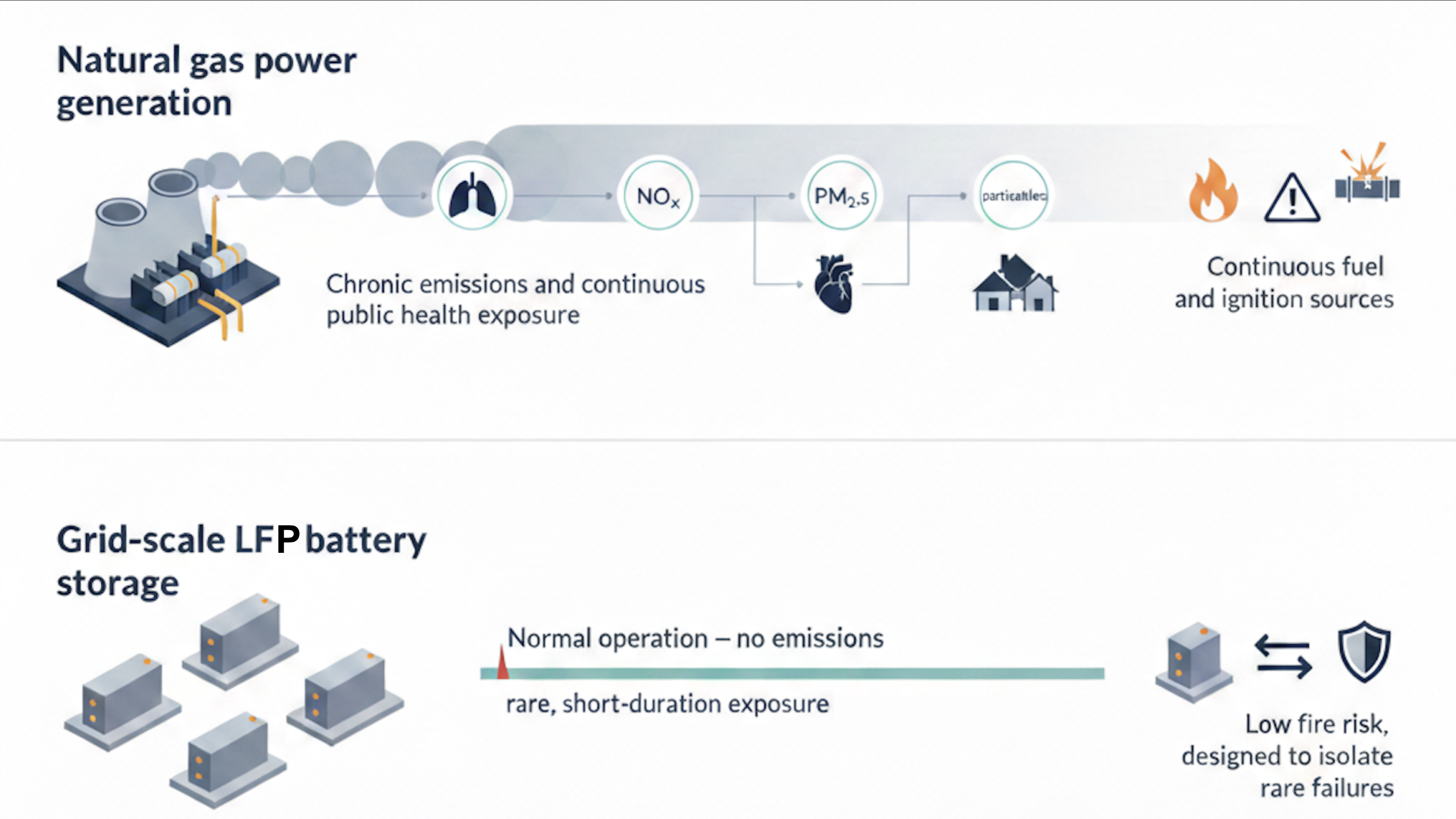
Today’s large systems are increasingly lithium iron phosphate, deployed outdoors in containerized units with physical spacing designed to isolate failures. When a battery failure occurs, it is typically localized, short in duration, and engineered to burn out rather than propagate.
Natural gas generation presents a very different risk profile, and this is why it makes sense to compare the two technologies directly. Gas plants emit nitrogen oxides and fine particulates every hour they operate, contributing to chronic public health exposure for nearby populations. They also involve continuous fuel handling and ignition sources by design.
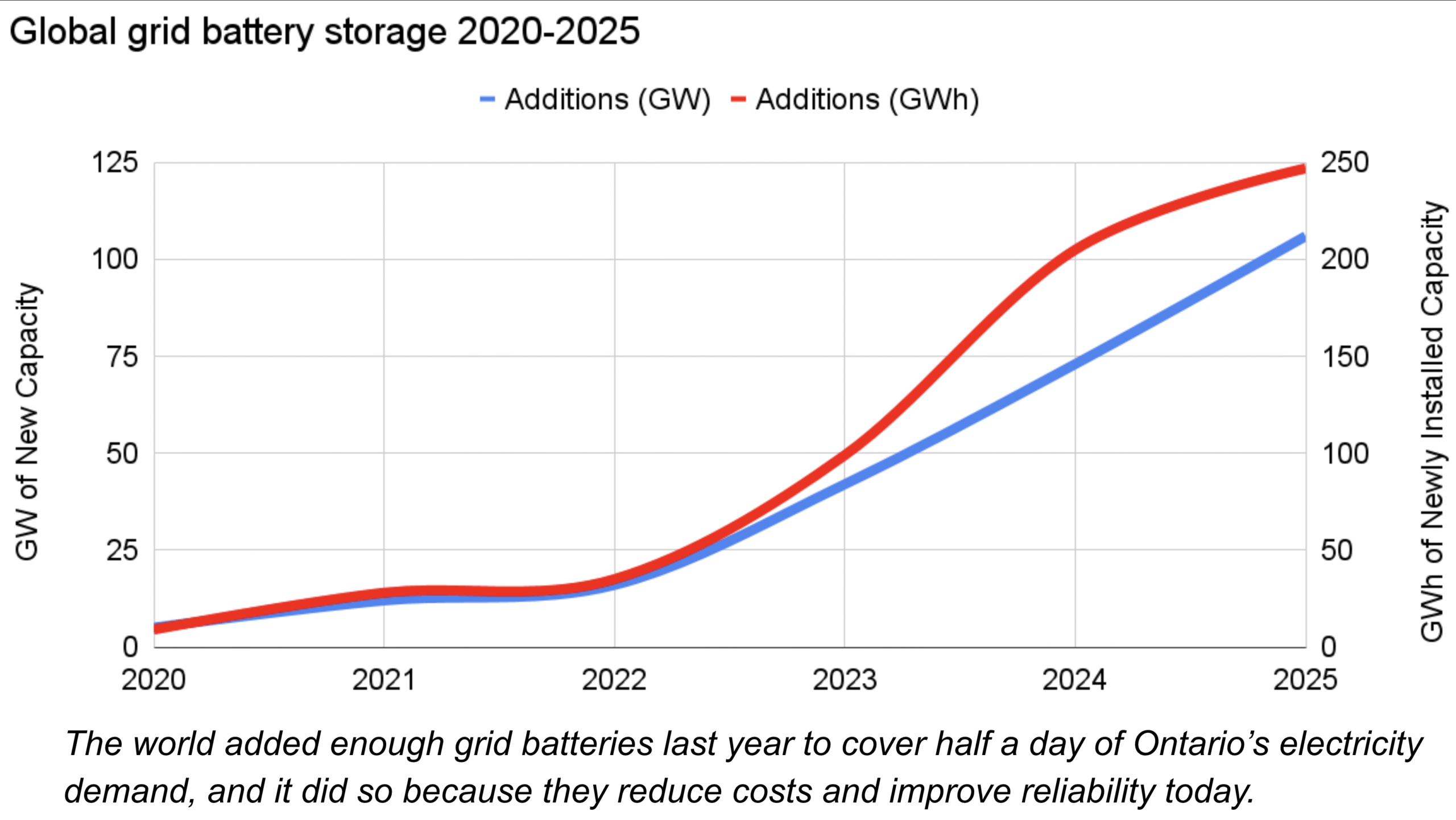
The pace of global battery deployment reinforces this point. Annual grid battery additions have risen from single digit GWh in 2020 to more than 200 GWh per year by the mid 2020s. In a single recent year, the world added enough grid batteries to cover roughly half a day of Ontario’s average electricity demand. Grid operators are conservative institutions. They do not deploy infrastructure at this scale unless it delivers value today in cost control, reliability, and operational flexibility.
For Ottawa and Ontario, the implications are practical rather than ideological. Batteries offer a way to manage peak demand, defer expensive infrastructure upgrades, improve reliability, and reduce exposure to fuel price volatility. They build on Ontario’s existing storage experience rather than replacing it, and they align with global trends driven by economics rather than aspiration. The upcoming discussion reflects that reality. The conversation will not be about whether batteries will be part of future grids, but how quickly and how intelligently they should be integrated.
The global electricity system is sending a clear signal through deployment and investment decisions. Batteries are becoming core grid infrastructure because they make the grid healthier, safer, and cheaper in ways that are measurable and repeatable. Ontario’s experience with storage means it is well positioned to understand that signal, interpret it correctly, and apply it locally in ways that serve ratepayers and communities over the long term.
Sign up for CleanTechnica's Weekly Substack for Zach and Scott's in-depth analyses and high level summaries, sign up for our daily newsletter, and follow us on Google News!
Have a tip for CleanTechnica? Want to advertise? Want to suggest a guest for our CleanTech Talk podcast? Contact us here.
Sign up for our daily newsletter for 15 new cleantech stories a day. Or sign up for our weekly one on top stories of the week if daily is too frequent.


CleanTechnica uses affiliate links. See our policy here.
CleanTechnica's Comment Policy

