
PHEV Sales Up 280% In 2025 In South Africa, While HEVs Down 6% As Chinese Brands Grow Market Share
Support CleanTechnica's work through a Substack subscription or on Stripe.
Or support our Kickstarter campaign!

Plug-in hybrids are the hottest thing in South Africa right now in terms of sales growth. Sales of plug-in hybrids (PHEVs) were up 280% in 2025 compared with sales figures from 2024. That’s because 738 PHEVs were sold in 2024 and 2,808 PHEVs were sold in 2025 in the passenger vehicle segment in South Africa. The overall new vehicles sales market was up 16% as 596,818 units were sold in South Africa in 2025. That means PHEVs had a market share of 0.47%. Over the past couple of years, plugless traditional hybrid electric vehicles (HEVs) had been more popular on the South African market, with very little action on the PHEV side of things, but a shift seems to be starting now with HEV sales down 6% in 2025. 13,552 HEVs were sold in South Africa in 2024 compared with 12,751 HEVs sold in 2025.
The rise of PHEVs in South Africa is being driven by the introduction of more affordable PHEVs with longer electric mode range, especially from Chinese brands. Looking at the top 5 best selling PHEV models, Great Wall Motors’ Haval H6 PHEV was top of the charts with 448 units sold. Here is the interesting thing. The PHEV H6 sold almost as many units as the HEV H6 which sold 512 units. To show that this shift from HEV to PHEV might be gaining traction, in 2024, when the H6 PHEV was not yet available, GWM sold 741 of the HEV versions. We could look at it as if the PHEV had not been made available in 2025, the H6 HEV was probably on a path to get to over 950 units in 2025, and now a huge share of that has gone to the PHEV version. This is a strong signal that South Africans are starting to appreciate plug-ins, although leaning more towards PHEVs than BEVs. Perhaps range anxiety is still a factor, and also pricing as most BEVs are still priced much higher than some of the top selling PHEVs.

One company that is not taking advantage of this shift but actually has a good PHEV model it could capitalize on is Toyota. In 2024, Toyota sold 761 RAV4 HEVs, and then sold 906 RAV4 HEVs in 2025. As you can see, these numbers are strikingly similar to the H6 HEV numbers from 2024 and growth track it would probably have been on in the absence of the PHEV. It is quite plausible that had Toyota supported the PHEV RAV4 more in South Africa through intentional marketing and promotion, the company could also have pushed over 500 units of it in 2025. Instead, in contrast to GWM and its Haval brand, Toyota’s conservative approach on the PHEV side saw only 10 RAV4 PHEVs sold in 2024, and the number even dropped to just 5 units in 2025. Toyota is sitting on a potential 200X opportunity for 2026 for the RAV4 in SA given the popularity of the Toyota brand in the overall market.

Back to the top 5 PHEV list. Chery’s Tiggo 7 was in second place with 419 units, followed by Chery Group’s company Jaecoo’s J7 with 317 units in third. In fourth place was the BMW X3 PHEV with 289 units. Rounding up the top 5 was Chery’s other brand Omoda, with the C9 registering 218 units. So Chery is going big on the PHEV market in South Africa. This has been the theme of 2025 as more Chinese brands have launched in South Africa.

One brand conspicuous by its absence on the charts despite offering several models on the South African market is BYD. Driving around Gauteng and other provinces it’s quite easy to spot some BYD Sharks and Sealion 06s now, meaning BYD has sold some PHEVs in South Africa, but for some reason, BYD is just not ready to report its sales figures as yet. One brand to look out for in 2026 is Geely. Geely has recently launched several models in South Africa and is definitely one to watch.
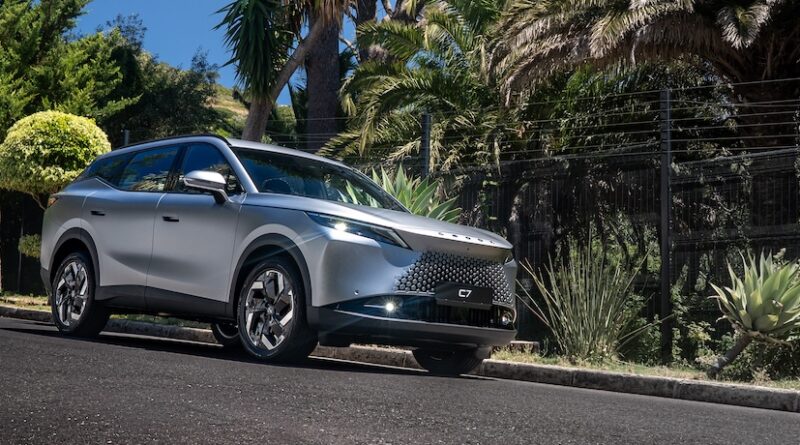
Images: The Omoda C7 SHS (PHEV). Equipped with an 18.4 kWh LFP (lithium-ion phosphate) battery, which can charge from 30-80% in just 20 minutes via a 40 kW fast charger, or from 25-100% in 160 minutes when plugged into a 6.6 kW charger. Images courtesy of Chery South Africa
Support CleanTechnica via Kickstarter

Sign up for CleanTechnica's Weekly Substack for Zach and Scott's in-depth analyses and high level summaries, sign up for our daily newsletter, and follow us on Google News!
Have a tip for CleanTechnica? Want to advertise? Want to suggest a guest for our CleanTech Talk podcast? Contact us here.
Sign up for our daily newsletter for 15 new cleantech stories a day. Or sign up for our weekly one on top stories of the week if daily is too frequent.
CleanTechnica uses affiliate links. See our policy here.
CleanTechnica's Comment Policy

