
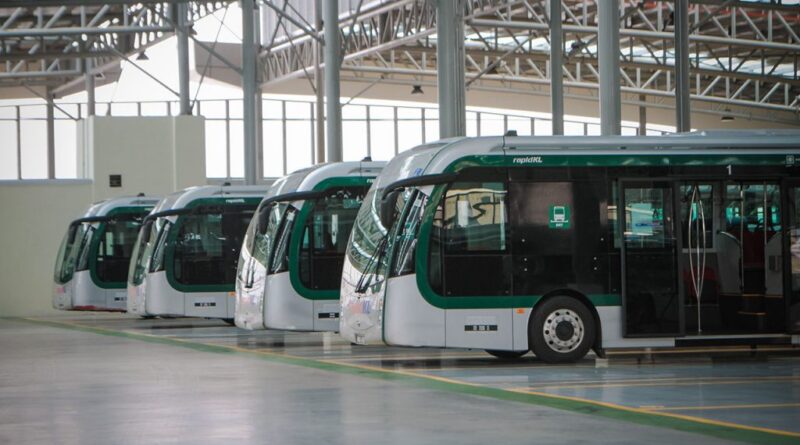
Malaysia Starts Initial Phase of Electric Bus Re-fleeting, Targeting 1,100 Units by 2030
Support CleanTechnica's work through a Substack subscription or on Stripe.
Or support our Kickstarter campaign!

Over a thousand electric buses will be introduced to Malaysia’s road network, starting with the capital Kuala Lumpur, as the country’s long-stalled push to decarbonize public transport is finally breaking out of pilot mode.
In a report by the Malaysian Transport Ministry, Prasarana Malaysia Berhad, the country’s dominant public transport operator has announced plans to procure more than 1,100 electric buses nationwide between this year and 2030 — a move that ranks among Southeast Asia’s largest electric bus rollouts to date and signals a decisive shift away from diesel.
The procurement forms part of Prasarana’s Sustainability Blueprint and aligns with Malaysia’s National Energy Transition Roadmap (NETR), which targets deep emissions cuts alongside accelerated transport electrification. Prasarana is aiming for a 45% reduction in operational carbon emissions by 2030, driven by fleet electrification, renewable energy deployment, and energy-efficiency upgrades across its network.
Most notably, the plan puts a sunset on diesel bus purchases. Prasarana will procure 310 diesel buses as its final internal combustion acquisition, with deliveries concluding by March 2026, before transitioning fully toward electric buses by 2037. While that timeline would look cautious in Europe or China, it marks a material inflection point in a region where diesel buses still dominate urban transport.
Electric buses are already operating, albeit at limited scale. Prasarana currently runs 15 electric buses on the BRT Sunway line, and the upcoming LRT Shah Alam Line (LRT3) will be supported by 150 electric feeder buses. The new procurement plan makes clear that these deployments are no longer symbolic demonstrations, but early building blocks for system-wide electrification.
Through its subsidiary Rapid Bus Sdn Bhd, Prasarana plans to procure up to 1,600 electric buses between 2026 and 2031, replacing aging diesel fleets across the Klang Valley and Penang. Transport Minister Anthony Loke Siew Fook has positioned the program as a core pillar of Malaysia’s public transport modernization strategy, explicitly linking climate targets with service reliability and urban livability.
The buses will be supplied by BYD, although there is talk that a wider range of electric bus brands may be procured in the 4 years of the re-fleeting program, which commenced last year.
The first phase will see 250 electric buses delivered between March 2026 and March 2027. Of these, 175 units will be deployed under Rapid KL in the Klang Valley, while 75 buses will serve Rapid Penang, with operations expected to begin in May 2026.
Penang, in particular, highlights why electrification is becoming unavoidable. Rapid Penang currently operates about 310 buses, many of them more than a decade old. The operator has begun its final diesel renewal this year (70 new diesel buses) and then all subsequent fleet replacements will shift to electric vehicles. By 2027, Penang alone is expected to deploy up to 240 electric buses across two procurement phases.
As in most emerging electric bus markets, cost remains a constraint. According to Loke, electric buses currently cost between RM1.2 million (~$295,920) and RM1.5 million (~$369,900) per unit — nearly double the price of diesel alternatives. While the total program budget has not been disclosed, the government has indicated that procurement decisions will emphasize lifecycle value rather than upfront cost, a critical distinction given the lower fuel and maintenance costs of electric buses over time.
Electrifying the fleet is only part of the strategy. Prasarana is also scaling up renewable energy integration across its infrastructure. Solar installations began in 2023 at the BRT Sunway station and six other locations, with plans to expand solar deployment to roughly 75 rail and bus depots, stations, and transport hubs nationwide over the next three years. Pairing electric transport with cleaner power addresses a common weakness in global electrification efforts.
The sustainability push extends beyond vehicles. Planned investments include improved pedestrian walkways, more accessible bus stops, and upgraded transport hubs, reinforcing the principle that decarbonization works best when paired with higher-quality, people-centered urban design.
Prasarana is also expanding its Rapid Penang On-Demand service, which currently operates 50 vans statewide. Following a request from the Penang government, the operator plans to procure an additional 170 vans, with the procurement process expected to begin in the second half of 2026. While not electric yet, on-demand services play a supporting role in reducing private car dependence when integrated with high-capacity, low-emissions transit.
Taken together, these initiatives place Malaysia on a credible — if measured — path toward lower-emissions urban mobility. The timeline may not satisfy the most aggressive climate advocates, but the direction is unmistakable: diesel is being phased out, and electric buses are becoming the backbone of public transport in Malaysia’s largest cities. In a Southeast Asian region where transport emissions are still rising, that shift carries real weight.
Support CleanTechnica via Kickstarter

Sign up for CleanTechnica's Weekly Substack for Zach and Scott's in-depth analyses and high level summaries, sign up for our daily newsletter, and follow us on Google News!
Have a tip for CleanTechnica? Want to advertise? Want to suggest a guest for our CleanTech Talk podcast? Contact us here.
Sign up for our daily newsletter for 15 new cleantech stories a day. Or sign up for our weekly one on top stories of the week if daily is too frequent.
CleanTechnica uses affiliate links. See our policy here.
CleanTechnica's Comment Policy

