
Canada Opens Up To China’s EVs: Motivated By The Long Term, Not Tariffs
Support CleanTechnica's work through a Substack subscription or on Stripe.
Our sources are once again proven reliable.
In our earlier exclusive a few days before the news broke globally, we spoke of how China’s automobile and industry organizations were pushing (caressing) the Canadian government to reduce EV tariffs so that they could export their EVs to Canada.
EV makers in China were ready for what one of them said was going to be the eventual turnout of the meeting with Prime Minister Mark Carney’s and Chinese President Xi Jinping — that concessions would be made with regards to electric vehicle distribution, and within 3 to 5 years, the assembly of EVs in Canada. That is what they are getting if trade concessions are finalized. Yes, Canada is going to reduce tariffs on Chinese-made EVs from a prohibitive 100% to a markedly lower 6.1%, under a framework that caps volumes and links the change to broader trade normalization efforts.
Officially, the adjustment is part of a rebalancing of Canada–China economic ties. In practice, it reflects pressure points that extend beyond the auto sector. China’s retaliatory measures against Canadian canola oil exports exposed a trade imbalance Ottawa could not ignore. Agriculture, unlike future-facing EV supply chains, delivers immediate economic and political consequences. The tariff recalibration suggests a recognition that EV policy does not operate in isolation from the rest of the trade relationship.
This context matters, because it frames Canada’s shift not as an embrace of Chinese electric vehicles, but as an acknowledgment that a rigid exclusionary stance carried mounting costs. More importantly, it marks China’s diplomacy, based on merit not on sheer economic strength.
The elephant in the room is now out
China’s EV industry has moved beyond transition. In volume terms, it now accounts for more than half of global battery-electric vehicle sales. This scale reshapes how concepts such as “overcapacity” should be understood. Chinese automakers are exporting not because domestic demand is weak, but because production systems are already sized for a global market that is electrifying more slowly than China itself.
Seen through this lens, Canada’s earlier 100% tariff functioned less as a brake on Chinese EV momentum and more as a barrier that kept Canadian consumers and policymakers outside the fastest-moving EV ecosystem.
Why Canada — and why now
Is Canada emerging as a plausible entry point for Chinese automakers into North America? There is not evidence of that. The US can continue to keep out cars because of its habitual tariff defense (or offense), or can continue to exclude them on “national security grounds.”
Regarding Canada, some experts on its economy said it can do this precisely because it has chosen a quota-and-tariff mechanism rather than an outright ban, preserving flexibility while maintaining alignment with Washington on broader industrial policy.
At the same time, Canada’s own EV market, based on reports, remains uneven. Adoption outside major urban centers is constrained by high prices and limited model availability, particularly as federal incentives narrow. Chinese brands, with cost-competitive platforms and vertically integrated battery supply chains, are structurally positioned to address this gap — at least within the limits imposed by Canada’s import caps.
The likely first movers
No official launch announcements have been made, but CleanTechnica’s industry sources agree that the global expansion patterns suggest a short list of automakers most likely to test the Canadian market. Listed below in alphabetical order are the most likely first movers.
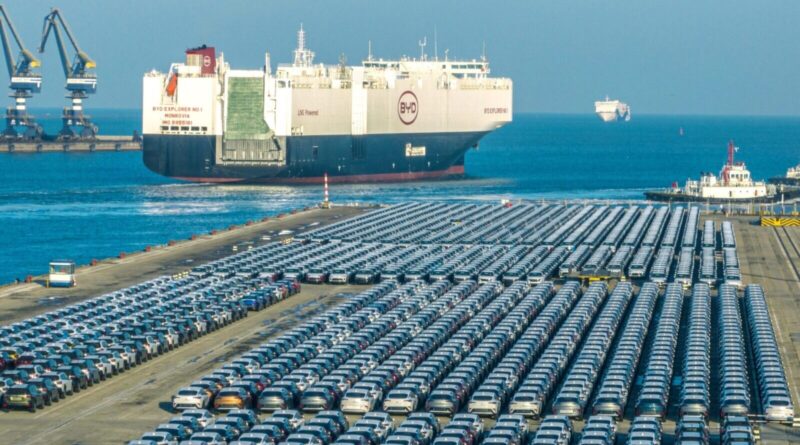
BYD is widely viewed as the frontrunner. As the world’s largest EV producer, BYD has extensive experience operating across diverse regulatory environments. Its strengths lie not only in mass-market passenger vehicles, but also in buses and commercial fleets — segments where Canadian cities are already electrifying. BYD’s vertically integrated model, particularly in batteries, reduces exposure to Western supply constraints.
Chery also belongs on any serious shortlist of Chinese automakers likely to enter Canada, and in some respects it may be better positioned than newer EV specialists precisely because of its long international track record. Chery was among the first Chinese carmakers to pursue sustained overseas expansion, with decades of experience operating in diverse regulatory, political, and consumer environments across Latin America, the Middle East, Europe, Australia, and Southeast Asia. It tried Canada in the past, under the HAAS and Vantas vehicle brands. Both failed. And while Chery may not lead with cutting-edge autonomy and smart vehicle branding like XPENG, or deep and broad vertical integration like BYD, its institutional memory in global market entry, risk management, and phased scaling makes it a credible — and potentially early — participant if Canada prioritizes experienced, low-drama entrants over disruptive volume plays.
Geely, especially via its premium Zeekr brand, may take a more targeted approach. With established ties to Western brands such as Volvo and Polestar and Waymo, Geely is familiar with safety, emissions, and design expectations in developed markets. A Canadian entry would likely focus on higher-income urban buyers rather than mass-market disruption.
NIO remains a more speculative possibility. Its software-centric ecosystem and battery-swapping model have been prioritized for Europe, but Canada’s concentrated urban corridors and early-adopter demographics could support a limited rollout if infrastructure partnerships are secured.
SAIC Motor, through its MG brand, is another strong candidate. MG’s revival in Europe and Australia as a value-oriented EV marque provides a template that could translate well to Canada, whose vehicle standards closely mirror European homologation rules.
XPENG can credibly be considered a potential frontrunner for a Canadian entry, though not in the same volume-driven sense as BYD. Its advantage lies in fit rather than scale. XPENG has positioned itself as a technology-forward automaker with products already engineered for export markets, emphasizing advanced driver-assistance systems, software-defined vehicles, and ultra-fast charging — attributes that align well with Canada’s urban, early-adopter EV demographic.
Constraints remain — and politics still matter
Various reports from Reuters, Associated Press, and Economic Times indicate that despite the tariff reduction, this is unlikely to become a flood of imports. Volumes are capped, political scrutiny remains high, and Canada is simultaneously investing in domestic battery plants and North American EV assembly. Any perception that Chinese EVs threaten those investments could quickly trigger a policy rethink.
There is also the U.S. factor. Deeply integrated North American supply chains mean that Chinese brands entering Canada are likely to be confined to vehicles built and sold domestically, without access to the U.S. market. That limitation shapes strategies on both sides.
Sign up for CleanTechnica's Weekly Substack for Zach and Scott's in-depth analyses and high level summaries, sign up for our daily newsletter, and follow us on Google News!
Have a tip for CleanTechnica? Want to advertise? Want to suggest a guest for our CleanTech Talk podcast? Contact us here.
Sign up for our daily newsletter for 15 new cleantech stories a day. Or sign up for our weekly one on top stories of the week if daily is too frequent.
CleanTechnica uses affiliate links. See our policy here.
CleanTechnica's Comment Policy

