
Breakdown of the “FastDriveVLA” — AI-Led L4 Autonomous Driving from XPENG & Peking University
Support CleanTechnica's work through a Substack subscription or on Stripe.
This week, XPENG, in collaboration with Peking University, announced a significant leap forward in this domain with the acceptance of their latest research paper at AAAI 2026, one of the world’s premier artificial intelligence conferences. Titled “FastDriveVLA: Efficient End-to-End Driving via Plug-and-Play Reconstruction-based Token Pruning,” the research details a novel framework that drastically reduces the computational load of onboard AI, bringing the industry one step closer to viable, scalable Level 4 autonomy.
CleanTechnica secured a copy of the paper and used the abstract to develop this report. (The press release is here.)
As context, XPENG’s 2025 Roadmap had focused on the development of L4 autonomy early on. The breakthrough arrives at a pivotal moment for the Chinese technology company, serving as a force multiplier for the company’s upcoming hardware and architectural shifts scheduled for 2025.
Just in November at XPENG’s Tech Day, the VLA 2.0 architecture removed the traditional “language translation” step, enabling direct Visual-to-Action generation. FastDriveVLA appears to be a critical optimization layer for this new pipeline.
And even earlier in the 2nd quarter of 2024, it’s proprietary “Turing” AI chip was set for mass production. The efficiency gains from FastDriveVLA could allow the new silicon—already capable of 2,200+ TOPS—to handle even more complex scenarios or manage multiple systems (like cockpit AI and driving AI) simultaneously.
Visual bottleneck
The research addresses the critical bottleneck facing the next generation of self-driving cars: the “visual token” explosion. As the industry pivots toward end-to-end Vision-Language-Action (VLA) models—which learn directly from raw video feeds rather than human-written code—vehicles are inundated with data. A standard VLA model breaks a single image frame into thousands of digital building blocks called “tokens,” all of which must be analyzed to make driving decisions. The XPENG–Peking University team found that typical models process approximately 3,249 visual tokens per frame, a computational burden that creates dangerous latency and high energy consumption.
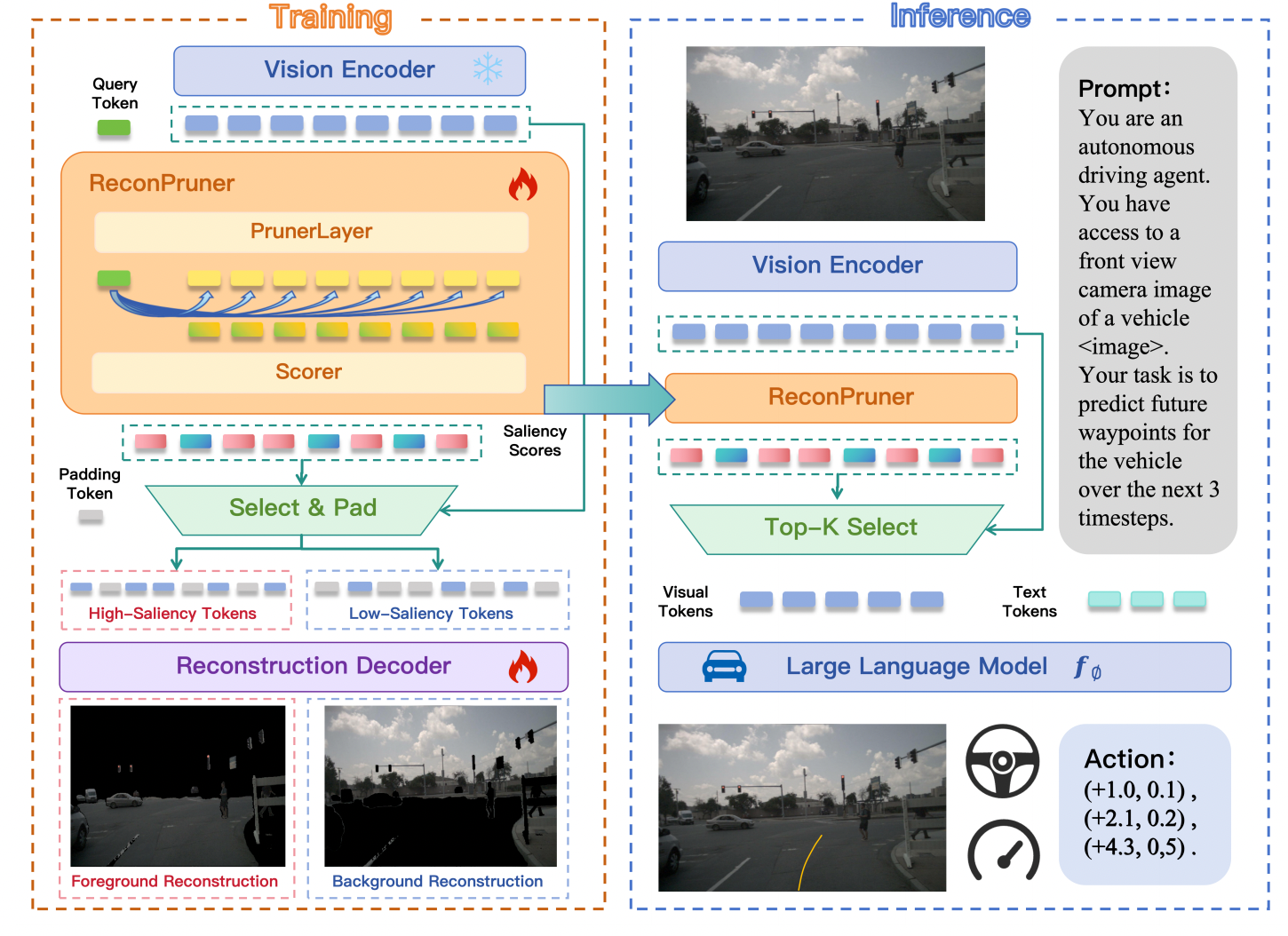
To solve this, the team developed “FastDriveVLA,” a framework inspired by the foveated nature of human vision. Just as a human driver subconsciously ignores static clouds or distant buildings to focus on moving traffic and pedestrians, FastDriveVLA utilizes a novel adversarial foreground-background reconstruction strategy to filter out non-essential data. When tested on the industry-standard nuScenes autonomous driving benchmark, the framework successfully identified and “pruned” the irrelevant background data, reducing the token count from 3,249 to just 812 per frame. This 75% reduction in data volume resulted in a 7.5× decrease in computational load without sacrificing planning accuracy, effectively allowing the AI to “see” faster and react more sharply.
This software efficiency is a force multiplier for XPENG’s proprietary hardware strategy, specifically the rollout of its “Turing” AI chip. Scheduled for mass integration in Q2 2025, the Turing chip is the world’s first 40-core processor designed specifically for AI-defined vehicles, robots, and eVTOLs. While a cluster of three Turing chips—standard in XPENG’s upcoming “Ultra” vehicle trims—delivers a staggering 2,250 TOPS (Tera Operations Per Second) of compute power, the efficiency gains from FastDriveVLA are crucial. By slashing the computational overhead of the vision system, the Turing chip is freed up to run XPENG’s massive 30-billion-parameter VLA 2.0 models locally on the vehicle, rather than relying on cloud connections that can be severed in tunnels or rural areas.
The integration of FastDriveVLA into XPENG’s VLA 2.0 architecture marks a distinct shift in the company’s technological roadmap. Unveiled at XPENG’s AI Day in November 2025, VLA 2.0 utilizes a “Vision-Implicit Token-Action” pathway that removes the traditional intermediate step of translating visual data into language descriptions before taking action. This direct neural pathway, trained on over 100 million video clips representing 65,000 years of human driving, allows for more intuitive, reflex-like driving behaviors. The pruning capabilities of FastDriveVLA ensure that this massive neural network can operate within the thermal and power constraints of a consumer electric vehicle.
For the broader automotive industry, this development signals that the barrier to entry for Level 4 robotaxis is lowering. By demonstrating that high-performance autonomy can be achieved with optimized data management rather than just infinite hardware scaling, XPENG has validated a more sustainable path to deployment.
As the company prepares to launch its dedicated robotaxi fleet in 2026 and deepen its technical alliance with Volkswagen, the ability to deploy “human-like” attention mechanisms on production-grade silicon may prove to be the decisive factor in the commercial viability of driverless transport.
Implications for the “Land Aircraft Carrier”
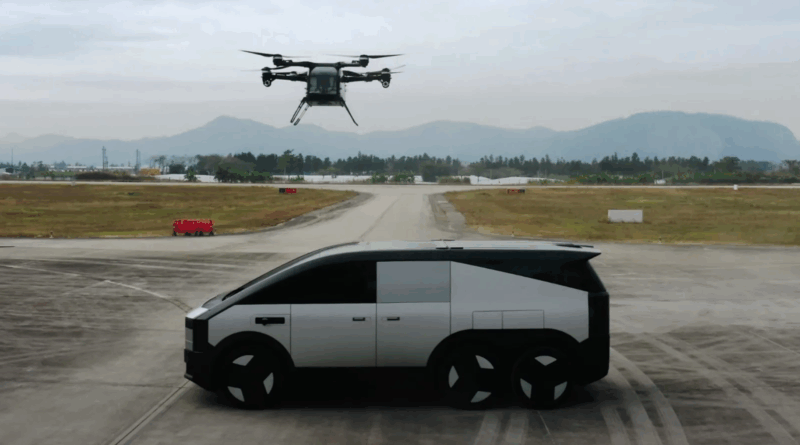
While the AAAI paper explicitly targets ground-based autonomous driving, the underlying technology has profound implications for XPENG’s most ambitious project: the “Land Aircraft Carrier” flying car, scheduled for mass production in 2026. XPENG has publicly confirmed that its eVTOL (electric Vertical Take-Off and Landing) air module shares the same “Turing” silicon and VLA 2.0 architecture as its ground vehicles. Therefore, it is highly probable that the efficiency gains from “FastDriveVLA” will be adapted for the skies.
In the context of electric aviation, the “battery tax” is the primary engineering constraint. Every watt of power consumed by onboard computers is a watt subtracted from flight time. If FastDriveVLA can indeed deliver a 7.5× reduction in computational load, the energy savings for the air module could be significant. A more efficient vision system means the onboard Turing chips generate less heat, requiring lighter cooling systems and drawing less power from the battery pack—potentially extending the flight duration of the aircraft, which currently targets a modest range for short urban hops.
Reviewing the illustration below, the “reflex-like” speed gained from pruning visual tokens is arguably more critical in the air than on the ground. Unlike a car, which operates on a 2D plane, a flying vehicle must navigate 3D space where threats—such as birds, drones, or sudden wind gusts—can appear from any angle. The latency reduction provided by FastDriveVLA could allow the Land Aircraft Carrier’s autonomous flight system to stabilize the aircraft or execute collision-avoidance maneuvers with a speed that matches or exceeds human pilot reflexes.
Foreground-background
The “foreground-background” reconstruction strategy described in the paper is uniquely suited for aerial navigation. In the sky, the ratio of “background noise” (clouds, blue sky, distant horizon) to “critical foreground” (landing pads, power lines, other aircraft) is extremely high. A system that can aggressively prune 75% of the visual feed to focus solely on navigation hazards would solve one of the biggest challenges in autonomous flight: processing high-resolution video streams without overwhelming the flight computer.
While XPENG has not yet released specific data on “FastDriveVLA” for aviation, the shared architecture suggests that this breakthrough in ground-based vision is likely the “secret sauce” enabling the high-level automation promised for their 2026 flying car.
The acceptance of the paper is a notable accolade in itself, given the conference’s highly selective nature this year. AAAI 2026 received nearly 24,000 submissions but accepted only 4,167, resulting in an acceptance rate of just 17.6%. For XPENG, this recognition validates a strategic pivot toward end-to-end large models that promise to redefine how vehicles perceive and navigate the world.
Author’s note: The last two parts of the article are educated guessed and purely technical speculations on the part of the author. We asked for verification from XPENG as of press time but the holidays may have delayed a response. We will update the article or post a totally new one from the results of the inquiry.
Sign up for CleanTechnica's Weekly Substack for Zach and Scott's in-depth analyses and high level summaries, sign up for our daily newsletter, and follow us on Google News!
Have a tip for CleanTechnica? Want to advertise? Want to suggest a guest for our CleanTech Talk podcast? Contact us here.
Sign up for our daily newsletter for 15 new cleantech stories a day. Or sign up for our weekly one on top stories of the week if daily is too frequent.
CleanTechnica uses affiliate links. See our policy here.
CleanTechnica's Comment Policy

