

Floating Solar Power To Rise To 77 Gigawatts By 2033

Floating solar power has been one of the most interesting and fast-growing trends in the solar industry in the past several years, and especially the past couple of years. Going from an obscure, niche idea to a more and more common solution at larger and larger scale, floating solar power is becoming a notable segment of the solar market.
Now, a new report from Wood Mackenzie is focused entirely on floating solar power! It forecasts that the overall floating solar market could reach 77 gigawatts (GW) by the year 2033.
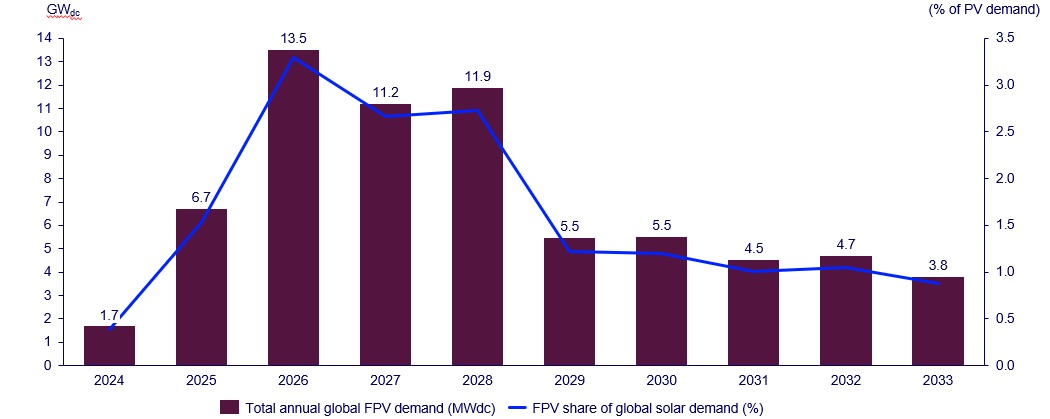
The report also suggests that Asian Pacific Region (APAC) is expected to be a dominant character in this segment of the solar industry. Wood Mackenzie expects that it will account for 81% of the floating solar PV market, or 57 GW, by 2033.
“Nine of the top ten global FPV markets are expected to be from the APAC region,” PV-Tech writes.
“The research includes system cost estimates for floating solar installations across 12 markets, with a detailed cost breakdown for each country, along with analysis of market drivers and anticipated challenges. Additionally, the report features a taxonomy of floating solar manufacturers and developers, as well as insights into offshore solar projects and their current status,” the company writes.
The three largest markets for floating solar power are expected to be India, China, and Indonesia. Just those three markets are expected to account for 31 GW by 2033. In Europe, the three biggest markets are expected to be Germany, France, and the Netherlands, with Germany getting 2.2 GW of floating solar power by 2033, France getting 1.2 GW, and the Netherlands getting 1 GW. (The US is expected to reach 0.7 GW.)
What is driving floating solar’s growth, though? “[Harshul] Kanwar said that while the capital expenditure for floating solar systems is approximately $0.13/W to $0.15/W higher than for ground-mounted PV systems, the recent decline in the prices of passivated emitter and rear cell (PERC) and tunnel oxide passivated contact (TOPCon) modules to below $0.10/W has significantly lowered the overall costs for floating solar installations,” pv magazine writes.
I do wonder if continued innovation in this floating solar sector won’t end up making this 77 GW forecast pessimistic, but we’ll have to wait to see, and enjoy tracking floating solar power projects in the meantime.

