
How Cleantech & Autonomy Can Increase Natural Intelligence & Propel Society Forward
Support CleanTechnica's work through a Substack subscription or on Stripe.
Everyone wants a better future, not only for ourselves, but for our children and grandchildren. Society is supposed to continue getting better with each passing generation, and we hope that this trend continues far into the future. If anything, we want this to happen faster! In this article, I want to discuss how technologies we’re excited about today can improve society in ways much bigger than most of us think. But, to see these full benefits, we’re going to have to do something most people find a little off-putting.
Clean Energy, Efficient Technology, and Autonomous Machines Can Save A LOT of Time & Effort
Let’s start with something most readers can agree with: technology means prosperity. I don’t mean to say that there are no drawbacks and that new technologies don’t ever go wrong, but on average, new technologies save us a lot of trouble over time. Instead of walking, we can drive, ride, or fly. Instead of digging a trench or a ditch, machines can help us do it in a fraction of the time. Now, doing heavy and/or tedious labor is becoming even easier with automation.
We may get to the point where there just isn’t enough human work to go around. Automated factories, automated burger machines, self-driving cars, and such will make many jobs obsolete. Some say that the jobs will be replaced with better jobs, while others think that the jobs aren’t coming back, so we’d better do something else to keep the economy going, like pay out a universal basic income (UBI).
I’m going to sidestep this issue for now, largely because I think that the whole framing of UBI being the answer to automation is a bit like putting the cart before the horse.
Regardless of where you stand on UBI, it’s hard to argue against the idea that cheap, abundant energy that doesn’t hurt us combined with automation massively increases productivity and creates a lot of wealth. Possible social ills aside for now, there’s a lot of value that these technologies unlocks.
What Makes Free Markets Tick
One commonly accepted economic idea is that prices serve as a signals that communicate a lot of information about the economy. Nobody has to know the whole economy inside and out because everyone is in charge of their own little corner of it. So, when people are willing to pay more or pay less, it’s an indication to whoever makes and distributes the goods that there’s high or low demand. Without knowing the ins and outs of all possible customers’ lives, companies can more or less get things right.
The reverse is also true. When a person sees high prices (such as when gouging happens after a disaster), the market is signaling that a commodity might be in short supply compared to demand. So, people who need the good the worst can pay more to get them while people who can wait will try to wait for lower prices.
What this does is chain every human brain together into a sort of cybernetic collective. Nobody has to understand the whole market, which is a good thing because the ins and outs of every aspect of a whole market with all of the companies, distributors, employees, families, and buyers is more than any person can possibly keep track of. Even if you think that computers can aid in trying to get away with central planning, you never know about the whole extent of grey markets and know very little about what’s going on in black markets, on the dark web, and in other jurisdictions.
Free market advocates argue that trying to tamper in the market only messes things up. Raising or lowering interest rates, placing price caps, prohibiting gouging, giving away money, collecting up too much money, and regulating almost anything can be argued to disrupt price signals and cause people in the economy to make poor decisions. This then leads to misallocation of wealth, which drags down the efficiency and effectiveness of the economy.
Whether you accept the full argument and reject all government interventions in the market is up to you (most people reject at least some of this theory), but it’s hard to argue that price signals don’t matter or that the economy doesn’t operate like a giant computer network of brains.
Stress Makes Brains Malfunction
As someone who has worked in firearms and self defense training, law enforcement, and emergency management, I can’t stress enough the value of staying calm. There’s a lot of science behind this, and it’s well-established fact that when under stress, the human brain goes through some serious changes.
During life-threatening stress, the human brain does some things that seem dumb on the surface. The higher parts of the brain start to shut down, our fine motor skills get sloppy, our hearing becomes weak, and tunnel vision robs us of a lot of context. For this reason, a competent defensive firearms instructor will train you to look around after a defensive shooting because you’re not going to naturally notice your surroundings when under that kind of stress.
There are good historical and evolutionary reasons for all this. Back in the hunter-gatherer days, there wasn’t time to think carefully about an animal or another human attacking you. You had to strike out with as much brutality and force as you could muster. Social skills didn’t matter in those situations. Hearing didn’t matter. Feeling didn’t matter. The only thing that mattered was smashing the other living thing before it smashed or ate you!
But, in the modern world, this response to stress is pretty suboptimal. Police who can’t get details right can make tragic mistakes, like killing someone who’s reaching for a dark-colored wallet. Social cues (a higher brain function) are the key to understanding many situations, and being unable to “read the room” can lead people to losing jobs, ending marriages, and committing crimes in the “heat of the moment”.
Financial stress won’t usually turn a human into a rage monkey that kills people, but being short on money never makes us think better. When we need the most mental computing power, stress takes it away. Again, we aren’t cave dwellers who need to smash things to survive, we live in a modern economy and need to process a lot of complex social, economic, and political information to improve our chances. Being in smash mode only makes things worse.
Among the information we need to be able to read and intelligently process are those price signals, but when we’re low on cash and afraid of becoming homeless, our ability to do that effectively and be the cold, rational actor some economists think we all are is diminished.
When enough people are put in caveman mode by financial stress, the whole cybernetic collective’s brain power gets messed up, and our whole society is dragged down. Not only does this make everyone less financially well off, but it also drives problems like violent crime, political instability, and spicy issues like abortion.
Upgrading The Collective’s Brain Power
Regardless of whether automated machines powered by clean electricity take everyone’s jobs away, we’d be fools to just let the opportunity to fix a lot of society’s problems pass us by.
The job-replacing automation leaves a lot of added value that could be targeted with a modest tax. I’ll let real economists run all of the numbers, but ideally we don’t want to tax automation so much that we discourage companies from developing, refining, or using the technology. In other words, an excessive tax would strangle the baby in the crib before it could grow to do great things for us all.
Between this revenue stream and other proposed things, like a mechanism to pay people for their data, redirecting money from today’s bloated and inefficient welfare programs, and redirecting money from idiotic programs like the War on Drugs and mass non-rehabilitative incarceration, it should be possible to pay a modest basic income to all citizens who want it without dragging the economy down or causing inflation (the new money gets taken back out of the economy by taxation and the end of inefficient welfare programs).
Ultimately, though, the boost in individual brain power alone that would come from poverty alleviation would add up to some serious improvements in the economy. With more people making intelligent, rational decisions, we all win. Being able to do valuable things like raise children, pursue self-employment, and not just spend years putting out financial fires, everyone’s efficiency and contribution goes up.
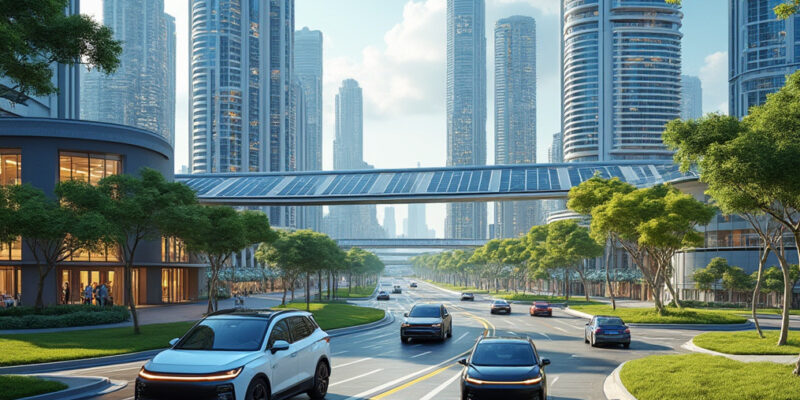
Featured image: an AI-generated image of a futuristic city.
Sign up for CleanTechnica's Weekly Substack for Zach and Scott's in-depth analyses and high level summaries, sign up for our daily newsletter, and follow us on Google News!
Have a tip for CleanTechnica? Want to advertise? Want to suggest a guest for our CleanTech Talk podcast? Contact us here.
Sign up for our daily newsletter for 15 new cleantech stories a day. Or sign up for our weekly one on top stories of the week if daily is too frequent.


CleanTechnica uses affiliate links. See our policy here.
CleanTechnica's Comment Policy

