

Home & Utility Upgrades to Support Electrification & Clean Local Resources
Support CleanTechnica's work through a Substack subscription, on Patreon, or on Stripe. Help us produce all of the high-quality, original content we publish week after week despite the challenges of content-scraping AI, antisocial media, inflation, and other hurdles.
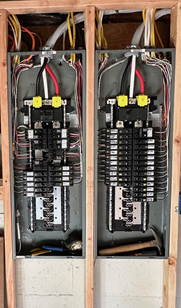
Advances in electric appliances, electric vehicles (EVs), rooftop solar and energy storage — plus incentives from utilities and governments — are attracting growing consumer interest in these technologies. Consumer investments may include upgrades for electric service panels, especially when installing multiple electrification measures in older homes (see photo). In some cases, utilities may need to upgrade their equipment.
Berkeley Lab’s new technical brief, Sizing Electric Service Panels and Utility Infrastructure for Residential Electrification and Distributed Energy Resources Adoption, explains in clear terms the components of customer- and utility-owned electrical service and considerations for upgrading equipment to support electrification and adoption of distributed energy resources.
Examples of appliances that households may electrify include high-efficiency heat pumps for heating and air-conditioning, heat pump water heaters, induction stoves for cooking, and heat pump clothes dryers.
When evaluating the need for upgrading residential electric service, primary considerations are the type and age of the main breaker panel, the main breaker size and number of breaker spaces available. The National Electrical Code allows use of metered electricity usage data to determine whether new load additions to existing residential buildings require upgrading the main breaker. Using demand data from advanced meters to size main breakers is far more accurate than using traditional demand factor estimates. Performance data reflect the actual maximum demand requirements of the residence and can potentially reveal that panel upgrades are not needed or may minimize required upgrades.
Other actions can help reduce the need for electric service equipment upgrades — for example:
- Using high-efficiency appliances to reduce overall electrical demand and provide more headroom for new loads
- Installing a sub-panel to increase available space without requiring a full panel upgrade
- “Plug sharing” or “circuit sharing” to enable one breaker position to connect multiple loads (for example, a clothes dryer and an EV charger) by allowing only one load to operate at once
- Controlling loads automatically by tripping designated loads if pre-set load thresholds are exceeded
Cody Davis, Electric Power Engineers, and Lisa Schwartz, Berkeley Lab, authored the technical brief. The U.S. Department of Energy’s Office of Energy Efficiency and Renewable Energy supported this work.
Contact: Lisa Schwartz, Berkeley Lab’s Energy Markets and Policy Department
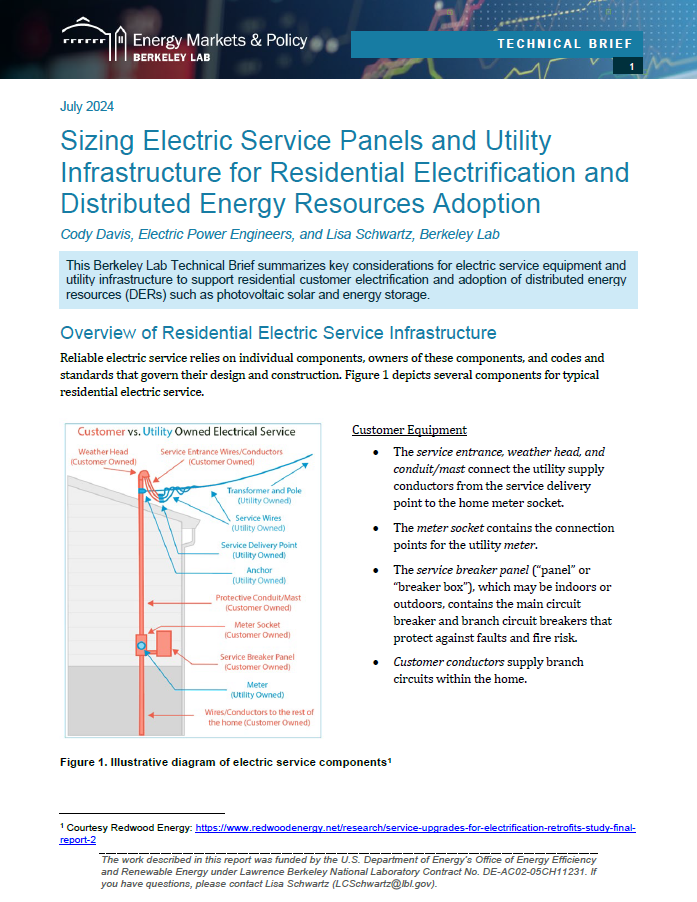
Publication Type: Policy Brief, Date Published 07/2024, Authors Davis, Cody, Lisa C. Schwartz
Abstract: This Berkeley Lab Technical Brief summarizes key considerations for electric service equipment and utility infrastructure to support residential customer electrification and adoption of distributed energy resources such as photovoltaic solar and energy storage.
Organization, Energy Markets and Policy Department, Energy Analysis and Environmental Impacts Division
Research Areas, Integrated Distribution System Planning 2, Efficiency, Electrification, and Flexibility, Integrated Distribution System Planning – Project
Related Files: Brief PDF (704.18 KB)
Courtesy of Department of Energy, Lawrence Berkeley National Laboratory, Energy Technologies Area, Berkeley Lab.
Sign up for CleanTechnica's Weekly Substack for Zach and Scott's in-depth analyses and high level summaries, sign up for our daily newsletter, and follow us on Google News!
Have a tip for CleanTechnica? Want to advertise? Want to suggest a guest for our CleanTech Talk podcast? Contact us here.
Sign up for our daily newsletter for 10–15 new cleantech stories a day. Or sign up for our weekly one on top stories of the week if daily is too frequent.


CleanTechnica uses affiliate links. See our policy here.
CleanTechnica's Comment Policy

