

Fewer Markets Are Importing Russia’s Coal
Support CleanTechnica's work through a Substack subscription, on Patreon, or on Stripe. Help us produce all of the high-quality, original content we publish week after week despite the challenges of content-scraping AI, antisocial media, inflation, and other hurdles.
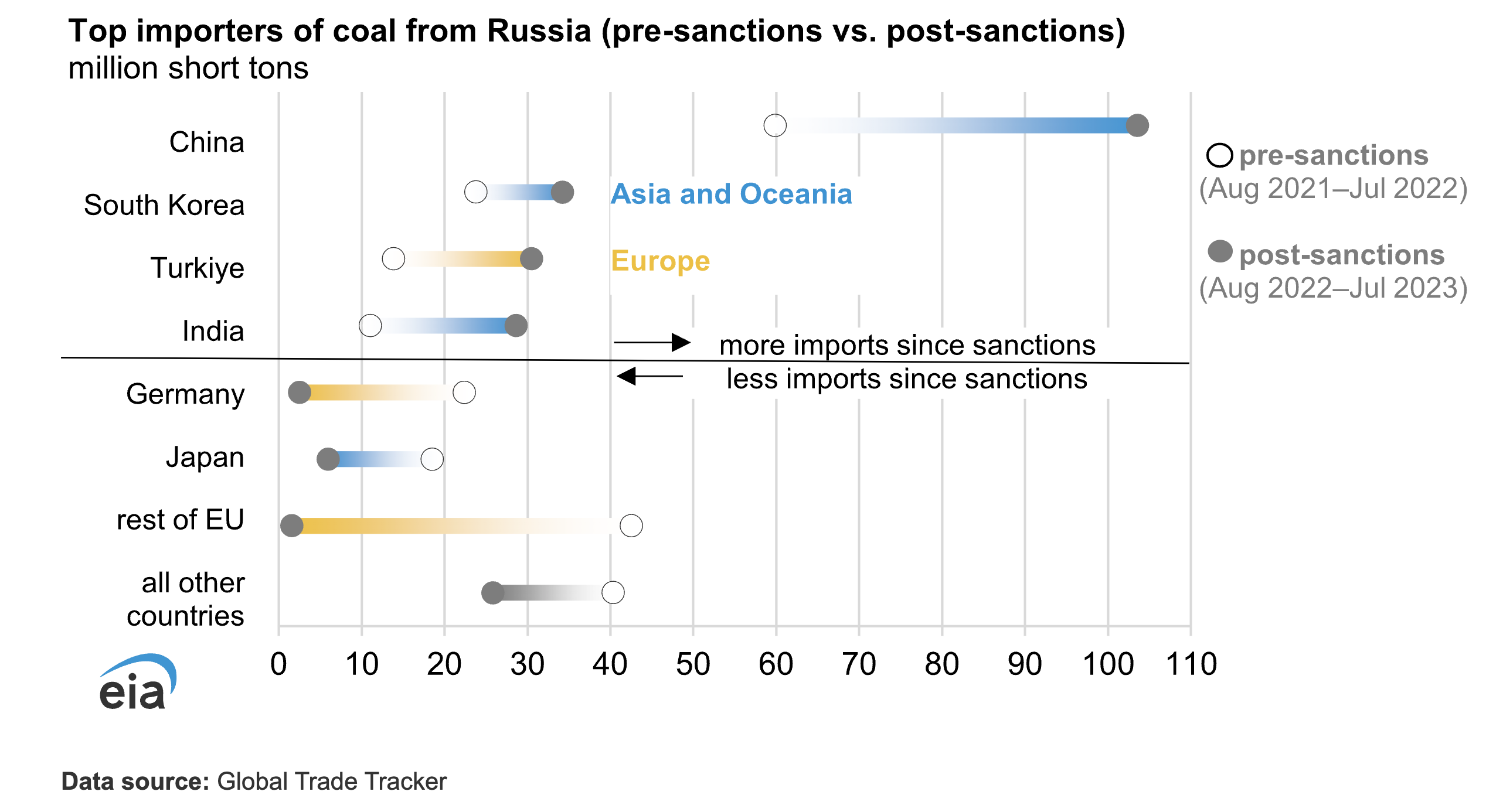
Russia’s reliance on four, mainly Asian, countries to import its coal has increased since some countries implemented sanctions against Russia after it invaded Ukraine, according to Global Trade Tracker data. This trade shift corresponds with increased coal exports from the United States to Europe and EU sanctions that went into full effect in August 2022. The United States, Japan, Australia, and other countries issued sanctions during this same time period after Russia’s full-scale invasion.

China, South Korea, Turkiye, and India are currently the top importers of coal from Russia. These countries received over 80% of Russia’s coal exports from August 2022 to July 2023, compared with 47% from August 2021 to July 2022. Coal imported by European countries from Russia decreased 57% between these two periods. Imports into Eurasia, which includes Ukraine, stopped almost entirely. Imports received by all regions other than Asia declined, while global coal imports from Russia remained relatively flat, at nearly 233 million short tons (MMst).
China and South Korea are historically the top two importers of coal from Russia. China imported 104 MMst from August 2022 to July 2023, a 73% increase from the preceding 12 months, and South Korea imported 34 MMst, a 44% increase. Prior to sanctions, Germany, an EU member, and Japan were the third- and fourth-largest importers of coal from Russia. Both countries banned imports from Russia in 2022. In their place, Turkiye increased its imports of Russia’s coal by 120% to 30 MMst, and India increased imports by 159% to 29 MMst over the same period.
All four of these primary importers—China, South Korea, Turkiye, and India—continued to collectively receive over 80% of Russia’s coal exports each month after August 2023. Limited eastbound rail infrastructure from the Kuzbass region in Western Siberia, where coal production is centered, leads to congestion, delays, and longer turnaround times. Russia’s largest coal transshipment port, Vostochny, is located on the Pacific coast and maintains a competitive advantage for exporting to North Asia and China, but increased exports have caused railway and seaport bottlenecks. As a result, India has sought out northern shipping routes from Russia, and more broadly, total seaborne shipments of coal increased nearly 18% year over year in the first part of 2023.
Principal contributor: Gavin Clark
Courtesy of U.S. EIA.
Sign up for CleanTechnica's Weekly Substack for Zach and Scott's in-depth analyses and high level summaries, sign up for our daily newsletter, and follow us on Google News!
Have a tip for CleanTechnica? Want to advertise? Want to suggest a guest for our CleanTech Talk podcast? Contact us here.
Sign up for our daily newsletter for 10–15 new cleantech stories a day. Or sign up for our weekly one on top stories of the week if daily is too frequent.


CleanTechnica uses affiliate links. See our policy here.
CleanTechnica's Comment Policy

