
Turning Any Level 2 Charging Station Into a Fast Charger, For Cheap
Support CleanTechnica's work through a Substack subscription, on Patreon, or on Stripe. Help us produce all of the high-quality, original content we publish week after week despite the challenges of content-scraping AI, antisocial media, inflation, and other hurdles.
There’s one big thing that can suck about driving an EV: going places where there’s a lack of infrastructure. In many rural areas, there are just no public chargers. So, you’re basically stuck plugging in at a hotel room or AirBnB, or you’re going to need to head into an RV park to get Level 2 speeds (BYOC – Bring Your Own Charger – applies). Worse, when the best speeds available are Level 2, you’re stuck with needing hours to get to the next stop, or overnight charging.
But, what if there were a way to quickly turn any Level 2 charger or RV park plug into a rapid charging station? I’m not talking about doing an upgrade of the site, carrying weird electronics along to tap several stations, or anything like that. I’m talking about taking advantage of the station as-is and charging an EV up in under an hour.
Well, there is one catch: you’ll need to be driving on two wheels! (article continues after video).
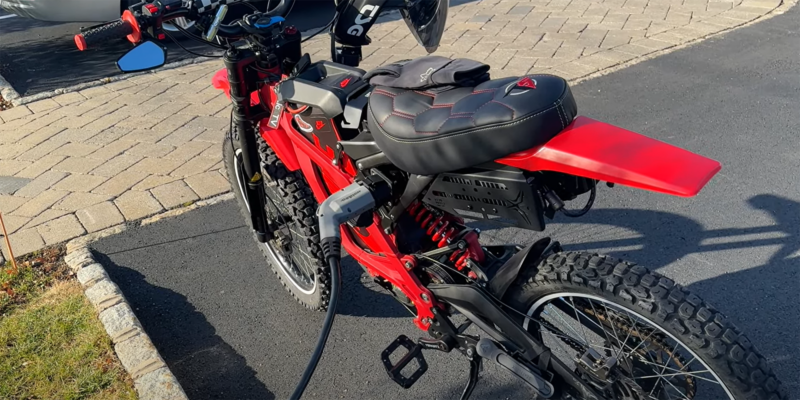
In the video, we see a Sur Ron fast e-bike with a special modification: the ability to pull power from a J1772 EV charging station. Because it needs so little power to begin with, and people usually charge them on 110v plugs at home in hours, pulling 220v and higher amps means it’s possible to charge the e-bike quickly. In fact, it’s possible to get enough range to move on in well under an hour.
To get this done, the first step is to get an adapter to pull power from the J1772 station. Those are available on Amazon here. This part tells the charging station to release power into the plug. It looks like a 120v plug, but you have to read the fine print, because it really puts out 208-240 volts. So, you can’t use it for most power electronics unless they can be switched to use 240 volts.
The other problem is that fast e-bikes don’t have an onboard charger like an electric car. So, you have to pick up a high-amp 240-volt charger to carry along or mount somewhere on the bike. These chargers can pull power from the adapter and put it into the bike’s battery pack.
The fastest onboard charger I could find was this one from Sur Ron Shop. Instead of pulling just 10 amps, it can pull around 9 amps at 240 volts, and output 20 amps at the battery pack’s charging voltage. This means charging at around 1300 watts, which is a lot more than you’d get with the stock charger at home. This means charging from 0-90% in 90 minutes, but if you only need a partial charge away from home, you can do that in less than an hour.
With around a 75-mile range (depending on the model), adding even half of a battery means adding almost 40 miles of range. For a vehicle like an e-bike, that’s probably more than you’d ever need for normal riding. Even bike tourers probably wouldn’t want to take the bike more than 100-150 miles in a day, so this is enough to make it possible to do that with only a lunch-time charging stop.
Featured Image: a screenshot from the video above.
Sign up for CleanTechnica's Weekly Substack for Zach and Scott's in-depth analyses and high level summaries, sign up for our daily newsletter, and follow us on Google News!
Have a tip for CleanTechnica? Want to advertise? Want to suggest a guest for our CleanTech Talk podcast? Contact us here.
Sign up for our daily newsletter for 10–15 new cleantech stories a day. Or sign up for our weekly one on top stories of the week if daily is too frequent.


CleanTechnica uses affiliate links. See our policy here.
CleanTechnica's Comment Policy

