
Indigenous Communities Protect the Amazon
Support CleanTechnica's work through a Substack subscription, on Patreon, or on Stripe. Help us produce all of the high-quality, original content we publish week after week despite the challenges of content-scraping AI, antisocial media, inflation, and other hurdles.


About 1.5 million Indigenous people reside in the forests of the Amazon in South America. Although deforestation and fires have eaten into this iconic forest in recent decades, Indigenous communities are helping protect some of its most intact parts.
Standing, healthy forests breathe in carbon dioxide and store it in their trunks, limbs and roots. But if trees decompose after being cut or burn during a fire, they return that carbon to the atmosphere. Although the Amazon is still a net carbon sink — capturing 100 million metric tons more carbon dioxide per year than it emits — it is on the brink of becoming a net carbon source. Over the past 50 years, an estimated 17 percent of the Amazon’s forests have been lost.
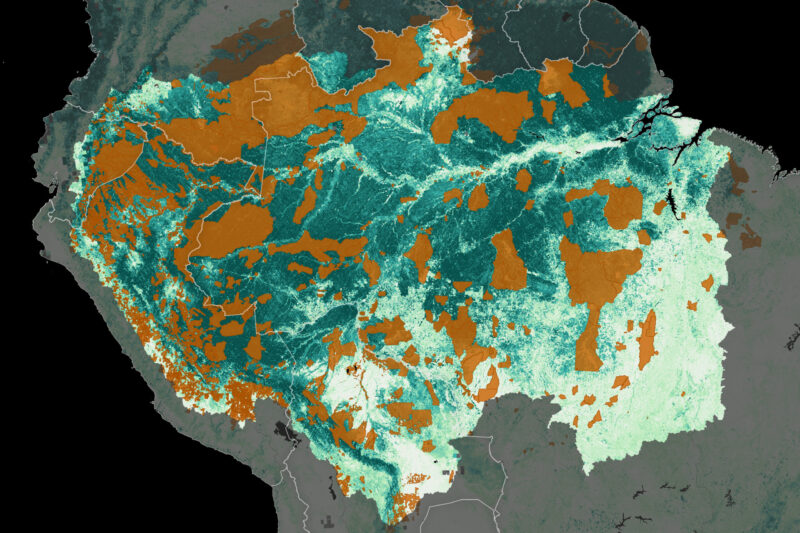
The map above shows Indigenous-managed territories in the Amazon River basin, which includes portions of Bolivia, Brazil, Colombia, Ecuador, French Guiana, Guyana, Peru, Suriname, and Venezuela. About 385 Indigenous groups reside on about 2.4 million square kilometers of Amazonia. A growing body of research indicates that these groups are defenders against deforestation, protecting some of the most carbon-rich parts of the Amazon.
“Indigenous communities are unsung heroes of conservation, and many actively monitor their forests,” said Peter Veit, who is a senior fellow at World Resources Institute (WRI).
Veit led research published in January 2023, which found that forests managed by Indigenous people and other communities between 2001 and 2021 were carbon sinks, whereas forests not managed by Indigenous people and other communities were on average net carbon sources.
The research built on previous work led by WRI that used data from Landsat satellites and NASA’s ICESat (Ice, Cloud, and land Elevation Satellite) mission to map the carbon taken up or emitted by forests across the world. This work found that globally, forests took up about twice as much carbon as they emitted between 2001 and 2019, but some forests are much greater sinks of carbon than others. For example, forests in the Congo River basin in Central Africa captured 610 million more tons of carbon dioxide per year than they emitted, which is six times greater than the net carbon sink of forests in the Amazon River basin.

In Brazil, forests outside of community protection are being lost to commercial farming and cattle ranching, extractive industries, infrastructure and other developments. The map above shows biomass data from NASA’s GEDI (Global Ecosystem Dynamics Investigation) mission in the Brazilian state of Rondônia, one of the most deforested parts of the Amazon. In the western part of the state, the territory of the Uru-Eu-Wau-Wau Indigenous community stands out as an area where dense biomass remains.
Further deforestation threatens to turn the Amazon from a net carbon sink to a source. WRI is working with Indigenous communities to help them use Landsat-based Global Forest Watch data to monitor forests and alert them of deforestation. A 2021 analysis found that after 36 Indigenous communities in the Peruvian Amazon used these satellite-based alerts, deforestation rates declined by 52 percent in one year.
NASA Earth Observatory images by Lauren Dauphin, using NASA GEDI data from Dubayah, R.O. et al. (2022), Indigenous Territories and Natural Protected Areas data from the Amazon Geo-Referenced Socio-Environmental Information Network (RAISG), and river basin data from the World Wildlife Fund HydroSHEDS Project.
Story by Emily Cassidy. Originally published on NASA Earth Observatory.
Sign up for CleanTechnica's Weekly Substack for Zach and Scott's in-depth analyses and high level summaries, sign up for our daily newsletter, and follow us on Google News!
Have a tip for CleanTechnica? Want to advertise? Want to suggest a guest for our CleanTech Talk podcast? Contact us here.
Sign up for our daily newsletter for 10–15 new cleantech stories a day. Or sign up for our weekly one on top stories of the week if daily is too frequent.


CleanTechnica uses affiliate links. See our policy here.
CleanTechnica's Comment Policy

