
Vast Differences In Fuel Economy Possible For Vehicles In Same Class
Support CleanTechnica's work through a Substack subscription, on Patreon, or on Stripe. Help us produce all of the high-quality, original content we publish week after week despite the challenges of content-scraping AI, antisocial media, inflation, and other hurdles.

The U.S. Environmental Protection Agency (EPA) has published a chart showing the minimum and maximum combined city/highway fuel economy ratings for each vehicle size class in the country. What’s interesting is that there are vast differences possible in terms of fuel economy even within the same vehicle class, and that’s most true in 6 of the most common vehicle classes — subcompact cars, midsize cars, large cars, station wagons, small SUVs, and standard SUVs.
“Their data shows that, in most cases, there is a wide range of fuel economies for consumers to consider when purchasing a new vehicle,” the U.S. Department of Energy notes. “For model year 2020, the midsize car class had the widest range in fuel economy, spanning from 12 to 141 MPG/MPGe*.”
As the Department of Energy notes, and all CleanTechnica readers should know well, a key point is that the high fuel economy ratings are for fully electric vehicles. Electric powertrains are 3–4 times more efficient than gasoline powertrains. “The vehicle classes that have maximum fuel economy ratings topping one hundred MPG reflect the inclusion of all-electric models. These models have much higher efficiency than conventional vehicles. The median fuel economy of all vehicle classes falls into a much narrower band ranging from 19 to 28 MPG/MPGe*.” In other words, it’s just the availability of electric vehicles that creates such high fuel economy ratings, and that’s why some classes have much narrower bands — there are not electric vehicles available in those classes.
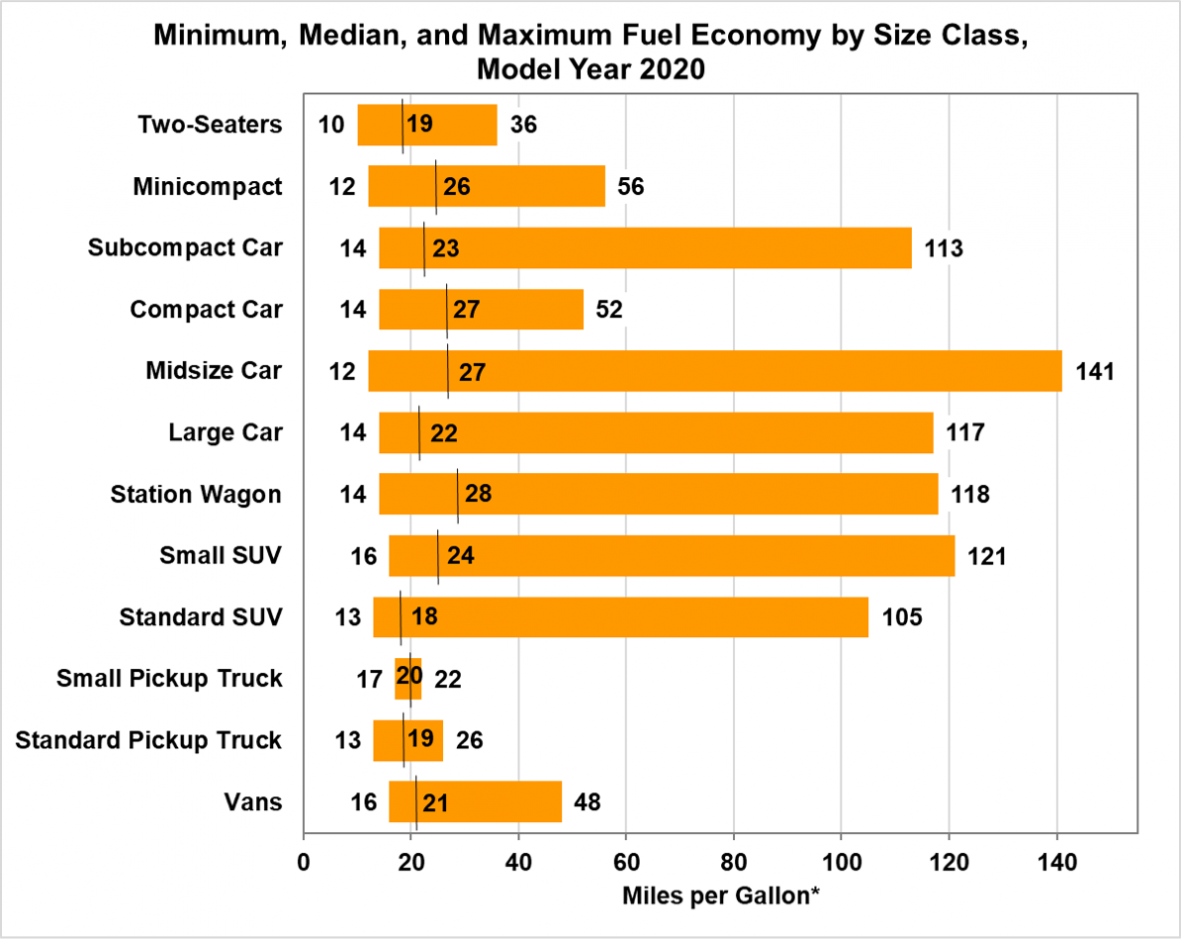
Of course, electric vehicles don’t use any gasoline, so the shared ratings are enabled by creating a faux fuel economy for electric vehicles. “Plug-in electric vehicles are measured in miles per gallon equivalent or MPGe where 1 gallon of gasoline is equal to the energy in 33.7 kW-hrs of electricity,” the Department of Energy writes.
In essence, this is why electric vehicles are considered clean tech, and why we write about them so much here on CleanTechnica. There is a dramatic, vast difference in fuel economy, pollution, and societal harm between gasoline-powered or diesel-powered cars and electric cars.

Sign up for CleanTechnica's Weekly Substack for Zach and Scott's in-depth analyses and high level summaries, sign up for our daily newsletter, and follow us on Google News!
Have a tip for CleanTechnica? Want to advertise? Want to suggest a guest for our CleanTech Talk podcast? Contact us here.
Sign up for our daily newsletter for 15 new cleantech stories a day. Or sign up for our weekly one on top stories of the week if daily is too frequent.


CleanTechnica uses affiliate links. See our policy here.
CleanTechnica's Comment Policy

