Buildings

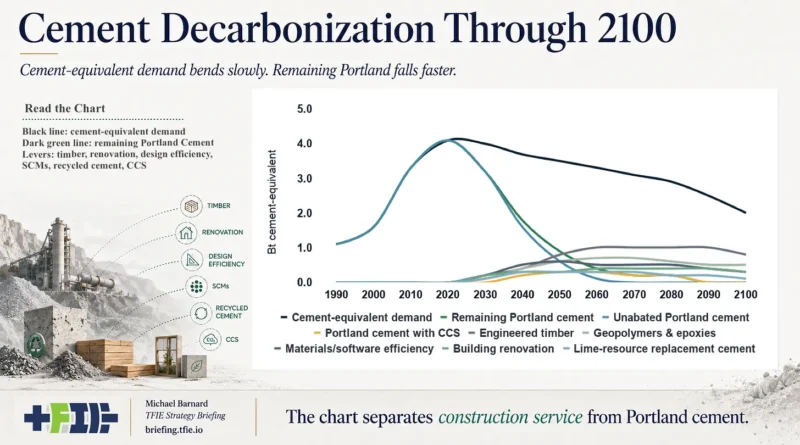
Cement’s Future Is Less Portland, Not One Magic Cement

Cement decarbonization attracts miracle stories. One company has a new binder. Another has a carbon-negative aggregate. Someone else has an electrochemical process, a hydrogen kiln, a low-carbon limestone route, a supplementary cementitious material, a recycled cement process or a carbon-capture retrofit. Some of these ideas are useful. Some will become … [continued]

China’s First Build Is Ending, And The World Won’t Repeat It

One of the easiest ways to get long-range energy and materials demand wrong is to treat first-build infrastructure demand as a permanent condition. Countries build their first stock of housing, highways, ports, rail, power systems, water systems, industrial parks, and concrete-and-steel cities once. After that, the demand structure changes. The … [continued]

California Pivots: Cutting CEQA Red Tape To Boost Housing & Climate Goals

In rare good news out of the United States, California’s just passed reform of the California Environmental Quality Act (CEQA) has opened the door for a wave of infill housing development, marking a significant shift in the state’s longstanding approach to urban growth. Signed into law a week ago, the … [continued]

Insurance Industry Predicts More Future Losses — Now Tariffs Add To The Impact Of Climate…

My condo community in Florida has been struggling with our insurance premiums. While our east coast location hasn’t put us in the path of any significant damage nor submitted climate claims since Hurricanes Jeanne and Francis in 2005, we have — like so many places across the US — been … [continued]

Cement’s CO2 Emissions Are Solved Technically, But Not Economically

Cement is the gray glue that binds our cities and industries together. It makes tall buildings possible and foundations strong. It helps us bridge rivers and valleys and keeps wind turbines upright. We don’t have a replacement for it. It’s not going anywhere.