Batteries

Heart Aerospace Just Flew The Aviation Transition Investors Should Be Putting Billions Into

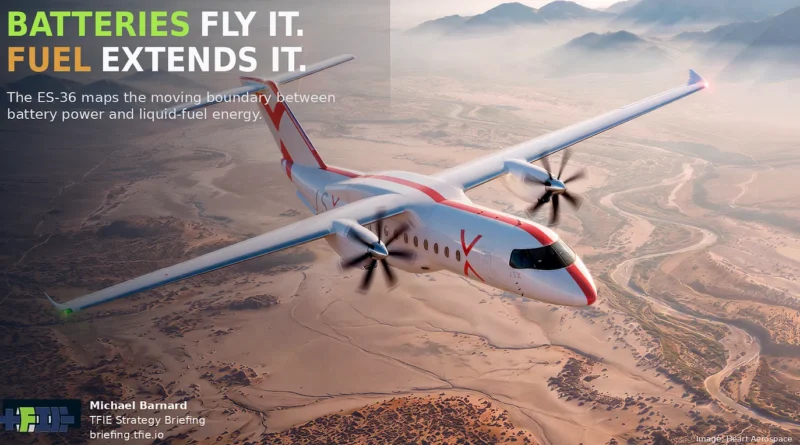
Heart Aerospace’s X1 demonstrator flew for 27 minutes on August 12 from Plattsburgh International Airport, powered entirely by batteries. The aircraft has a 106-foot wingspan, weighed more than 25,000 pounds at takeoff and drew more than a megawatt at peak. Heart calls it the largest battery-electric aircraft ever flown. The … [continued]

Power Systems Have More Flexibility Plans Than Flexible Grids

Grid flexibility is easy to mistake for a technology market. One jurisdiction announces several gigawatt-hours of batteries, another creates a new ancillary-service product, and a third launches a capacity auction, pumped-hydro program or demand-response target. Those are meaningful signs of activity, but they do not answer the harder question: can … [continued]

Lower Saxony’s Hydrogen Trains Are Now A Battery Exit Strategy Problem

Lower Saxony’s hydrogen trains will probably not be retired because a politician announces that battery-electric multiple units were the better technology. They will be retired when the bill arrives for extending the life of an underused, specialized hydrogen system and the state has to compare that cost with buying the … [continued]

BC Hydro’s Net Metering Change Points Past Export Credits

BC Hydro’s change to net metering looks, at first glance, like another rooftop solar fight. The old Rate Schedule 1289 is closing to new customers on July 1, 2026, and new self-generation customers will move to Rate Schedule 2289, where excess generation is paid at 10¢/kWh in the billing cycle … [continued]

Fossil Fuels Are 40% Of Freight Shipping Tonnage, But Half Its Fuel Use

Maritime fuel debates usually start with the wrong object. They look at today’s bunker fuel demand, line up replacement molecules, and ask whether ammonia, methanol, hydrogen, LNG, biofuels, or synthetic fuels can scale far enough to replace it. That sounds like a practical question, but it skips the larger one: … [continued]

Aviation Fuel Demand Doesn’t Collapse. Cheap Kerosene Growth Does.

Aviation is one of the harder transition sectors to model well because it invites two bad shortcuts. One is to assume that flying keeps growing as it did in the cheap-kerosene era, with a cleaner molecule somehow dropped into the same demand curve. The other is to assume that decarbonization … [continued]

Utilize Bomb-Grade Plutonium For Energy? Really?

I am one of those people who hates the word “utilize.” The logic of the English language would seem to be that to utilize something is to alter it to give it utility that it didn’t originally have. One example is to punch holes in the bottom of a bucket … [continued]

More On Batteries, Or How To Grow Lemons In Vermont

CleanTechnica has carried reviews on a number of backup battery systems in the last few years, including Anker Solix, Bluetti, and Jackery. Reading the reviews, I got ever more intrigued by what I found. These are not just batteries, but power stations with charge controller and inverter built in. They … [continued]

Renewables as a Bridge to Gas? America’s Energy Logic Goes Backwards

In recent remarks, John Ketchum, CEO of NextEra Energy, laid out a curious and somewhat baffling narrative: renewables should serve as a transition solution toward expanding natural gas generation. Yes, you read that correctly. After decades of framing gas as a so-called “bridge fuel” to a renewable future, the argument … [continued]