Manufacturing

Hydrogen Learning Curves Are Counting The Wrong Doublings

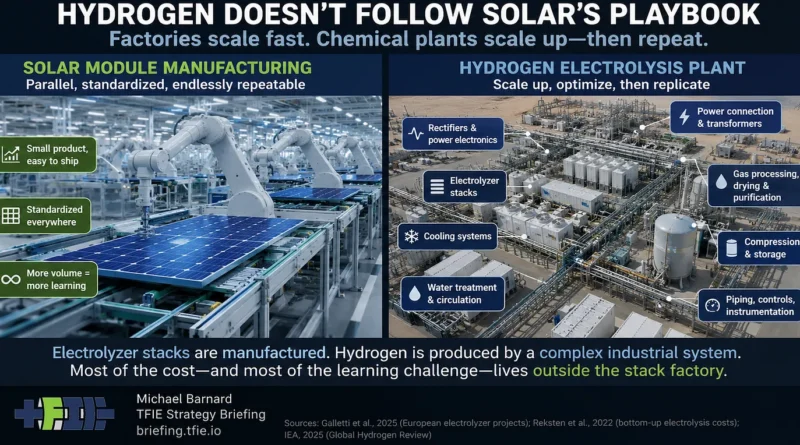
Hydrogen cost forecasts often borrow one of the clean-energy transition’s most useful empirical tools: the experience curve. If a technology has historically fallen by a given percentage in cost every time cumulative deployment doubles, analysts can estimate how many doublings lie ahead and compound the learning rate into a future … [continued]

Steel’s Future Starts With Demand, Scrap, And Electricity, Not Hydrogen

Steel keeps getting framed as a hydrogen problem because hydrogen gives the sector a single shiny lever. Replace coal with hydrogen, keep making new iron, plug it into an electric arc furnace, and declare victory somewhere around the ribbon-cutting ceremony. It is an attractive story for governments, incumbent producers, electrolyzer … [continued]

Cement Is One Of Few Industries Where Carbon Capture May Be Competitive In Niches

As concrete month draws nearer to a close, it’s time to look at an option not previously explored, continuing to use limestone but bolting on carbon capture and paying for waste disposal in permanent sequestration sites. After fifteen years of assessing carbon capture technologies, pilots and proposals, this is one … [continued]

Just When I Thought I Was Done With Cement Replacements, A Look At Geopolymers

One of the many people who have suggested I look at something in the space of cement and concrete decarbonization suggested red mud. All I knew was that it had something to do with aluminum, and hence I thought it would be another metal slag supplement to cement. You know … [continued]