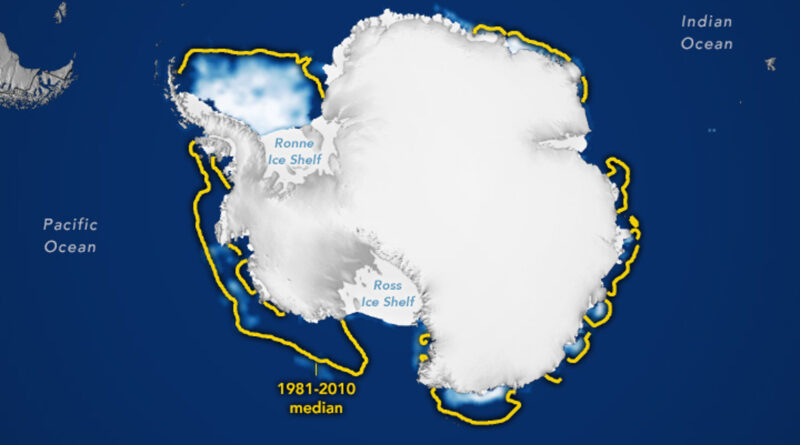
Sea Ice In Antarctica Was Expanding Until 2016. Then Everything Changed.
New data from submerged sensors is providing clues about why sea ice in Antarctica has declined markedly since 2016.

New data from submerged sensors is providing clues about why sea ice in Antarctica has declined markedly since 2016.
Summer can be cruel to the planet’s remaining ice. Over the span of just days in July 2023, seasonal warmth led to the rapid disintegration of sea ice near the junction of two large outlet glaciers in northeast Greenland. The two glaciers—Storstrømmen and L. Bistrup Bræ—are visible in this image … [continued]
The latest research from the South Pole shows a dramatic loss of sea ice around the continent of Antarctica.
As meltwater rushes through the cracks in the Antarctic ice shelves, it can destroy the ice shelves in minutes or hours. This is amplified by the warming atmosphere, and as the warming continues, this phenomenon may happen more often than not.
A new paper has emerged with fresh data from NASA providing a visual of Antarctica’s rapidly melting ice.
2016 is very likely to be the hottest year on record when it’s over, according to a new assessment from the World Meteorological Organization. As it stands, preliminary data are showing that global temperatures in 2016 are roughly 1.2° Celsius above pre-industrial levels — not far below the supposed “safe” limit of 1.5° Celsius above pre-industrial levels.
