
DNV’s 2050 Fuel Forecast Leaves Out Electrification
Support CleanTechnica's work through a Substack subscription, on Patreon, or on Stripe. Help us produce all of the high-quality, original content we publish week after week despite the challenges of content-scraping AI, antisocial media, inflation, and other hurdles.
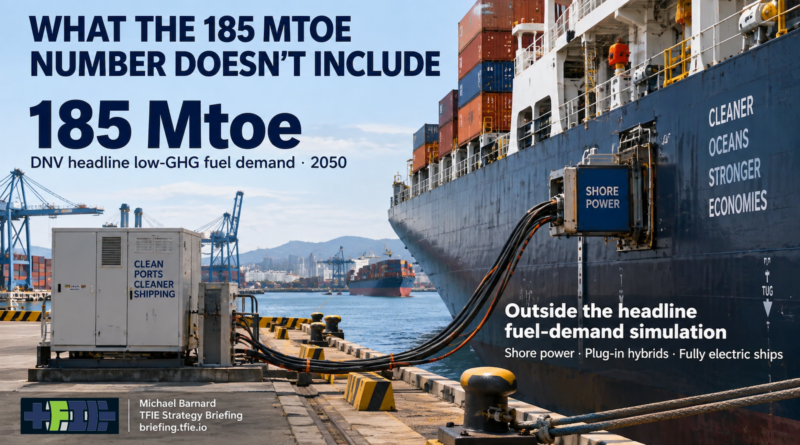
DNV’s new Maritime Forecast to 2050 puts a very large number on shipping’s future demand for low-carbon molecules. In its strongest global-regulation scenario, internationally operating ships above 400 gross tonnes require about 185 million tonnes of oil equivalent of low-GHG fuel in 2050, roughly 7.7 to 7.8 exajoules. That implies an enormous future market for biofuels, synthetic fuels and other replacements for conventional marine fuels.
There is an important boundary around that number. DNV says shore power and plug-in hybridization could further reduce demand for low-GHG fuels, but they are not included as fuel-demand reduction pathways in the simulations producing its headline numbers. Later in the report, DNV again notes that shore power, plug-in hybrids and fully electric ships could make a substantial dent in the 2050 fuel market. The report therefore recognizes an electrification pathway that its main fuel-demand calculation does not allow to compete directly with low-GHG fuel.
The full TFIE Strategy Briefing comparison follows what happens when that boundary is opened up, along with changes in freight demand and efficiency. The result is a different view of how much maritime work ever reaches the market for low-carbon molecules, even though DNV and my own pathway initially appear to land on almost exactly the same 2050 fuel number.
This is not a case of DNV overlooking batteries. The report describes more than 1,500 battery-equipped vessels already operating and another 371 on order. Ferries dominate the installed fleet, which is unsurprising given their short and repetitive routes, but batteries are also appearing in offshore support vessels, tugs, coastal cargo vessels, feeder containerships and some cruise vessels. DNV appropriately distinguishes batteries used to optimize engine operation from plug-in vessels that actually substitute shore electricity for fuel, and it remains cautious about using batteries for the propulsion energy of large deep-sea ships.
The distinction matters because expensive low-GHG fuel can change more than the efficiency with which a vessel burns fuel. It can also change whether buying that fuel remains the economically preferred way to perform a particular part of the vessel’s work. A ship returning to the same terminal several times a day has options that an ocean-crossing bulk carrier does not, while hotel loads, manoeuvring, port operations and short nearshore segments can be electrified without pretending that the entire vessel has suddenly become a battery ship.
DNV already allows fuel prices and emissions constraints to change operational behaviour in important ways. Its scenarios put efficiency near the centre of maritime decarbonization, with energy-efficiency measures and speed reductions cutting fleet energy demand substantially under stronger regulation. DNV’s own summary of the 2026 forecast says stronger global regulatory signals could reduce fleet energy consumption by as much as 25% by 2050.
That is the right analytical direction. Every unit of energy no longer required through better hulls, propellers, operational practices, slower steaming and other efficiency measures is a unit that does not require an expensive replacement fuel. The problem is that the same price signal should also affect the choice between molecules and electrons where direct electricity is technically credible. If a low-GHG liquid becomes much more expensive than conventional marine fuel, the economics of plugging in during port calls or designing more electric vessel architectures improve at the same time.
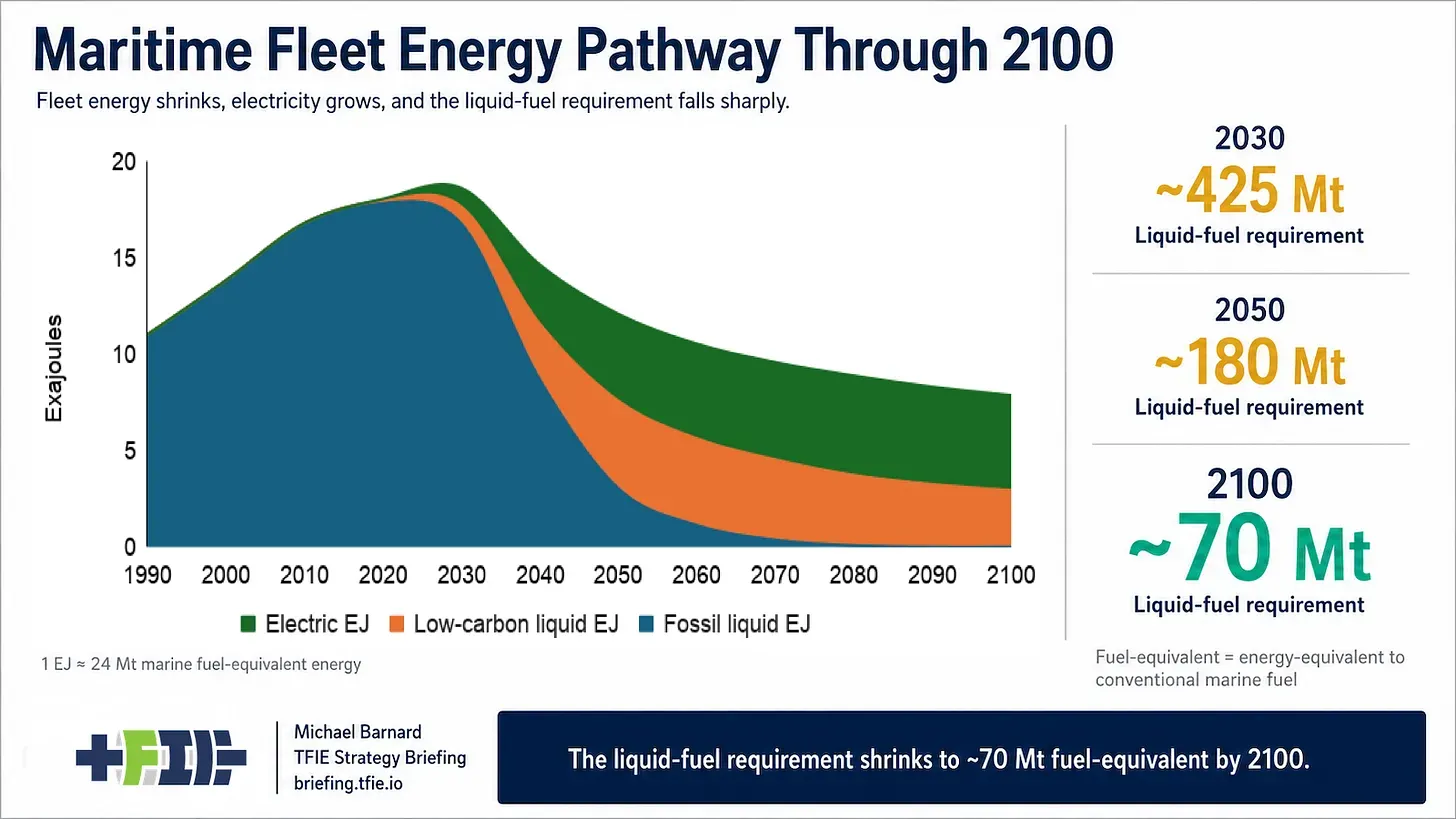
My own maritime pathway makes that substitution explicitly. By coincidence, it leaves about 7.6 EJ of residual liquid energy in 2050, extremely close to DNV’s roughly 7.7–7.8 EJ of low-GHG fuel. That near-match initially looks much more meaningful than it is. My number applies to a broader maritime fleet and is what remains after a substantial modeled electric-energy allocation has already been carved out, whereas DNV’s number applies to a narrower international fleet and comes from a model in which those direct-electric pathways do not reduce the headline fuel requirement.
The two numbers therefore should not be interpreted as independent forecasts converging on the same answer. Their proximity is useful because it draws attention to what happens before the residual fuel number appears. A forecast of future marine-fuel demand necessarily contains assumptions about vessel efficiency, propulsion architecture, route structure, infrastructure and the work ships are being asked to perform, whether those assumptions are visible in the headline figure or not.
There is another denominator that matters just as much: freight. Shipping is often discussed as though the world will continue moving essentially the same commodities over the same distances and the only question is which fuel powers the ships. Some maritime activity is highly durable, but some of today’s shipping task exists because the global economy moves enormous quantities of coal, crude oil, petroleum products and gas from extraction points to consumers. Those cargo flows do not sit outside the energy transition. They are part of it.
DNV does account for changes in seaborne trade rather than simply freezing today’s freight structure forever. The difference is one of degree. My pathway places greater weight on structural reductions in fossil-energy cargoes and other bulk flows exposed to changes elsewhere in the industrial system, while retaining durable container traffic, passenger activity, regional logistics and working-vessel demand. The detailed commodity assumptions matter enormously, but they are better treated as explicit scenario choices than hidden inside a single future-fuel number.
The practical consequence is that the addressable market for low-carbon shipping fuels is not today’s bunker market with a new label. Efficiency acts first. Direct electricity can remove another part where vessel duty cycles suit it. Structural change in freight can remove some of the work itself. Only the remaining maritime energy requirement has to be served by scarce biological carbon, synthetic hydrocarbons, methanol, ammonia or other fuel pathways.
That sequencing changes how fuel-supply projections should be interpreted. A very large residual market makes limited biological feedstocks look hopelessly inadequate and creates a correspondingly large role for electricity-intensive synthetic fuels. A smaller residual market changes that competition substantially. It does not make any particular fuel automatically cheap, sustainable or scalable, but it means future fuels should compete for the maritime work that actually remains rather than for an assumed continuation of today’s bunker demand.
None of this makes DNV’s forecast weak. In fact, the 2026 report is considerably better than maritime-fuel discussions that jump directly from current oil consumption to competing replacement molecules. DNV takes efficiency seriously, recognizes the economic importance of direct electrification where it works, distinguishes different regulatory futures and acknowledges that the eventual fuel market is sensitive to technology, regulation and cost.
The interesting limitation is narrower. The report recognizes shore power, plug-in hybrids and fully electric vessels as potentially material reducers of fuel demand, but they do not feed back into the simulation producing the 185 Mtoe headline result. That means the number should be read as conditional on the modelling boundary rather than as the amount of low-GHG fuel shipping inevitably needs in 2050.
The coincidence with my own 7.6 EJ result made that boundary unusually visible. Once the two pathways are unpacked, the important question stops being whether 7.8 EJ and 7.6 EJ are impressively close. It becomes how much maritime activity, after efficiency, electrification and changing freight demand, still requires molecules at all.
Read the full DNV–TFIE comparison in TFIE Strategy Briefing, including the assumptions that produce the near-identical 2050 numbers and what they imply for the much smaller market that future shipping fuels may actually have to serve.
Sign up for CleanTechnica's Weekly Substack for Zach and Scott's in-depth analyses and high level summaries, sign up for our daily newsletter, and follow us on Google News!
Have a tip for CleanTechnica? Want to advertise? Want to suggest a guest for our CleanTech Talk podcast? Contact us here.
Sign up for our daily newsletter for 10–15 new cleantech stories a day. Or sign up for our weekly one on top stories of the week if daily is too frequent.


CleanTechnica uses affiliate links. See our policy here.
CleanTechnica's Comment Policy

