
Saudia Arabia Launches New Ceer EVs To Compete Against Tesla In It Own Backyard
Support CleanTechnica's work through a Substack subscription, on Patreon, or on Stripe. Help us produce all of the high-quality, original content we publish week after week despite the challenges of content-scraping AI, antisocial media, inflation, and other hurdles.
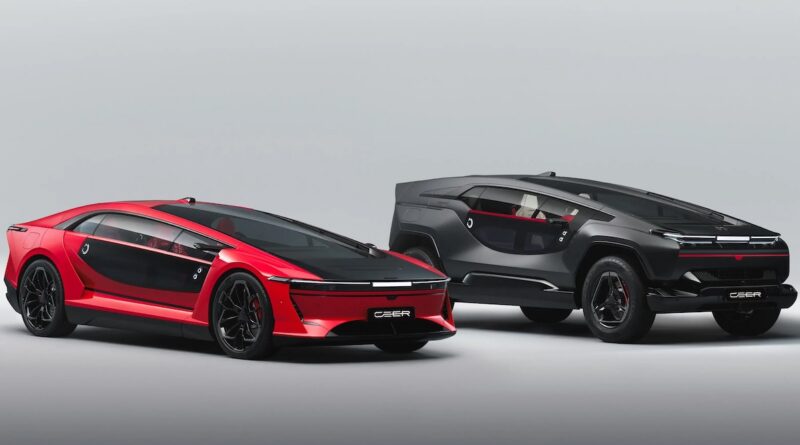
Timing is everything, as the saying goes. Last year Tesla launched itself into Saudi Arabia, banking on the country’s new electrification policy to support EV sales in the oil soaked Kingdom. However, the Saudi-backed US automaker Lucid already staked out a home-town claim on the turf, and now here comes another Saudi venture, Ceer Motors, to heat up the competition. Leveraging licenses from its partner BMW, Ceer has just officially unveiled its new EXOBOT EVs, the first two in a planned rollout of seven new vehicles to be manufactured in Saudi Arabia over the next five years.
New Home Grown Auto Industry For Saudi Arabia
Some in the automotive news media have lauded Ceer for succeeding where Tesla failed, namely, creating a stunning new EV that captures the full futuristic vibe of electric drive, and also does not resemble a conventional sedan or, for that matter, a dumpster.
The looks are besides the point, though. Ceer belongs to a class of automakers taking on the role of “domestic champion” to support a home-grown EV industry on their home turf. Some nations are willing to rely on imports from market leaders Teslas and/or China, but others have identified the vehicle electrification movement as a key economic development platform.
It’s not just about making cars. As a showcase for energy transition technology, EVs pull a hefty tail of workforce training, academic resources, and R&D activities along with them.
With Ceer, Saudi Arabia joins the domestic champion club. The venture launched in 2022 under the umbrella of PIF, the Kingdom’s Public Investment Fund, in a joint venture with the well-known Taiwanese firm Foxconn. The new venture has an eye on the regional export market as well as EV-curious drivers in Saudi Arabia, presumably those with deep pockets.
“Saudi Arabia has laid out a number of targets for its own automotive sector, with a focus on creating a sustainable industrial base that will contribute to the country’s GDP growth, promote the transfer of knowledge to the Kingdom and spur job creation,” Ceer explained in a press statement in 2022.
“Ceer are not just building cars; they are pioneering a movement,” PIF emphasizes. “The mission is clear: to design, build, and offer aspirational battery electric vehicles to the vibrant communities of Saudi Arabia and the GCC.
It Takes A Village
According to PIF, Ceer has the potential to make a direct GDP contribution of $8 billion USD to the Kingdom’s economy by 2034.
Moving things along is the new Ceer Electric Vehicle Manufacturing Complex in King Abdullah Economic City, a sprawling, $5 billion USD campus that began construction in 2024. the complex includes every stage of manufacturing alongside logistics, waste management, warehouses, offices, water treatment facilities, and its own test track.
The partnership with BMW also gives Ceer a running start, and there’s plenty more where that came from. In a press statement announcing the new construction contract, Ceer CEO Jim DeLuca also noted that Dürr, Schuler, Siemens, ABB are also among the firm’s industry partners.
The VinFast Connection
DeLuca was tapped for the CEO position last year, following a 40-year career in the auto industry including senior roles at General Motors and VinFast, where he served as the startup’s first CEO. Apparently Ceer anticipates that DeLuca can do for Ceer what he did for VinFast.
VinFast is the automotive branch of the Vietnamese conglomerate Vingroup. VinFast surfaced on the CleanTechnica radar in 2020, when it announced plans to launch its EVs in the US market. That was quite a switcheroo for VinFast. The startup launched in 2017 and began manufacturing its first vehicles in Vietnam shortly after, with an assist from BMW. Those first vehicles were not EVs. They were ICE vehicles leveraging BMW platforms.
“VinFast is Vietnam’s first domestic mass-production automaker, and it’s no coincidence that Vingroup suddenly decided that the time is right for Vietnam to get its very first domestic automaker in gear right at this particular time,” CleanTechnica reported in 2020. “It’s further proof that gasmobiles are on the way out and electric vehicles are on the way in.”
Here Comes Türkiye
VinFast earned a mention in a New York City Climate Week briefing I attended on September 21, organized by BloombergNEF under the title, “The Global Energy Transition’s Next Act.” BNEF head of Clean Transportation, Colin McKerracher, presented the firm’s EV outlook and used the term “domestic champion” to describe breakthrough automakers like VinFast.
McKerracher also described Türkiye as another example of domestic championship, with the government-supported EV startup Togg tapped to grow the nation’s EV market. Togg officially launched in 2019 with the goal of establishing itself as a “globally competitive mobility technology brand,” including connectivity, energy storage, and EV charging as well as the cars themselves.
Togg plans to introduce five EVs by 2030. Like Ceer, the company positions itself as a national centerpiece of economic development. Togg anticipates that it will add €50 billion to Türkiye’s GDP over the next 15 years while creating 5,000 direct jobs, with thousands more in follow-on positions.
As for the trajectory of EV uptake more generally, McKerracher said he is optimistic about the momentum of the vehicle electrification movement, but with a caveat. “If batteries keep getting better and cheaper, I’m still optimistic,” he said.
And, that brings us to the US, where legacy US automakers pulled back on their electrification plans after the majority of voters in the US decided to give Donald Trump another crack at the Oval Office.
Other automakers have picked up the slack, but the US will continue to lag behind unless something changes. A team of Harvard economists has calculated that EVs would account for about 48% of new car sales in the US by 2030, on a business-as-usual environment consisting of policies in place before Trump took office for the second time last year. After Trump, the 2030 uptake drops to 38%.
Thirty-eight percent still represents a rapid acceleration in just a few years, leading some CleanTechnica readers to wonder if hitting that mark is possible. McKerracher suggested that some familiar-sounding “wild cards” could do the job, here in the US and in other markets. He cited the fuel crisis sparked by Trump’s war in Iran, of course, along with the rising interest in self-driving cars, virtually all of which are electric.
The growing popularity of EREV (extended range EV) technology could also help things along. Unlike conventional plug-in hybrids, EREVs are always powered by their battery. The idea, first pioneered by General Motors in the Chevy Volt, is to run an on-board gas generator to recharge the battery when a charging station is unavailable or inconvenient. While not a full electrification solution, according to McKerracher EREV drivers tend to rely less on the gas option compared to plug-in hybrid drivers.
That makes three wild cards stimulating EV uptake globally. The fourth one is specific to the US. McKerracher pointed out that, earlier this year, Trump suggested that China could build EVs in the US. Trump also brought up the idea again just a few days ago.
“Now, if China wanted to come in, and open a plant to build their cars here, I’d be okay with it,” Trump told Fox News last week.
Well, that’s one way to kickstart the EV sales momentum back into action. Readers, what do you think? What could possibly go wrong?
Photo: The Saudia Arabia automaker Ceer has finally unveiled its much-anticipated flagship EVs, the new EXOBOT sedan and EVs, with five more models planned for production over the next five years (cropped, courtesy of Seer).
Sign up for CleanTechnica's Weekly Substack for Zach and Scott's in-depth analyses and high level summaries, sign up for our daily newsletter, and follow us on Google News!
Have a tip for CleanTechnica? Want to advertise? Want to suggest a guest for our CleanTech Talk podcast? Contact us here.
Sign up for our daily newsletter for 10–15 new cleantech stories a day. Or sign up for our weekly one on top stories of the week if daily is too frequent.


CleanTechnica uses affiliate links. See our policy here.
CleanTechnica's Comment Policy

