
Seriously, Who Is Buying All Those New Subaru EVs?
Support CleanTechnica's work through a Substack subscription, on Patreon, or on Stripe. Help us produce all of the high-quality, original content we publish week after week despite the challenges of content-scraping AI, antisocial media, inflation, and other hurdles.
No, really. Who is buying Subaru EVs? CleanTechnica asked that question back in May, when Subaru reported that its EV sales have gone up — not down, as one may expect in the US. More recently, word slipped last week that Subaru has delayed the launch of its biggest EV yet to hit the US market, the 2027 Getaway 3-row SUV. Is the bloom already off the rose?
Who Is Buying Subaru EVs?
If you bought a Subaru EV this year, drop a note in the discussion thread and share why. Meanwhile, last spring Subaru expressed happiness with the results of its small but growing EV sales record in the US, though the picture has shifted since then.
In May, Subaru reported that sales of its revamped Solterra EV totaled 1,128 units in April 2026, an 18.9% increase over the same month last year. The number is minuscule compared to industry leader Tesla. However, the year-over-year increase is significant considering that the all-important $7,500 federal EV tax credit was eliminated last year by US President Donald Trump and his Republican alliance in Congress.
Subaru also noted that its newly delivered Trailseeker and Uncharted EVs accounted for a total of 928 units sold in April, a small but not insignificant turnout for a new EV in the US market.
In June, Subaru ran the numbers for its May results. Total sales for all vehicles, gas and electric, were up 10.4% compared to May of 2025, but Solterra cratered to just 705 units. Positive reviews for the Trailseeker (like this one) may have steered prospective buyers over to the Trailseeker and Uncharted, which helped make up the difference with 1,074 and 1,270 units, respectively.
While Solterra’s performance was disappointing, the three EVs combined delivered an increase in EV sales for the period January-May 2026 over the previous year. The total topped 8,000 units this year, compared to 5,326 for the Solterra alone last year. However, the June figures raised additional concerns. On July 1, Subaru reported that Solterra nosedived to just 218 units, while Trailseeker fell to 953 units and Uncharted came in at 699.
Whatever Happened To The Getaway EV?
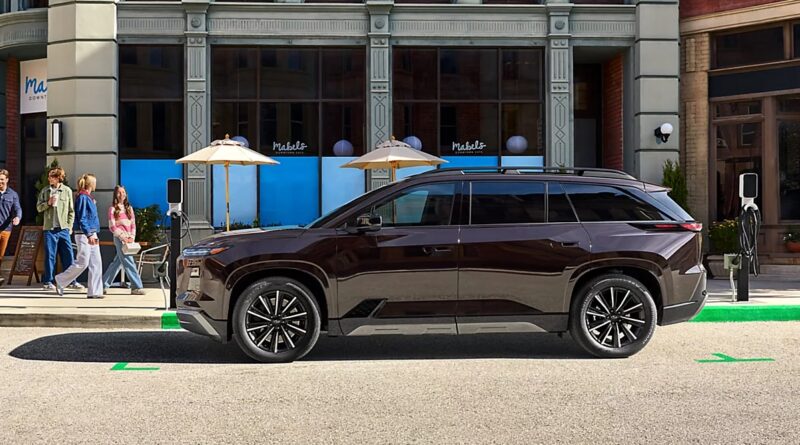
If Subaru is banking on the forthcoming 3-row Getaway SUV to firm up its EV sales in the US, that plan is in limbo for now. Last week the company, which piggybacks on Toyota for its US manufacturing operations, let word slip of a hitch in the plans.
Carscoops has the scoop, reporting that Subaru confirmed the Getaway delay without providing a new timeline for the launch. Further detail is slim, though Carscoops surmises that the move likely stems from a production-related adjustment to Toyota’s plans for the Highlander EV at its factory in Kentucky.
Delay aside, the Highlander connection should be good news for Subaru. When Toyota introduced the all-electric Highlander in February, the news was met enthusiastically by the automotive press. Subaru apparently expects some of that to ripple onto the Getaway.
The Highlander announcement also coincided with a newly launched home EV charging partnership between Toyota and the US startup Treehouse. No word yet on whether or not Subaru is planning a similar venture, though Toyota’s Lexus branch is already on board.
Wouldn’t You Really Rather Not Fund Fascism?
Like other stakeholders in the US market, Subaru is facing an uphill battle even as EV uptake continues to grow in other parts of the world. It’s a wonder that global automakers continue to invest in electrification here, when plenty of low-hanging fruit is available elsewhere.
Still, Trump has not stopped the electrification trend, let alone reversed it. EVs continue to sell in the US, just not as rapidly as advocates have anticipated. Notably, the range of consumer choice in the EV space has increased exponentially since 2019, when Tesla held 80% of the all-electric EV market.
Tesla’s share shrank to 43% during the first quarter of 2025, year, consistent with a consumer study that revealed a loss of faith in the Tesla brand alongside increased competition from other automakers. Last year also saw the evaporation of the federal tax credit colliding with Tesla CEO Elon Musk’s increasingly public affinity for right-wing politics and his role as leader of the White House “DOGE” office.
This year, Tesla again rose a hair above 50% in the US market, though the shift is attributed to pullbacks by other EV makers rather than a new growth spurt on the part of Tesla. That tracks with Musk’s doubling-down on his support for fascist-adjacent groups, wamplified considerably by his social media platform X (formerly Twitter).
Still, plenty of drivers continue to hold the candle for the Tesla brand, and the company continues to dominate as the single largest seller of EVs in the US by a wide margin. What could possibly change their minds at this point. Who knows! Tesla investors are certainly beginning to have second thoughts. Though it could be just a temporary blip, investors reacted to last week’s Q2 presentation by Elon Musk with a vigorous thumbs-down.
The Future Is…Interesting!
Not helping matters much is Musk’s futuristic posturing, which is also beginning to wear thin. In a new long form interview with The Economist, Musk ventured far from the world of EV sales and into, well, something else. The Economist somehow managed to wrangle Musk’s argle-bargle into some form of order, describing it as a twin paradox.
“The first paradox is that one of the world’s most power-hungry tycoons is enthusiastically helping create a technology that he says will render him—and all other human beings—powerless after as little as five years,” The Economist observed.
“The second is that the world’s richest man says he is preparing for a world of infinite abundance, where money, including his $750bn fortune, no longer matters,” the publication continued.
Ya think? Tell that to people here at home, who are struggling to keep their households — and their rights — afloat under the floppy, bloviating weight of President Trump, who sailed into office for the second time with Musk’s enthusiastic support, including a healthy dose of financial aid.
All this talk of abundance is also so much airborne castle-building to people around the world who had vital support systems snatched out from under their feet when Musk’s DOGE office summarily dis-assembled the US Agency for International Development last year.
USAID clients are not the only ones to suffer. Last week, ABC News reported that globally, 280,000 USAID-funded jobs suddenly evaporated as a result of Musk cuts, to be replaced by sex work in some cases.
As Elon himself would say, let that sink in.
Photo (cropped, courtesy of Subaru): Subaru is among the automakers that continue to hold the EV sales fort in the challenging US market, though production of the company’s much-anticipated Getaway 3-row SUV (pictured above) has been delayed.
Sign up for CleanTechnica's Weekly Substack for Zach and Scott's in-depth analyses and high level summaries, sign up for our daily newsletter, and follow us on Google News!
Have a tip for CleanTechnica? Want to advertise? Want to suggest a guest for our CleanTech Talk podcast? Contact us here.
Sign up for our daily newsletter for 15 new cleantech stories a day. Or sign up for our weekly one on top stories of the week if daily is too frequent.

CleanTechnica uses affiliate links. See our policy here.
CleanTechnica's Comment Policy

