
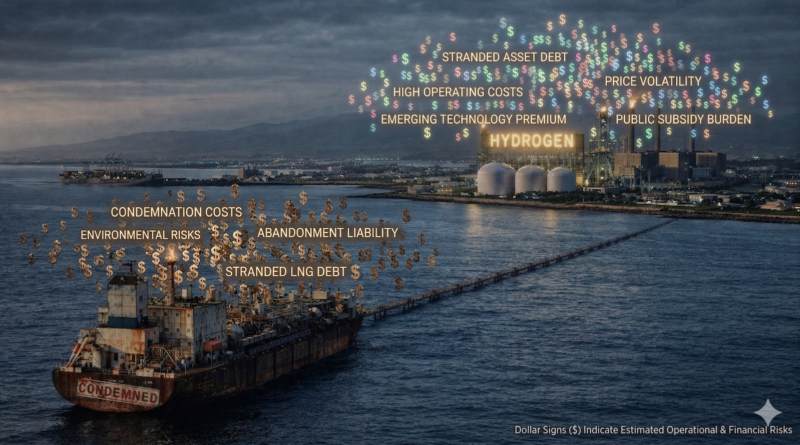
Hawaiʻi’s Latest LNG Plan Rests On Assumptions That Do Not Survive Scrutiny
Support CleanTechnica's work through a Substack subscription or on Stripe.
Hawaiʻi’s debate over importing liquefied natural gas has turned on a state study that was supposed to show whether LNG could lower electricity costs on Oʻahu while serving as a bridge to a cleaner system later. The scenario sold for the past year turned out to be based on a spreadsheet that’s full of errors. The story has moved on and the Hawaiʻi State Energy Office is now supporting a scenario that they had previously rejected, one that doesn’t meet Hawaiʻi’s energy goals. The scenario depends on imported green hydrogen or green ammonia being significantly cheaper than the cost of delivering gray hydrogen or ammonia today, and on infrastructure reuse assumptions that don’t stand up to scrutiny.
In the study, produced for Hawaiʻi State Energy Office with consulting support from HDR and others, the scenario that got the most public attention was Alternative 3A, the admittedly optimistic case. It was the one used to support the headline claim of large customer savings. 3A assumed LNG would displace a wide mix of energy sources, including low sulfur fuel oil, biodiesel, and some utility-scale solar.
It claimed savings on the order of $700 million to $800 million, and it helped support the public case that LNG might reduce costs while improving reliability and buying time for a later transition to hydrogen or ammonia based generation. That claim began to unravel in March when outside reviewers, including local engineering professor emeritus Matthias Fripp, University of Hawaiʻi Economic Research Organization (UHERO), and Hawaiʻi Natural Energy Institute (HNEI), pointed to serious errors and questionable assumptions in the modeling, most notably that it excluded the cost of the imported LNG itself.
HSEO has now admitted that there were indeed significant errors in the scenario cost model, that Alternative 3A was wrong and says it will remove the scenario from the study. However, the office has followed that admission not by reopening the LNG case from first principles, but by leaning harder into Alternative 1A. It is the study’s base pro-LNG bridge case. It assumes LNG is imported to displace oil-fired generation on Oʻahu in the 2030s, that Hawaiʻi still meets its interim renewable targets, and that by 2045 the system transitions to hydrogen for firm generation. The economic upside in 1A comes not only from LNG being cheaper than low sulfur fuel oil (VLSFO), the primary source for all of O’ahu’s energy, for a period, but from the assumption that parts of the LNG buildout can later be reused for green hydrogen or ammonia, avoiding significant future capital costs.
Under those assumptions, HDR says 1A produces a modest positive net present value of about $150 million. Unstated in publicly available documents is the cost of imported green hydrogen or ammonia. If 1A is now the case HSEO wants Hawaiʻi to trust, what exactly does 1A assume, and how much strain do those assumptions bear? The answer is that 1A is not a broad and sturdy savings case. It is a narrow path built on a stack of favorable conditions.
The first layer of the 1A story is the simple one. Alternative 1 is the branch in which LNG acts as a bridge to hydrogen. HDR says that branch still has a positive NPV, ranging from about $150 million to $308 million depending on how much of the renewable portfolio standard path is met. Alternative 2, by contrast, is the non-hydrogen future and remains negative, ranging from about negative $206 million to negative $364 million. That split is already telling. The surviving positive scenario is the one that depends on hydrogen later. The non-hydrogen pathway is the one that stays negative. The bridge only works if the destination appears on time and at acceptable cost.
If the argument now rests on 1A, then the hydrogen and ammonia assumptions become central. This is where the case runs into the wall of physical and economic reality. The study’s fallback defense of 1A depends on avoided deferred hydrogen capital costs being real, meaningful, and large enough to preserve a positive NPV. But neither HSEO nor HDR has published a transparent delivered-fuel case for imported hydrogen or green ammonia that makes this end-state look remotely bankable. Instead, the positive result relies on the idea that LNG infrastructure today will make hydrogen tomorrow easier and cheaper. That is not the same thing as showing hydrogen tomorrow will make economic sense. UHERO is right to flag the low hydrogen pricing and post-2045 asymmetry as a major concern.
In my own published work, I have argued that green hydrogen at production in mid-century is more likely to be in the $6 to $8/kg range than in the lowball numbers used in advocacy pieces, and that delivered hydrogen is worse once storage, shipping, import handling, and margins are included. A combined cycle plant at 55% efficiency turns one kilogram into about 18.3 kWh of electricity. That means each $1/kg of hydrogen becomes about $54.6/MWh of electricity in fuel cost alone. At $6/kg, that is about $328/MWh. At $8/kg, it is about $437/MWh. At $10/kg, it is about $546/MWh. Those are fuel costs alone before plant capital, fixed O&M, storage on island, boil-off management, and risk margins. There is no way to put those numbers next to a serious least-cost future for Oʻahu and pretend they are a minor detail.
Liquid hydrogen does not save the picture. Once the full value chain is included, including production, liquefaction, shipping, import handling, storage, and profit, the delivered price needed to make the 1A hydrogen story work is far below what the outside literature and my own work suggest is plausible. A generous threshold for LH2 to be relevant to a future firm-power story is roughly $2 to $2.5/kg delivered all-in. Above that, the fuel-only cost of power starts running above roughly $110/MWh to $140/MWh before any plant or storage costs. Yet full-chain analyses of international LH2 transport typically land far higher than that. Even before generous margins, they tend to come in around the mid single digits to high single digits per kilogram. Once profit layers and commercial risk are added, the gap gets worse.
In plain language, 1A needs shipped liquid green hydrogen that is below the cost of manufacturing green hydrogen anywhere in the world. Just the cost of liquefaction and shipping is well above the range of costs necessary for hydrogen generation to make sense economically for Hawaiʻi.
Green ammonia as an energy carrier is not the rescue either. In my prior work I estimated that direct ammonia combustion for power at about $1,000/ton delivered implies electricity around $900/MWh, while cracking ammonia back to hydrogen and running it through a fuel cell lands around $420/MWh before allowing for realistic commercial margins and system friction. Scale those back to ask what delivered ammonia price would be needed to support something like the narrow upside HSEO is trying to preserve in 1A, and the answer is punishing. Direct combustion would need green ammonia around roughly $110 to $170/ton to get into a range that even starts to look plausible. Using ammonia as a hydrogen carrier would need something more like $240 to $360/ton delivered.
In plain language, gray ammonia prices depend heavily on natural gas and ranged from $350 to $550/ton in 2025 before delivery. The price point green ammonia needs to hit as an imported energy carrier to make economic sense for Hawaiʻi is Hawaiʻi is below the cost of ammonia manufactured from natural gas at that plant gate, before the costs of liquefaction and shipping.
Full-stack value-chain estimates for renewable ammonia are much higher once production, transport, storage, terminal handling, and profit are included. The implication is simple. The hydrogen and ammonia end-state that 1A leans on is not just uncertain. It is priced outside a credible range and above the cost of manufacturing them.
If the hydrogen and ammonia fuels themselves are too expensive to make any business case work, it’s perhaps gilding the lily to test the reuse of the LNG infrastructure that 1A also depends upon. That is the half-billion-dollar line item HNEI is skeptical of. The problem is that a rigorous asset-by-asset look at the infrastructure says the reusable share is materially smaller than the model suggests. The offshore LNG-specific assets are the first place to look. The Floating Storage and Regasification Unit (FSRU), buoy, and subsea pipeline are about $412 million of the capex stack. HSEO’s own future concept shows the FSRU no longer in service by 2045 and the subsea line from the FSRU no longer in service. Those assets are not bridging to the future. They are stranded.
The onshore pipelines are the strongest reuse case, but they are a small capital item. In HDR’s capex stack, the onshore connections are only about $34 million. Those pipelines may be partly convertible to hydrogen service, but even there reuse is not one-for-one. Hydrogen service means reviewing metallurgy, welds, seals, compressors, controls, and pressure regime. There is potential value in keeping corridor and pipe steel, but the economic value is far below the kind of sweeping “significant portions” language that makes the bridge sound much stronger than it is. The combined-cycle plants are where most of the remaining reusable value has to sit. But here again, the reuse is partial. Site works, civil works, steam systems, electrical systems, and some balance-of-plant may carry over. Burners, fuel systems, safety systems, controls, and possibly more depending on the equipment will need major modification or replacement for hydrogen service. That is not no reuse. It is partial reuse with large retrofit cost.
Put the stack together and the picture is much less favorable than the 1A framing suggests. The clearly stranded offshore LNG import chain is about one-fifth of the total LNG capex stack. The clearly reusable onshore pipelines are under 2%. Transmission upgrades are likely reusable, but they are general grid value, not a hydrogen bridge feature. Most of the model’s implied bridge value has to come from partial reuse of the combined-cycle plants. A disciplined gross estimate would put reusable capital somewhere in the range of one-third to one-half of the LNG capex stack, not something like the large majority that the rhetoric invites people to imagine. And that is gross reuse, not net savings.
Net savings are the number that matters, and they are smaller. Reuse is not free. Conversion is not free. New liquid hydrogen or ammonia receiving and unloading systems, pipelines and processing facilities still have to be built. Future capital saved in 2040 or 2045 also has to be discounted back to present value. UHERO points out that the workbook uses a nominal discount rate of 9.27%, which already leans against future capital having a large present value. Once those pieces are combined, a gross reusable capital range of perhaps $700 million to $1.2 billion becomes a much smaller present-value savings number. A fair outside estimate is that the actual present-value benefit of reuse is more likely around $100 million to $250 million, maybe $300 million on a generous read, not the roughly $500 million that props up the economics of 1A. That gap matters because 1A only reports about $150 million of possible net present value (NPV) benefit to begin with. Cut the reuse value from $500 million to $200 million and the positive NPV is gone.
Neither the cost of the green imported fuels or the infrastructure reuse economic case stands up to scrutiny. One requires magical thinking and the other is significantly overstated.
There is another weakness in the 1A case. HSEO and HDR defend it partly by saying the study excluded certain benefits, including generation capacity costs for solar or biodiesel plants that would need to be constructed in the absence of LNG, battery storage, reliability benefits, and resilience benefits from transmission upgrades. That defense is understandable, but it also reveals how narrow the frame is. The study compares firm generation alternatives inside a bounded slice of the system. It does not answer the broader least-cost transition question for Oʻahu. UHERO is right to say that the real structural barriers are clean-energy procurement, land use, permitting, interconnection, and export limits on rooftop solar. If the broader system can move faster on those fronts, then the amount of oil remaining to be displaced shrinks, the amount of LNG needed to justify infrastructure shrinks, and the value of the bridge shrinks with it.
This is where the story stops being about a spreadsheet and starts being about governance. HSEO is asking the public and legislators to accept that 1A still provides a positive signal after 3A collapsed. But HNEI says the current study is insufficient to determine whether LNG would provide meaningful savings to ratepayers. UHERO says the scenarios are not a neutral platform for decision-making and that even a corrected fossil-versus-fossil comparison would not settle the policy question. The House Energy Committee now says all reviewers have emphasized that the current study does not provide any reliable basis for decision-making. At some point, continuing to defend the directional conclusion becomes less an act of analysis and more an act of institutional self-preservation.
Quality control was not just the responsibility of HDR. HSEO and its head accepted the results uncritically and promoted the least likely of the scenarios whole heartedly for the past year, clearly without the slightest due diligence. Now they are pivoting to an also unrealistic scenario, once again uncritically.
For Hawaiʻi residents, this should not be framed only as a modeling dispute among experts. It is a pocketbook issue, a prudence issue, and an island self-reliance issue. The state’s strongest LNG case failed because the fuel itself was omitted from the savings logic. The fallback case depends on unusually low assumptions about future hydrogen and ammonia economics that do not survive a full value-chain build-up. It also depends on a reuse story that overstates the fiscal value of what can actually be carried forward. That means Hawaiʻi families are being asked to fund a bridge whose destination fuel is too expensive and whose reusable infrastructure is worth less than advertised.
Hawaiʻi should not be asked to accept another imported-fuel dependency on the promise that it can later morph into a cheap clean-fuel system when the numbers for those fuels do not pencil out. Public agencies should be held to conservative assumptions, clear outside-view testing, and honest accounting of what assets become stranded. On an island grid with high bills and a long history of fuel dependence, the burden of proof should be high. HSEO lost 3A. The problem is that 1A does not stand up to scrutiny either.
Sign up for CleanTechnica's Weekly Substack for Zach and Scott's in-depth analyses and high level summaries, sign up for our daily newsletter, and follow us on Google News!
Have a tip for CleanTechnica? Want to advertise? Want to suggest a guest for our CleanTech Talk podcast? Contact us here.
Sign up for our daily newsletter for 15 new cleantech stories a day. Or sign up for our weekly one on top stories of the week if daily is too frequent.
CleanTechnica uses affiliate links. See our policy here.
CleanTechnica's Comment Policy

