

Why HVDC Export Cables Are An Underappreciated Risk In Offshore Wind
Support CleanTechnica's work through a Substack subscription, on Patreon, or on Stripe. Help us produce all of the high-quality, original content we publish week after week despite the challenges of content-scraping AI, antisocial media, inflation, and other hurdles.
An Irish energy client was speaking with governmental contacts recently, and HVDC risk came up. Not the usual high-level question of whether HVDC is needed for long-distance offshore transmission, because that answer is often yes once projects get large and far enough from shore, but the more awkward question of whether the cable system itself was being treated with enough seriousness.
That stuck with me, because in many offshore wind conversations the turbines dominate the imagination. People worry about nacelles, blades, foundations, auctions, curtailment, and power prices. The export system sits in the background as if it were a commodity attachment. The more I looked at the evidence, the less convincing that framing became. For a modern offshore wind project, especially one leaning on long export corridors and high-capacity links, HVDC cannot be an afterthought and cannot be assumed to be lower risk than the turbines just because the technology is mature. Mature technologies can still sit inside fragile delivery chains, route-specific marine conditions, and outage regimes that produce a nasty downside tail. Ofgem’s 2025 consultation on offshore transmission owners makes clear that these systems are growing in scale and exposure.
There is a technical reason HVDC keeps showing up in offshore wind planning. As projects move farther from shore and capacities climb into the high hundreds of megawatts and into gigawatt territory, HVAC becomes less attractive because charging currents and losses rise with distance. HVDC solves a real electrical problem. It moves large amounts of power over long subsea distances with lower losses and often a better technical fit for the job. But solving one problem does not erase others. A project can have the right transmission technology choice and still understate the delivery and recovery risk of that choice. That distinction matters. Turbines can fail one at a time. Array cables can lose part of a block. A major export cable fault on an HVDC system can remove a very large share of plant output in a single event. Ofgem’s 2025 consultation notes that newer HVDC offshore projects are tending to sit farther from shore, to involve more cable length, and to carry more generation per circuit, all of which can increase fault exposure and lengthen repair times.
That is the first thing developers and policymakers need to hold in their heads at the same time. HVDC subsea cable failures are not frequent in the way transformer nuisances or turbine component issues can be frequent. They are lower-frequency events. But they are also high-consequence events. ENTSO-E and Europacable, drawing on CIGRE HVDC performance surveys and European operating experience, point to subsea HVDC cable fault rates on the order of roughly 0.07 to 0.10 faults per 100 km-years, with average repair times around 60 days. That sounds rare, and in one sense it is. A 100 km route does not imply a fault every year. But the same numbers tell a different story when converted into exposure over the life of a project. A 150 km export route operated for 25 years is 3,750 km-years of exposure. At 0.07 faults per 100 km-years, the expected value is roughly 2.6 faults over the life of the asset. At 0.10, it is 3.75.
Expected value is not destiny, but it is enough to show why investors, insurers, lenders, and system planners should not wave the issue away. Even one 60-day export outage on a 1 GW wind farm operating at a 50% capacity factor implies around 720 GWh of lost generation. At $70 per MWh, that is about $50 million of gross revenue not produced before counting the repair itself, imbalance exposure, or knock-on financing costs.
The offshore wind record suggests that cable systems can underperform generic benchmark assumptions. John Warnock and colleagues, reviewing public-domain data for European offshore wind transmission systems, found that 19 of 50 operating offshore wind transmission connections above 100 kV had experienced failures. Their study estimated a mean failure rate for AC offshore wind connections of 0.00299 failures per km per year, compared with a CIGRE XLPE benchmark of 0.000705. That is more than four times higher.
The study’s conclusion was not that offshore wind is doomed by cable unreliability. It was that many failures appear tied to manufacturing and installation practices, particularly faults that emerge in early years once the cable is energized and put under real operating stress. That is a different kind of risk from a storm throwing a blade or a gearbox wearing out. It is a project execution risk embedded in a capital asset that is hard to inspect directly, expensive to access, and slow to repair.
The downtime numbers in offshore wind reinforce the point. Work cited by ORE Catapult found average downtime of about 38 days for inter-array cable failures and 62 days for export cable failures. Put that into operational terms. A 1 GW wind farm at 50% average output loses about 12 GWh per day when fully disconnected. Over 62 days, that is roughly 744 GWh. If the realized value of electricity and certificates is $60 per MWh, that is about $44.6 million in gross revenue foregone. At $80 per MWh, it is about $59.5 million. If the project is 1.5 GW, the numbers scale up by half again. Those are not exotic assumptions. They are arithmetic. Once that arithmetic is on the table, the comfortable instinct to treat export transmission as an engineering detail starts to look irresponsible.
This is where Bent Flyvbjerg’s work becomes useful. Flyvbjerg’s central insight is that large projects are not usually undermined by a single dramatic technical unknown. They are more often undermined by optimism bias, selective framing, and the human tendency to believe that this project will be better managed, cleaner in execution, and less exposed to friction than the long historical record suggests. His answer is reference class forecasting, usually shortened to RCF. The method is simple in concept and hard in practice. Instead of asking first what the project team believes about its own plan, you ask what happened to comparable projects in the real world. You identify the closest available class of similar projects, look at the distribution of actual outcomes, and place the current project inside that outside view. The point is not to eliminate engineering judgment. The point is to stop engineering judgment from being captured by the inside story the project is telling about itself. The New Zealand Infrastructure Commission’s Oxford Global Projects benchmark and the UK Department for Transport’s optimism bias review both build on that logic.
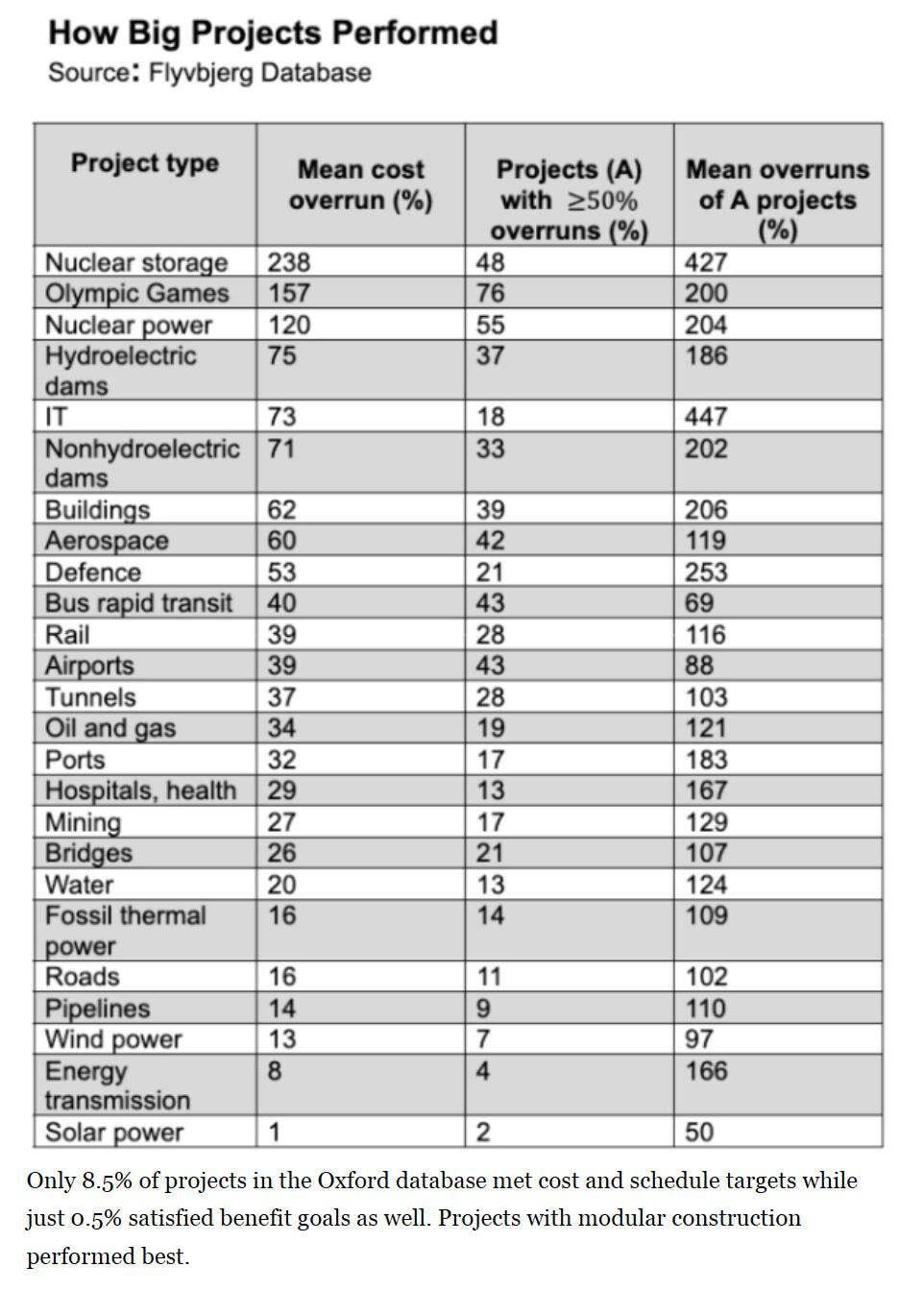
That chart matters because it changes how people think about risk categories. In the public data summarized by Flyvbjerg and his firm Oxford Global Projects, energy transmission appears to perform relatively well on average, with mean cost overrun of 8%, while wind power projects average 12%. Their public P80 uplifts are 15% for electricity transmission lines and 22% for wind farms.
Read too quickly, that can create the wrong impression. A reader can glance at the chart and conclude that transmission is the safe part and wind the riskier part. But the categories are broad. The transmission class does not isolate subsea HVDC export systems. The benchmark notes that it could not distinguish HVAC from HVDC in the transmission reference class. A short onshore line upgrade in a familiar corridor is not the same project as a long subsea HVDC export package tied to a far-offshore wind farm.
The chart is useful precisely because it is an outside view, but it is not granular enough to settle the question by itself. What it really says is that the export system belongs in the transmission family for reference-class purposes, while the overall offshore wind project belongs in the wind family. It does not say the subsea HVDC package is routine.
That is why underwater HVDC cables should be treated as a nested megaproject inside the larger wind farm, not as a line item. If the developer is estimating the whole project, the closest Flyvbjerg category is wind power. If the developer is estimating the export system as a standalone asset, or an OFTO-style transmission package, the closest category is energy transmission.
But in a disciplined risk process, both views should be used together. The whole wind farm should carry the wider wind-project outside view. The export package should carry its own transmission-class outside view, and then a project-specific overlay for subsea route complexity, depth, weather windows, burial challenges, jointing, interfaces, marine spreads, and repair readiness.
The UK Department for Transport review points to offshore wind-specific RCF work by Søndergaard and Koch that is more conservative than the broad category averages. In one case, London Array-like forecasting improved with roughly 15% extra budget and 30% extra schedule. In another narrower UK offshore wind sample, Koch recommended budget uplifts of 35% to 40% and schedule uplifts around 30% to improve the probability of staying within plan. The message is not that every offshore wind project should assume a 40% overrun. It is that broad category averages can understate the tail risk in narrow, cable-heavy offshore wind delivery classes. Note that Flyvbjerg is explicit in his guidance to broaden, not narrow class inclusion in RCF processes, so this requires careful thought.
Why are offshore wind projects seeing more cable issues than generic cable statistics suggest? The answer appears to be mostly boring, which is exactly why it is dangerous. The public literature points first to manufacturing defects and installation damage. Warnock’s review found that only 1 of 44 failures in the sample was directly linked to fishing or anchoring, while many were categorized as internal faults or linked to installation. ORE Catapult and related sector work point in the same direction.
These are not mostly acts of God. They are often acts of project delivery. The route is unique. The seabed is variable. Burial depth is imperfect. Pull-in operations and jointing are unforgiving. Protection systems interact with foundation interfaces. Weather windows narrow. Installation spreads are expensive, so schedule pressure rises. The cable is tested onshore, transported, laid, buried, terminated, energized, and then asked to sit for decades in a harsh environment with limited forgiveness for small defects introduced along the way. Offshore wind has also been scaling quickly. Bigger projects, longer distances from shore, and larger capacity per circuit increase the consequence of each failure and make repair logistics harder. As Ofgem noted in 2025, more cable length means more exposure and longer recovery paths.
This is why the long tail matters more than the mean. If a technology or project package has a modest average cost overrun but a hard-to-control downside case involving months of outage, scarce repair vessels, limited jointer capacity, weather dependency, spare cable constraints, and concentrated loss of generation, then the mean is not the right mental model for risk-bearing institutions. Lenders do not get paid on the mean. Insurers do not price only the mean. Grid planners should not assume security on the mean. A 1 GW project losing 700 GWh to 750 GWh in a major export outage is not just a sponsor problem. In a market leaning heavily on offshore wind, it becomes a system problem. This is particularly relevant for Ireland, Great Britain, the North Sea basin, and other systems that are counting on long-distance offshore generation to meet decarbonization and security goals. If future supply depends on a relatively small number of large export corridors, then HVDC cable reliability and repair preparedness move from EPC detail to energy policy.
Developers can reduce this tail risk, but only by treating it as real early enough. The first step is to separate the risk accounting of the wind farm and the export system. Do not let the apparent maturity of HVDC flatten the contingency. Use the wind-power outside view for the overall project and the transmission outside view for the export package, then test whether the route, length, marine environment, and architecture justify additional uplift.
The second step is to spend more money before first power. Better seabed surveys, better burial design, better interface engineering, more conservative qualification of joints and accessories, and tighter management of manufacturing change are all cheaper than a major export fault after commissioning. ENTSO-E and Europacable stress high-quality marine survey data, project-specific risk assessment, careful burial design, and full qualification of cable systems and accessories. As Flyvbjerg would point out, think slow to act fast.
The third step is to be repair-ready before energization. Their recommendations include maintaining good route and design data, holding strategic spares, arranging access to jointers, tools, and vessels, and not assuming these can be secured quickly once something breaks. If a developer can cut expected outage duration from 60 days to 30 days through preparation, the avoided lost generation on a 1 GW project at 50% capacity factor is about 360 GWh. At $70 per MWh that is about $25 million of preserved revenue before counting the market and financing effects.
There is also a design and portfolio lesson. Where the economics allow, avoid concentrating too much generation behind too few single points of failure. Ofgem noted that HVDC circuits often carry larger blocks of generation than HVAC circuit arrangements, making each outage more consequential. That does not mean avoiding HVDC. It means understanding the concentration penalty that can come with it and making explicit decisions about redundancy, phasing, architecture, strategic spares, and insurance.
It also means collecting and sharing more data. One reason reference class forecasting for subsea HVDC export systems remains blunt is that public outcome data are still thin relative to the importance of the asset class. Better anonymized operating, failure, and repair data would improve both developer decisions and policy design. Flyvbjerg’s framework is valuable here because it reminds everyone that when you lack a perfect reference class, you should become more careful, not less. The absence of a neat public category for subsea HVDC export cables is not proof of low risk. It is evidence that planners need to use multiple outside views and a disciplined inside view at the same time.
The energy transition keeps teaching the same lesson in different forms. Technologies that are mature in physics and engineering can still be fragile in deployment. Offshore wind is not just a turbine story. It is a marine construction story, a transmission story, a logistics story, and a financing story. HVDC is one of the enabling technologies of large-scale offshore wind, and that is exactly why it deserves more attention, not less.
Once you look at the issue through the outside view that Flyvbjerg advocates, the comfortable assumption that cables are the easy part becomes hard to defend. For offshore wind developers, HVDC export systems should be treated as critical risk-bearing infrastructure from the beginning. For governments planning power systems around offshore wind, the same conclusion follows. The cable is not the afterthought. In many projects, it is where the long tail lives.
Sign up for CleanTechnica's Weekly Substack for Zach and Scott's in-depth analyses and high level summaries, sign up for our daily newsletter, and follow us on Google News!
Have a tip for CleanTechnica? Want to advertise? Want to suggest a guest for our CleanTech Talk podcast? Contact us here.
Sign up for our daily newsletter for 15 new cleantech stories a day. Or sign up for our weekly one on top stories of the week if daily is too frequent.


CleanTechnica uses affiliate links. See our policy here.
CleanTechnica's Comment Policy

