
The Real, Live Microbial Fuel Cells Behind Astrophage
Support CleanTechnica's work through a Substack subscription or on Stripe.
Movie-going scientists everywhere are buzzing about Project Hail Mary, the latest Hollywood blockbuster to chronicle one man’s heroic effort to save everyone on Earth from certain doom, with the part of the villain played by the supercharged, planet-hopping bacterium Astrophage. The film opens on March 20, so let’s put this out there for discussion: was Astrophage inspired by real-life microbial fuel cells?
The Science Behind Microbial Fuel Cells
Project Hail Mary is a screen adaptation of the book of the same title by Andy Weir, known for his meticulously researched scientific detail. The hero is Ryland Grace, a middle school science teacher who left his former career as an academic microbiologist, which helps explain why a teacher of children — played by Ryan Gosling — qualifies to embark upon an epic journey to far-off planets in search of a cure for the Earth’s ailing Sun.
Astrophage plays a key role in Project Hail Mary as both the disease and rocket fuel, which is why microbial fuel cells come to mind. Only Mr. Weir knows the answer to that, but in the meantime let’s venture to guess microbial fuel cells are in play. The idea of harnessing the energy of tiny organisms seems futuristic, but microbial fuel cells based on soil-dwelling bacteria were first demonstrated back in 1911, and it’s just one small step from there to space.
Fuel-producing bacteria of one sort or another have also been surfacing on the CleanTechnica radar since 2009, with the US Navy being among those in hot pursuit of the potential for a new bio-based energy resource. One pioneer in the field is microbiologist Derek Lovely, whose team at the University of Massachusetts in Amherst has identified a mud-dwelling, electricity producing (and conducting) microbe called Geobacter.
In 2013, word of an “exoelectrogenic” microbe also sailed onto the pages of CleanTechnica, referring to an organism that reacts with oxide minerals in their environment to produce electricity.
Putting Microbial Fuel Cells To Use
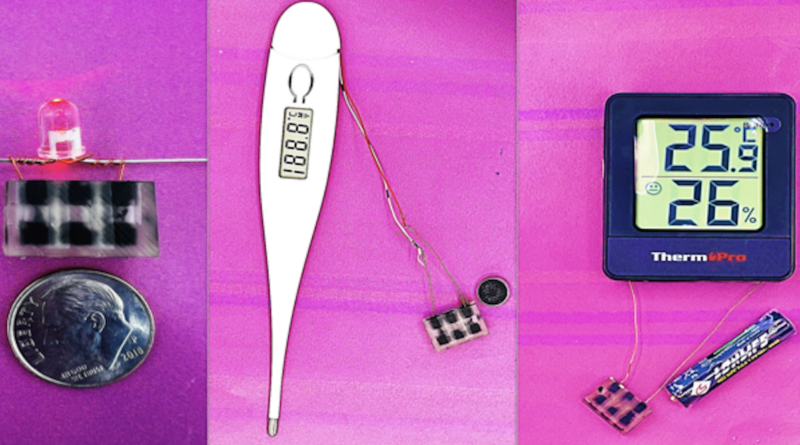
Identifying candidates for microbial fuel cells is a good start, but putting them to use in a useful device is a next-level challenge. One recent breakthrough occurred in April of 2023, when a research team at Binghamton University in New York described a dime-sized biobattery that could still release electricity even after laying dormant for 100 years.
“The overall objective is to develop a microbial fuel cell that can be stored for a relatively long period without degradation of biocatalytic activity and also can be rapidly activated by absorbing moisture from the air,” notes Professor Seokheun “Sean” Choi, who spearheaded the research.
The researchers sealed their bio-cell with high tech tape for the storage part of the demonstration. “When the tape was removed and moisture allowed in, the bacteria mixed with a chemical germinant that encouraged the microbes to produce spores,” the school explains.
The reaction produced enough electricity to power an LED, a digital thermometer, or a small clock. That’s not quite up to the level required by the US Navy, which funded the study through its Office of Naval Research. However, Choi racked it up as a good start on the road to commercial applications.
Don’t get too excited just yet. Next steps for the research team include scaling up to the level of conventional batteries, and shortening the power-up time frame. In the study, the fuel cell initially required an hour to achieve full power after the unmasking. A heat treatment eventually shortened the time to 20 minutes.
Book-Sized Microbial Fuel Cells Are Coming For Your Batteries
More recently, in 2024 researchers based at Northwestern University developed a book-sized microbial fuel cell based on dirt, with the potential for commercial applications while avoiding the supply chain complications typical of conventional batteries.
“About the size of a standard paperback book, the completely soil-powered technology could fuel underground sensors used in precision agriculture and green infrastructure,” Northwestern explains. “This potentially could offer a sustainable, renewable alternative to batteries, which hold toxic, flammable chemicals that leach into the ground, are fraught with conflict-filled supply chains and contribute to the ever-growing problem of electronic waste.”
In field tests, the “dirt battery” was outfitted with a wireless communications system and it successfully powered soil sensors that detect moisture and touch. It continued working regardless of wet or dry soil conditions, and it outperformed similar fuel cells by 120%, as measured by power delivery over time.
The Northwestern team is satisfied that the technology can capture small amounts of energy in soil to run low-power devices, potentially forever or as long as carbon is present in the soil. However, they advise that running larger devices on dirt, let alone whole cities, is not in their sight. Their next project involves building a similar fuel cell using only biodegradable materials.
The researchers also note anyone can build their own microbial fuel cell using off-the-shelf materials found in most hardware stores. Full details are available at the ACM Digital Library under the title, “Soil-Powered Computing: The Engineer’s Guide to Practical Soil Microbial Fuel Cell Design.”
What About Astrophage?
Astrophage lives in outer space, not dirt, but we are getting closer. Turning to sea-dwelling organisms now, the Department of the Navy has been promoting microbial fuel cells all through the 21st century. “These fuel cells convert naturally occurring fuels and oxidants in the marine environment into electricity, offering a clean, efficient and reliable alternative to batteries and other environmentally harmful fuels,” the Navy enthused back in 2010, in celebration of Earth Day.
“The fuel cell can be a viable power source for long-term operation of autonomous underwater unmanned vehicles, in-water sensors, and devices used for surveillance and monitoring the ocean environment,” they noted.
The Navy has also been turning its attention to microbes activated by the Sun. In 2017 the Naval Research Laboratory received a US patent for “a self-assembling, self-repairing, and self-contained microbial photoelectrochemical solar cell driven entirely by sunlight and microorganisms.”
That’s a bit closer to the Astrophage idea. “A solar microbial fuel cell (SMFC) is a non-semiconductor-based system, which employs microorganisms to generate electric power by photosynthetically replenishing reactants of a sealed microbial fuel cell using sunlight,” the Navy explains.
“The SMFC reactants (glucose and oxygen) are internally regenerated by a group of photosynthetic microbes whose reactants, carbon dioxide (CO2) and water (H2O), are the products of the microbial fuel cell,” they add. “This interdependency results in many thousands of hours of long-term electricity generation from sunlight without replenishment of the microbial fuel cell reactants.”
Moviegoers, did you catch that thing in Project Hail Mary about Ryland Grace leaving his former career as an academic scientist because he insisted something-something about water and living things? If you recall what Grace learned about Astrophage, drop a note in the comment thread.
Microbial Fuel Cells In Outer Space
Getting another step closer to Astrophage, we note that NASA provided technical guidance to Project Hail Mary, and the agency has also been investigating the use of microbial fuel cells to power activities in space since the early 2000’s. Back in 2018, for example, the agency recapped fuel cell research taking place at the International Space Station, too, featuring the organism Shewanella oneidensis MR-1.
Shewanella is a focus of attention because it can produce energy in two systems. Oxygen is the primary system, and if the bacterium finds itself in a low-oxygen environment, it can deploy iron, manganese, and other metals in a secondary system.
As for the latest news about real-life applications on Earth, the fast-growing wind, solar, and storage industries among other rising technologies have been sucking up most of the media attention. If you can dig up something on MFCs, drop a note in the discussion thread.
Image: The futuristic Astrophage organisms depicted in the new Hollywood blockbuster film Project Hail Mary share some roots with ongoing microbial fuel cell research at Binghamton State University and other institutions (courtesy of BSU via Eurekalert).
Sign up for CleanTechnica's Weekly Substack for Zach and Scott's in-depth analyses and high level summaries, sign up for our daily newsletter, and follow us on Google News!
Have a tip for CleanTechnica? Want to advertise? Want to suggest a guest for our CleanTech Talk podcast? Contact us here.
Sign up for our daily newsletter for 15 new cleantech stories a day. Or sign up for our weekly one on top stories of the week if daily is too frequent.
CleanTechnica uses affiliate links. See our policy here.
CleanTechnica's Comment Policy

