
TOPCon Solar Cells Are Killing A Key Anti-Solar Talking Point
Support CleanTechnica's work through a Substack subscription, on Patreon, or on Stripe. Help us produce all of the high-quality, original content we publish week after week despite the challenges of content-scraping AI, antisocial media, inflation, and other hurdles.
The bibble-babble of false information about solar power will never stop spewing into the Intertubes from sock puppet anti-solar organizations. However, that’s just background noise for the global solar industry, which continues to plow forward and innovate. As part of that, it is quickly adopting new, tunnel oxide passivated contact (TOPCon) solar cells. TOPCon technology is more efficient at converting light into electricity than the current industry standard. The new technology also reduces the carbon footprint of solar cell manufacturing, busting the anti-solar movement’s favorite “solar pollutes” talking point even wider open than it is now.
Solar Pollutes Less
The anti-solar organization Citizens for Responsible Solar provides a good example of the “solar pollutes” talking point. CRS has loomed large in the US anti-solar disinformation machine since its launch in 2019 by political operative Susan Ralston, known for her tenure at the White House during the George W. Bush presidency.
CRS styles itself as an apolitical, “grassroots group of concerned citizens.” However, multiple news organizations (here’s an example) have drawn attention to the pool of conservative talent populating CRS offices, and alongside the organization’s ability to amplify its easily debunkable talking points among local anti-solar efforts.
On its website, CRS prioritizes five points that everyone “needs to know” about solar, including one titled “Solar Energy is NOT clean or free from CO2 emissions.”
Right you are, Roger Ramjet. “The sun is free, but harnessing the sun’s power into usable energy requires industrial processes to make cement, steel, glass and other components. These processes emit CO2,” CRS elaborates.
Clearly, some key context is missing, but CRS does not provide it, of course. By way of followup, someone needs to leave the CRS website and turn to research-based organizations that are happy to fill in the blanks.
The UK organization Carbon Brief is among the many organizations that have done their homework. Citing lifecycle emissions data from the United Nations, Carbon Brief notes that “a typical ground-mounted solar project produces 19 times fewer emissions than a coal plant and eight times fewer than a gas plant, per unit of electricity generated.”
TOPCon: Even Less Carbon Emissions Than Ever Before
Of course, not Carbon Brief nor any other reliable source of information can shut CRS up. Only money will do that. Still, facts still matter in much of the world, and that’s where there transition to TOPCon technology is making a significant difference.
Specifically, the shift to TOPCon solar cells has the potential to widen the emissions gap between solar power plants and fossil fuels, even more so than previously indicated. The UN report cited by Carbon Brief was posted in 2021 and updated in 2022, when the “typical” ground-mounted solar project did not use TOPCon technology.
The Fraunhofer Institute in Germany introduced TOPCon solar cells back in 2013, but another up-and-coming new architecture was also beginning to emerge around the same time, called PERC for passivated emitter rear cell. With lower production costs providing an edge, PERC beat TOPCon to the punch. As of 2022, TOPCon solar cells only accounted for about 10% of the global market.
Still, by 2022, some analysts were already projecting a TOPCon surge into 2025, leading to 60% share by 2035. More recently, the rapid pace of TOPCon uptake has motivated researchers to take a deep dive into emissions from TOPCon manufacturing. The latest news comes from a research team at the University of Warwick in the UK.
“Using life-cycle assessment modelling, the team found that producing the newer TOPCon panels has lower environmental impacts in fifteen out of sixteen categories as compared to the incumbent PERC technology,” UW summarized. “This includes a 6.5% reduction in climate-changing emissions per unit of electricity capacity, with increased silver consumption being the only downside as it depletes critical minerals.”
The UW team further notes that emissions are even lower when access to low-carbon electricity is stacked on top. Full details are available in the journal Nature under the title, “Maximising environmental savings from silicon photovoltaics manufacturing to 2035.”
“Combining TOPCon adoption, manufacturing improvements, and grid decarbonisation was found to potentially reduce solar manufacturing emissions by up to 8.2 gigatonnes of CO₂ equivalent by 2035 — around 14% of current global annual emissions,” UW explains. “In addition, photovoltaics installed between 2023 and 2035 are projected to avoid more than 25 gigatonnes of carbon emissions by replacing fossil fuel electricity.”
TOPCon Solar For The USA
As for whether or not TOPCon solar cells ever make it to the US, as of last year, the prospects were pretty good despite the sharp U-turn in federal energy policy.
In February of 2025, for example, the US firm Talon PV announced a TOPCon licensing agreement with another US solar manufacturer, First Solar. The agreement marked a giant step towards Talon’s plans for a 4-gigawatt TOPCon solar cell manufacturing facility in Baytown, Texas, with production anticipated by Q1 of 2027.
Last October, another solar manufacturer, T1 Energy, also got in to the mix when it acquired a minority stake in Talon.
“T1 is advancing its own solar cell fab, the 5 GW G2_Austin project in Rockdale, Texas,” T1 explained in a press statement dated October 10. The first phase is expected to come online in the fourth quarter of 2026.
“Talon is developing a 4.8 GW solar cell plant in Baytown, Texas. Both Texas-based companies plan to utilize advanced manufacturing to produce the most globally advanced commercially available solar cells in the U.S,” T1 elaborated.
“The T1 and Talon projects are examples of American companies investing in American energy, supported by President Trump’s OBBBA and 45x tax credits,” T1 added.
“Both projects are expected to meaningfully add domestic manufacturing capacity and produce TOPCon solar cells, the most globally advanced commercially available solar cells in the U.S.,” T1 added again for good measure.
Keep an eye out for more goings-on over at T1. Last October, the company also hammered out a multi-year deal with the solar module frame manufacturer Nextracker, and in December, T1 entered into a three-year contract with the independent power producer Treaty Oak Clean Energy.
Under the Treaty Oak contract, T1 will deliver at least 900 megawatts of solar modules made with TOPCon solar cells from the G2_Austin factory.
As noted by T1, the G2_Austin timeline calls for two construction phases. Work on the first, 2.1 gigawatt phase was already underway in December, with another 3.2 gigawatts to follow.
Your move, CRS.
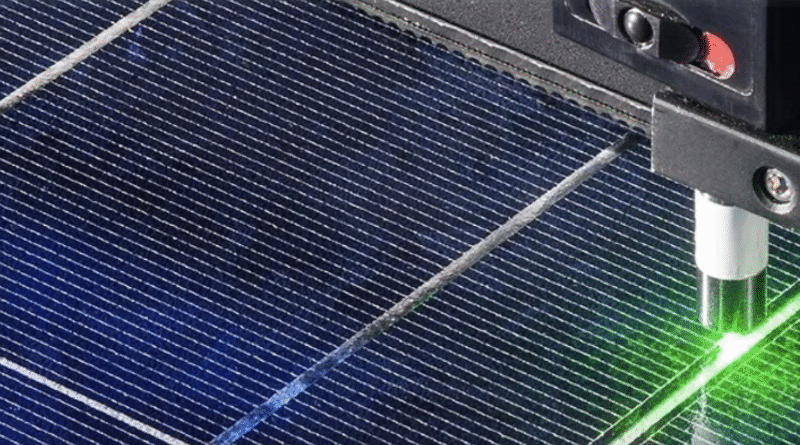
Photo: The US manufacturer Talon PV plans to launch a new generation of high-efficiency TOPCon solar cells into the US market, despite the sharp U-turn in federal energy policy (cropped, courtesy of Talon).
Sign up for CleanTechnica's Weekly Substack for Zach and Scott's in-depth analyses and high level summaries, sign up for our daily newsletter, and follow us on Google News!
Have a tip for CleanTechnica? Want to advertise? Want to suggest a guest for our CleanTech Talk podcast? Contact us here.
Sign up for our daily newsletter for 15 new cleantech stories a day. Or sign up for our weekly one on top stories of the week if daily is too frequent.


CleanTechnica uses affiliate links. See our policy here.
CleanTechnica's Comment Policy


