
Bad Bunny Put A Spotlight On The Special Relationship Between The US & Puerto Rico
Support CleanTechnica's work through a Substack subscription or on Stripe.
There has been a lot of bellyaching among right wing extremists about the NFL’s decision to make Puerto Rican musician Bad Bunny the headline attraction of this year’s Super Bowl halftime show, claiming he was “not an American artist.” That dismissive attitude offers insight into the fraught relationship between the United States and an island that lies partly on the Atlantic Ocean and partly on the Caribbean Sea, about 1100 miles southeast of Miami.
Many may remember that after the devastation of Hurricane Maria in 2017, the sitting US president flew to Puerto Rico, handed out a few hundred rolls of paper towels, then jetted home without offering any significant policy initiatives or financial assistance for the devastated island. The memory of that insulting behavior still burns hotly for many Puerto Ricans.
Who Is An American?
Is Bad Bunny an American? The answer is yes, absolutely. Residents are US citizens who are allowed to travel the US without a passport, although in today’s climate of xenophobic hysteria, it is probably best if they bring documentation with them. Very few know how the special status of the island came to be. I did not know myself until I read historian Heather Cox Richardson’s Substack post for February 9, 2026.
Puerto Rico was once a Spanish possession in the days when the conquistadors were pillaging Central and South America in search of treasure. In 1492, Columbus landed on the island and was immediately impressed with how meek and peace-loving the native Taino Indians were. They weren’t Indians at all, of course. Columbus thought he had found India. But Columbus was undeterred by his 8000-mile navigational error. He promptly wrote to the king of Spain, praising the docility of the native people, which he said would make them excellent slaves.
In fact, they were, but a combination of grinding drudgery and disease decimated the original inhabitants, which required the Spanish to import “guest workers” from Africa to run their plantations. Puerto Rico itself became an assembly point for ships sailing to and from Spain with so much treasure that it was named Puerto Rico, which means “rich port” in Spanish.
The Sugar Trade & Global Politics
The primary crop on the island was sugar cane, which was the basis of two products essential to life in the colonial era — rum and molasses. Sugar, as it turns out, played a central role in Puerto Rico’s history. In the late 1800s, large corporations took over their competitors to create so-called “trusts,” the biggest and most powerful of which was the Sugar Trust, which cultivated powerful friends in government.
In 1890, Congress passed the McKinley Tariff, which ended sugar tariffs and tried to increase domestic production by offering a bounty on domestic sugar. This was a disadvantage to sugar producers in Hawai’i. In 1893, sugar growers there staged a coup to overthrow the Hawaiian queen and asked Congress to admit the islands as an American state, but the effort bogged down.
When the Spanish-American War broke out in 1898, the Senate still did not have enough votes to admit Hawaii, so Congress annexed it by a joint resolution and McKinley, now president, signed the measure. Richardson says the acquisition of the territory of Hawaii opened the door to the annexation of islands.
The Treaty of Paris in 1899 transferred control of Cuba, the Philippines, and Puerto Rico, as well as a number of smaller islands, including Guam, to the United States. What did those islands have in common? All of them either were sugar producers or had the potential to become sugar producers.
The Northwest Ordinance Of 1787
Adopted under the Articles of Confederation, the Northwest Ordinance of 1787 established a system for incorporating new territories into the country on terms of equality to older states. But in the era of Jim Crow, annexing the newly acquired islands under the terms established a century before presented a political problem for lawmakers. Richardson says that while sugar growers wanted the islands to be domestic land for the purposes of tariffs, most Americans did not want to include the Black and Brown inhabitants of those lands in the United States on terms that would make them equal to white people — a theme that is still prominent in US politics today.
The 1898 resolution of war against Spain in Cuba had contained the Teller Amendment, which required the US to support Cuban political independence once the war was over and Spanish troops gone, providing a quick answer to American political annexation of Cuba — although it left room for economic domination, Richardson is quick to point out. But there was no such amendment for the rest of the islands the U.S. acquired in 1899.
Richardson informs her readers that a fiercely pro-business Supreme Court provided a solution for Puerto Rico in what became known as the Insular Cases. In May 1901, in Downes v. Bidwell, the court concluded that the newly acquired island was not a foreign country “in an international sense,” it was foreign to the US in a domestic sense “because the island had not been incorporated into the United States.”
Slicing & Dicing Citizenship
This new concept of “unincorporated territories” that were “foreign…in a domestic sense” allowed the US government to legislate over the new lands without having to treat them like other parts of the Union, while also preventing the inclusion of their people in the US body politic. Two months after the court’s decision, on July 25, McKinley issued a proclamation removing tariff duties for products from Puerto Rico, and the sugar industry boomed.
What did all this tortured legal reasoning mean? In 1902, a pregnant twenty-year-old Puerto Rican woman named Isabel González arrived in New York City to join her fiancé, but the immigration commissioner turned her away on the grounds that she was an “alien” who would require public support. González sued.
When her case reached the Supreme Court, it concluded that she was not an alien and should not have been denied entry to the United States. The justices went on to create a new category of personhood for the island’s inhabitants. They were not aliens, but they were not citizens either. Instead, they were “noncitizen nationals.” As such, they had some constitutional protections but not all. They could travel to the American mainland without being considered immigrants, but they had no voting rights in the US. Talk about bending the law into a pretzel to achieve the desired result!
The Federal Relations Act
US citizenship for Puerto Ricans was established in the 1917 Puerto Rico Federal Relations Act. Today, Puerto Rico is a self-governing commonwealth of about 3.2 million people. It doesn’t take a legal genius to envision the current administration reversing that Act and stripping Puerto Ricans of their US citizenship. That, more than anything else, may be what all the uproar about the Super Bowl halftime show was all about.
MAGAlomaniacs tied themselves in knots in an attempt to demonize the people of Puerto Rico. The tension has found its way into other artistic forms, beginning in 1961 with West Side Story and continuing with Ton Lehrer’s wickedly funny National Brotherhood Week, in which he says, “New Yorkers love the Puerto Ricans cuz it’s very chic.” Paul Simon wrote an exquisite musical called The Capeman that chronicled the social travails of a young Puerto Rican boy who murdered a white boy in a case that drew national attention and led to the establishment of the juvenile justice system in the US.
Rejecting Hatred
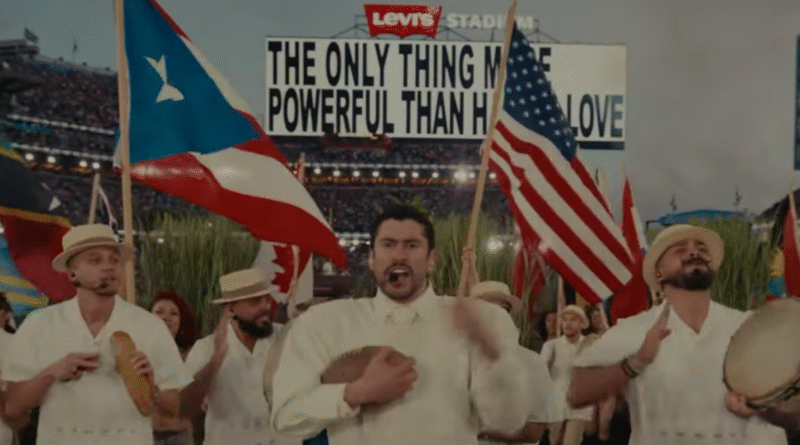
The show ended with Bad Bunny and a group of friends joyously celebrating American culture in front of a sign that read, “The Only Thing More Powerful Than Hate Is Love,” a riff on the song Brother, Brother sung by Marvin Gaye in 1971. All in all, the Bad Bunny halftime show was a powerful rejection of the boiling hatreds of the right wing extremists and a celebration of the message of Jesus, one that has been largely ignored for the past 2000 years. If you want to watch the entire halftime show — which had the biggest audience in Super Bowl history, it is at this link.
But the most powerful message of the whole evening may have been delivered in a quiet, dignified way by Lady Gaga, who recreated the theme song from Mister Rogers’ Neighborhood for one of the Super Bowl commercials. Here is a video showing how that song was recorded. It’s quite powerful, and for me, captures the spirit of the Bad Bunny halftime show in a simple yet powerful way. See if you don’t agree.
Sign up for CleanTechnica's Weekly Substack for Zach and Scott's in-depth analyses and high level summaries, sign up for our daily newsletter, and follow us on Google News!
Have a tip for CleanTechnica? Want to advertise? Want to suggest a guest for our CleanTech Talk podcast? Contact us here.
Sign up for our daily newsletter for 15 new cleantech stories a day. Or sign up for our weekly one on top stories of the week if daily is too frequent.
CleanTechnica uses affiliate links. See our policy here.
CleanTechnica's Comment Policy

