
Wall Street’s Failures on Tesla (TSLA) — And Has It Simply Flip Flopped?
Support CleanTechnica's work through a Substack subscription or on Stripe.
Or support our Kickstarter campaign!

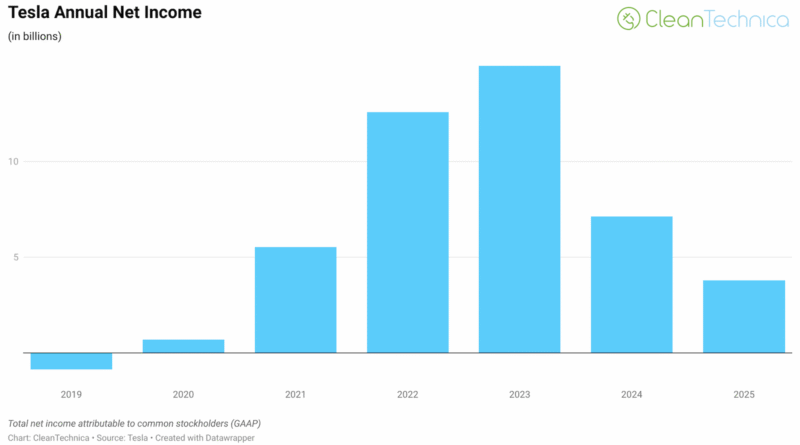
In response to my article yesterday about Tesla’s gradually declining net income, a reader pointed me in the direction of an interesting article from Fortune. Before I get to that and some additional thoughts that came out of that, it just hit me that I didn’t take a good look at Tesla’s annual income trends. Here’s a chart of Tesla’s annual net income from 2019–2025:
Shocking, no?
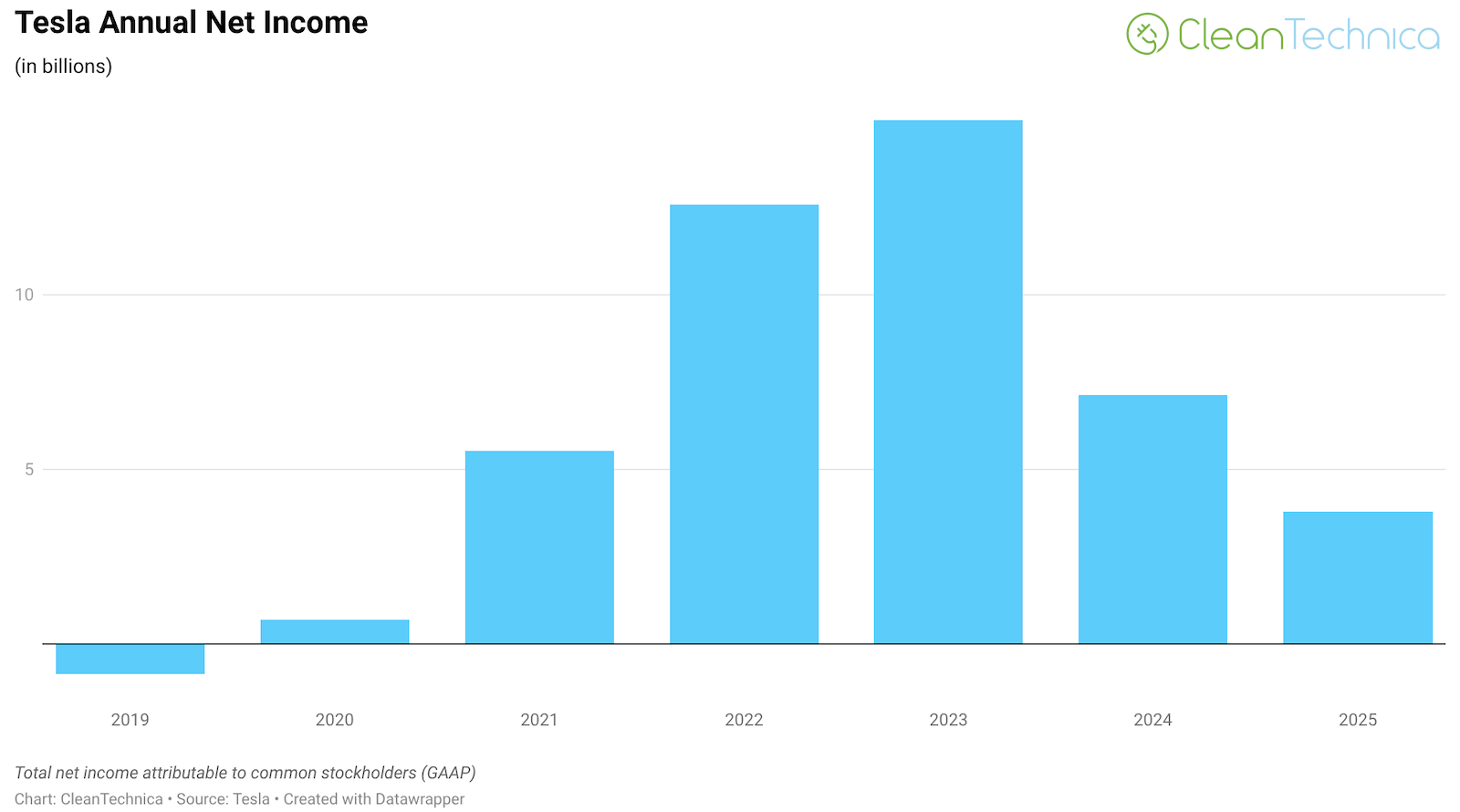
If that interactive embedded chart doesn’t show well for you, here’s a static version:
One of the key points of the Fortune article was that even beyond looking at Tesla’s declining net income, things look much worse if you remove non-recurring income.
“While earnings plummeted over the past two years, it’s added $31 billion, or nearly 30%, to the left side of its balance sheet. The more capital intensive Tesla becomes, the less efficiently it’s deploying that capital,” Shawn Tully noted. “It’s particularly ominous that so much of these paltry profits are flowing not from making and marketing cars and batteries, but via the sales of regulatory credits to other automakers that purchase them to compensate for failing to meet emissions standards, notably in California and the EU. This line item’s been gradually declining, and Musk acknowledges that the bounty will eventually end. Hence, it’s instructive to study just how much Tesla earns excluding this ‘non-core’ item, as well as past, profitable sales of Bitcoin that can’t be counted on in the future.”
Note that while many of us expected regulatory credits to drop off more quickly, due to changes in the US from Trump’s anti-cleantech, pro-pollution agenda, Tesla was still collecting quite a bit in the 4th quarter and 2025 overall. In millions, the following was Tesla’s regulatory credit revenue in the past five quarters:
- Q4 2024 — $692
- Q1 2025 — $595
- Q2 2025 — $439
- Q3 2025 — $417
- Q4 2025 — $542
Also note that these quarterly totals include regulatory credit revenue from Europe. However, historically, most of that money has come from the US, and it’s not clear how much more the company can count on that going forward.
“In 2025, Tesla pocketed $1.45 billion in credits after tax, plus $69 million from the sale of digital assets, for a total of $1.51 billion. That’s almost 40% of its net earnings of $3.79 billion. After subtracting those non-operating items, Tesla booked just $2.28 billion in ‘bedrock,’ repeatable earnings.”
Beyond highlighting that issue, Tully had a big point on Tesla’s “core” PE, which is what caught our reader’s attention. PE, or P/E, stands for the company’s price-to-earnings ratio — how the company’s stock price compares to its earnings. “At its current market cap of $1.44 trillion, Tesla’s selling at an adjusted PE of 632 ($1.44 trillion divided by $2.28 billion). Palantir, the super-hot supplier of software to the intelligence community, is often cited as the ultimate in over-the-top valuations at a multiple of 353. But Palantir’s got nothing on Tesla. At a ‘core’ multiple that’s 80% higher, Tesla easily beats Palantir for offering minimal pennies in profit for every dollar you’re paying for the shares,” Tully summarizes.
Looking at that is a little wild. Or very wild. And it got me thinking about something that I guess I’ve thought about many times but I haven’t really processed.
I have covered Tesla very closely since 2012. For those first several years, the company was neglected, not taken seriously, mocked, and laughed at. It was never going to be profitable — that was the narrative that was almost universal in the auto industry and on Wall Street. Like many others, I saw the benefits of electric cars and believed the company could pull through, could get to mass production and profitability. But those of us in that boat were a tiny minority. Wall Street kept writing off the company’s chances, more or less up to the quarter when Tesla did start mass producing the Model 3 and become profitable. One interesting thing to me was just how long it took the auto industry and Wall Street to see, or believe, Tesla was for real.
For the past couple of years, it has felt like the opposite has been true. I started noticing clear signs of Tesla demand problems two and a half years ago. We also got more skeptical about Tesla’s Full Self Driving progress and plans several years ago. However, each step of the way, each quarter, for the past few years, there’s consistently mocking of any criticisms and negative forecasts, and hype about what’s just around the corner. For sure, right now, the narrative of Tesla bulls is that huge growth is just about to come again. However, that’s been the argument for years now. It’s always just over this next hill. But is it? Is it, really?
As I pointed out recently, Tesla robotaxis were supposed to be covering 50% of the US population by the end of 2025, according to Elon Musk half a year ago. They were covering 0%. Now they are supposed to be operating in about 10 cities by the end of the year. But will they?
Even if robotaxis do happen to finally roll out like that (after nearly a decade of missed promises and incorrect forecasts from Elon Musk), there are costs to operating a robotaxi. If Tesla is going to continue operating these itself, it’ll have to pay for cleaning the robotaxis, charging them, repairing them, changing the tires, etc. Plus, it’s got to pay for soaring AI costs. How much money would Tesla actually be able to make on these early, limited robotaxi deployments? (Again, assuming Tesla actually does it this time, after year after year after year of missed plans.)
There’s also the challenge of getting riders. Waymo has partnered with Uber, Lyft, and others in some cities in order to get enough customers and get its ridership rolling. Is Tesla just going to rely on its brand appeal? Many people won’t touch the brand after what Elon Musk has done politically, including ending USAID, which is resulting in the deaths of countless people, including many children.
If Tesla opens up the option for Tesla owners to deploy their own cars as robotaxis, how many do so, and how much of that income does Tesla actually take for itself? If Tesla want to make it worthwhile for owners, how much money can it take from them?
In other words, even if Tesla meets its targets for robotaxis for once in 2026, is there actually an opportunity to turn around the company’s long-term net income trends? And, beyond that, does Tesla’s $1.31 trillion market cap make sense?
There’s all kinds of hype around robots, robotaxis, and Cybercabs, but is the hype realistic? Are expectations realistic? Does any of this justify such a high stock price and market cap? My hunch is that Wall Street and millions of people simply don’t want to be on the wrong side of the Tesla story again, are afraid of assuming Tesla won’t succeed and then being proven wrong again, and are just holding the course and hoping to be proven right despite a lot of evidence to the contrary. In short, are they making the same mistakes as a decade ago, but just on the flip side of the company’s trajectory?
Is 2026 the year Tesla proves the skeptics wrong again? Or is 2026 the year Wall Street is shown to get the Tesla story wrong again? Does the stock continue to go up for Tesla bulls? Or does the stock crash down to a level that much better matches Tesla’s income?
Support CleanTechnica via Kickstarter

Sign up for CleanTechnica's Weekly Substack for Zach and Scott's in-depth analyses and high level summaries, sign up for our daily newsletter, and follow us on Google News!
Have a tip for CleanTechnica? Want to advertise? Want to suggest a guest for our CleanTech Talk podcast? Contact us here.
Sign up for our daily newsletter for 15 new cleantech stories a day. Or sign up for our weekly one on top stories of the week if daily is too frequent.
CleanTechnica uses affiliate links. See our policy here.
CleanTechnica's Comment Policy

