
A Green Hydrogen Innovator In Oklahoma Has A Message For Texas: Hold My Beer
Support CleanTechnica's work through a Substack subscription or on Stripe.
Or support our Kickstarter campaign!
Texas has emerged as a hotbed of green hydrogen activity in the US, supported in part by know-how borrowed from the oil and gas industry. Now another iconic fossil fuel state, Oklahoma, is jockeying for a piece of the action. A case in point is the Oklahoma City startup Tobe Energy, which has earned an investment from the home state fund Hurricane Ventures, along with a $1.8 million seed haul in September. So, what’s all the fuss about?
The Membrane-Free Green Hydrogen Solution
The main attraction is Tobe’s membrane-free electrolysis system for extracting hydrogen gas from water. Membrane-free is an atypical technology in the electrolysis circle, which is largely dependent on specialized membranes, so let’s take a brief look at the big picture.
Plain water could provide the hydrogen users of the world — of which there are many — with a more sustainable alternative to the standard method for procuring hydrogen, which involves squeezing it from natural gas or coal.
To date, investors and policy makers have focused on membrane-dependent electrolysis systems that push hydrogen gas from water with a catalyst and a jolt of electricity, ideally supplied by wind, solar, or other renewables. If that sounds costly, it is. A good deal of the expense comes from the membrane needed to keep the reaction moving (see more electrolysis background here).
Green hydrogen innovators around the world have been working on alternative membrane formulas and other system improvements to reduce the cost of electrolysis. Tobe is among the startups determined to skip to the head of the line by throwing out the membrane altogether, and starting from scratch (check out Tobe’s spec page here).
$1.8 Million For Membrane-Free Electrolysis
The University of Tulsa publicized the Hurricane Ventures commitment on December 26, noting that the two cofounders of Tobe Energy, Colby DeWeese and Caleb Lareau, are alumni of the school. “The funding will accelerate the company’s mission to make clean hydrogen production cheaper, more efficient and widely accessible to accelerate the transition to a low-carbon economy,” UT enthused.
“The company’s novel, membrane-free system simplifies the production process, cutting costs by up to 75% and reducing waste heat. This scalable technology is designed for large-scale use in industries like energy, manufacturing and transportation,” UT added. The transportation angle is somewhat at odds with the emerging consensus regarding the best-case economic scenarios for green hydrogen uptake. However, the manufacturing and energy use cases support a focus on on-site production for on-site or hyperlocal use, paring transportation and storage costs to the bone.
Hurricane Ventures also features in the $1.8 million round of seed funding spearheaded by Cortado Ventures in September. Cortado is keen on clean tech investing in the Mid-Continent region, which it defines as centered on Oklahoma and rippling into states at its borders including Texas as well as New Mexico, Colorado, Kansas, Missouri, and Arkansas.
That may seem somewhat counterintuitive considering that red-state politics dominate the region. However, as amply demonstrated in Texas, vote-getting rhetoric can only do so much against the inevitable march of the decarbonization movement (here’s another example).
“These states are historically the Country’s centers for major legacy industries such as energy, aerospace, manufacturing, healthcare, and agriculture. As more startups innovate within these verticals, founders familiar with them are gaining an edge,” Cortado explains.
Pushing Down The Cost Of Green Hydrogen, With LEDs
CleanTechnica caught up with Tobe Energy briefly last September, so now would be a good time to dig in and see what Cortado and other seed participants see in the startup. Along with several to-be-named angel investors, the list includes the Scissortail and Hurricane branches of 46 VC, Techstars, and former SpaceX engineer Jamie Gull’s Wavefunction VC.
Cortado announced the close of the seed round on September 4, taking note of co-founder DeWeese’s experience in oil, gas, and petrochemical systems management. “Before launching Tobe, DeWeese served as principal process engineer at Hydrogen Technologies, where he led the design and delivery of the first zero-emission hydrogen boiler of its kind,” Cortado noted.
As described by Cortado, capital costs for the system run approximately 75% less than conventional electrolyzers. The news organization Journal Record also posted a long form article on the topic on November 5, offering additional details. As described by JR reporter Chip Minty, the Tobe electrolysis system deploys LEDs (light emitting diodes) as an energy-saver. “LEDs pass electricity through semiconductor chips that generate almost no heat and require at least 75% less energy to operate,” Minty notes.
“All of these other electrolysis companies have this resistant element that’s just like a filament,” DeWeese told JR. “We’re doing it just like an LED, so the secret sauce is a unique configuration, certain voltages, certain frequencies. It’s what causes the water to split.”
The LED angle on electrolysis is new to the CleanTechnica radar, but the idea of membrane-free electrolysis is not. That comes under the heading of photoelectrochemistry. When dunked in water and exposed to light, a PEC (photoelectrochemical cell) can churn out hydrogen gas. The technology, also nicknamed “artificial leaf” is designed to mimic photosynthesis as closely as possible, without relying on external sources of electricity (see more artificial leaf background here).
And, here’s where an interesting coincidence comes into play — or not, as the case may be. In its September 4 announcement, Cortado credits DeWeese’s father with the invention of “the TiVo.” If they mean the digital recording device firm TiVo, that company was founded by Mike Ramsay and Jim Barton in 1997. If you can figure out where a Mr. DeWeese factors in, drop a note in the comment thread.
TiVO4, on the other hand, has been surfacing around the green hydrogen field of late. TiVO4 — titanium vanadium (not vibranium!) oxide — is an emerging semiconductor material that can be applied to photoelectrochemical cells (here’s a recent example). After the holidays I’ll reach out to Tobe to see if any additional clarification is available.
In the meantime, let’s keep an eye on Oklahoma. As with Texas, Oklahoma has two factors going for it: an abundance of legacy expertise from the oil and gas industry, along with a strong and growing renewable energy profile. The state’s solar industry has lagged behind wind power and further obstacles are looming, but the state’s Department of Commerce is determined to make the renewable energy case for attracting new businesses to the state.
Although a long fracking-related earthquakes have dominated the news from Oklahoma, as of December the ODC website noted that Oklahoma is #3 in a 50-state ranking for total renewable energy capacity including solar, hydro, geothermal, and bio-diesel along in addition to wind power. Overall, renewables account for 47% of its electricity generation in the state, and the ODC emphasizes that businesses in search of 100% renewable energy can get that, too (see our Oklahoma archive here).
Partisan politics notwithstanding, it sure looks like Oklahoma is poised to play a significant role in the US energy transition. If you have any thoughts about that, drop a note in the comment thread.
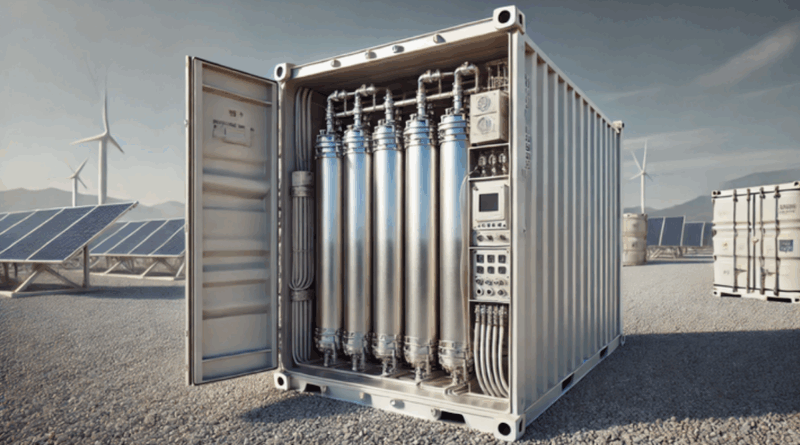
Photo (cropped): The Oklahoma startup Tobe Energy aims to cut the cost of green hydrogen with a membrane-free, stainless steel, drop-in system designed for on-site production and use (courtesy of Tobe Energy).
Support CleanTechnica via Kickstarter

Sign up for CleanTechnica's Weekly Substack for Zach and Scott's in-depth analyses and high level summaries, sign up for our daily newsletter, and follow us on Google News!
Have a tip for CleanTechnica? Want to advertise? Want to suggest a guest for our CleanTech Talk podcast? Contact us here.
Sign up for our daily newsletter for 15 new cleantech stories a day. Or sign up for our weekly one on top stories of the week if daily is too frequent.
CleanTechnica uses affiliate links. See our policy here.
CleanTechnica's Comment Policy

