
Tesla’s Long-Term Sales Decline in Europe — Can Cheaper Models & “Full Self Driving” Turn Things Around?
Support CleanTechnica's work through a Substack subscription or on Stripe.
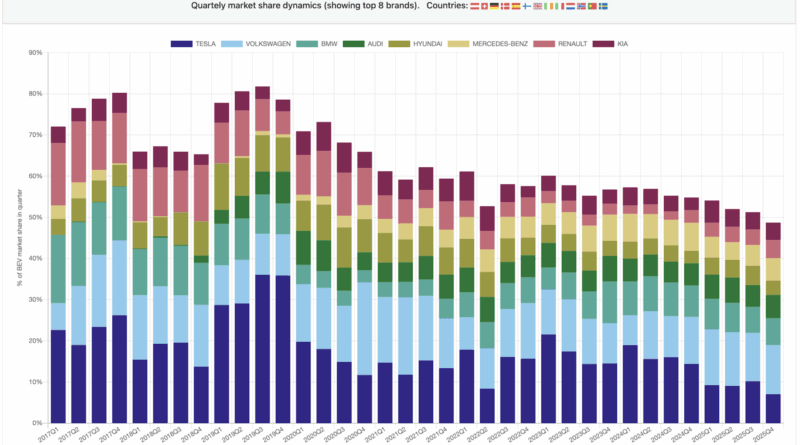
I was going to explore some European EV sales trends this week and ran across the following chart, which shows the 8 leading auto brands’ quarterly market share of the BEV market in 13 European countries (combined):
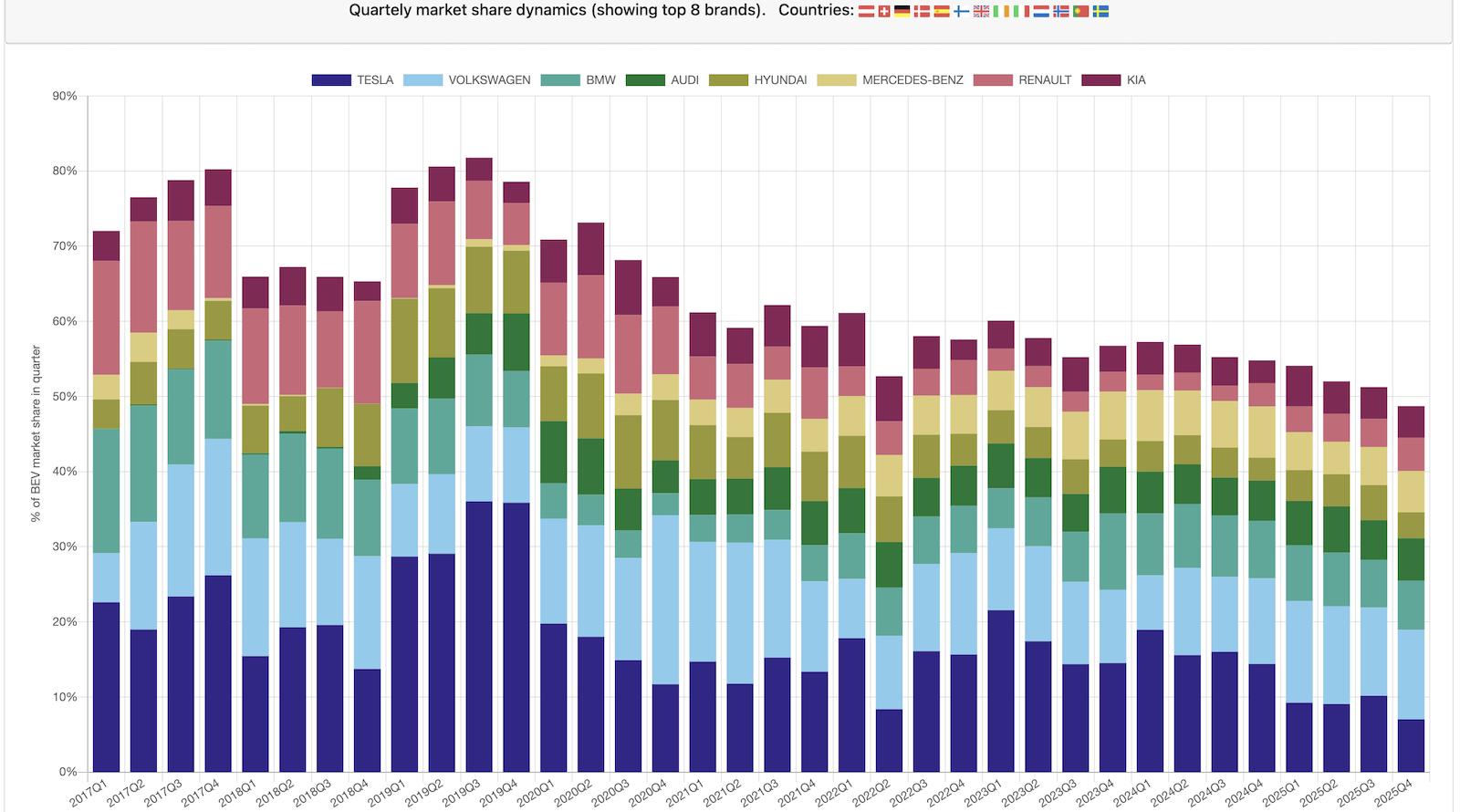
There are three things that jumped out to me looking at that chart. One is that Tesla’s share of the EV market has dropped enormously in the past 8 years. Comparing Q3 2017 to Q3 2025, it dropped from 23.4% to 10.2%. Tesla’s peak share was in Q3 2019 when it reached 36%. The second thing that stood out to me is that the combined market share of these top 8 brands also dropped a lot over this period. The third thing is that Renault’s share of the EV market collapsed in this time period as well, even more than Tesla’s share did in some regards. (I guess you could also throw in here that Audi went from nothing to significant market share, and seemingly just stole that share from BMW.)
Clearly, this year in particular has been a horrible year for Tesla, showing more than a 50% drop compared to 2024 (in every quarter).
Looking at our own European EV sales reports, which are broader than these 13 markets, the following are sales of Tesla’s two top models across the first 10 months of the year in 2023, 2024, and 2025:
- 2023: Tesla Model Y — 220,310, Tesla Model 3 — 73,385 (around 294,700 in total)
- 2024: Tesla Model Y — 164,014, Tesla Model 3 — 90,460 (around 254,500 in total)
- 2025: Tesla Model Y — 116,989, Tesla Model 3 — 62,629 (around 179,600 in total)
So, yes, it’s not just a market share decline because of a growing EV market — Tesla’s sales are really down enormously in Europe.
Tesla has two big ways it’s trying to stimulate more sales in Europe again. First of all, as in the US, it has released cheaper decontented versions of the Model 3 and Model Y there. While these are not seen as particularly useful sales boosters in the US, there is some hope among fans/shareholders that the offerings cut prices much more in Europe (especially with some government incentives taken into account) and could really make a difference there. We’ll have to see. The European EV market is much bigger and much more diverse than the US market, and while being more cost-competitive there is going to help move more vehicles, there’s a question of how much that 1) overrides people just not wanting to buy Tesla vehicles because of Elon Musk’s political activities, and 2) supersedes people’s preferences for certain domestic brands or model designs. We will see….
Just as one country example, in Germany, the Model 3’s low-end price has dropped from ~€46,000 (for what is now a “Premium” Model 3) to ~€38,000 (for the decontented Model 3). (Or, if you go back a couple of years to when Tesla offered a cheaper Model 3 Standard Range in mid-2023, the price was ~€42,000. Or you can go all the way back to early 2021, when prices were cut to ~€40,000 for a Model 3 Standard Range Plus. But, really, we’re looking at how much lower the price is compared to recent options, right?) In the USA, the low-end price dropped by about $5,500, but taking into account the loss of the $7,500 federal EV tax credit, it actually rose by $2,000. With regard to the Model Y, it was a $5,000 price drop, but effectively a $2,500 price increase.
The second thing Tesla is banking on is stimulating demand through “Full Self Driving” (FSD). The company is now providing customer test rides that show potential buyers FSD in action in 5 European countries: Germany, France, Italy, Denmark, and Switzerland. Tesla fans/shareholders claim that these ride-alongs are massively successful and popular. However, again, we’ll have to see how much that actually translates into more sales. Tesla owner take rate of FSD is seemingly around 10–15% in the US, and it’s unclear how much it stimulates sales. Note that this ride-along program just rolled out to Denmark and Switzerland yesterday, and it will presumably come to more European countries soon.
Can these recent developments stop the Tesla sales losses in Europe and boost the company’s market share there again? We will see.
Sign up for CleanTechnica's Weekly Substack for Zach and Scott's in-depth analyses and high level summaries, sign up for our daily newsletter, and follow us on Google News!
Have a tip for CleanTechnica? Want to advertise? Want to suggest a guest for our CleanTech Talk podcast? Contact us here.
Sign up for our daily newsletter for 15 new cleantech stories a day. Or sign up for our weekly one on top stories of the week if daily is too frequent.
CleanTechnica uses affiliate links. See our policy here.
CleanTechnica's Comment Policy

