
New Large-Scale Iron-Sodium Energy Storage System Passes The Test
Support CleanTechnica's work through a Substack subscription or on Stripe.
Fans of new sodium battery technology suffered a big disappointment earlier this year when the once-promising US energy storage startup Natron shuttered its doors. However, other US innovators have picked up the slack. That includes California-based Inlyte Energy, which has just completed a successful test of its full scale “salt battery,” aimed at pushing fossil fuels out of the power generation business.
A New Sodium-Based Energy Storage System, Supported By The US Department Of Energy
This year’s abrupt shift in federal energy policy brought much misfortune upon the US wind and solar industries, especially in the offshore wind area. However, energy storage continues to be a focus of attention — and funding — from the US Department of Energy.
In particular, the Energy Department is continuing to zero in on new utility-scale energy storage systems that deliver more electricity, for longer periods of time, than conventional lithium-ion battery arrays.
Inlyte fits the bill. Its iron-sodium formula is scalable to more than 48 hours, though the company states that it can also economically deliver electricity to fit daily 4-10 hour cycles. At four hours, that’s about the same as Li-ion technology but without the need for fire risk mitigation.
Research into sodium-based EV batteries and other energy storage systems devices dates back to the 1980s, though commercial applications proved elusive until a series of breakthroughs occurred in the early 2000s. CleanTechnica has been tracking 21st century progress in the sodium battery field, though Inlyte is a relatively fresh face on these pages.
The company formed in 2021 and quickly drew the attention of the Energy Department in 2022, which provided early stage funding through its ARPA-E SEED program. Inlyte also acquired the UK firm Beta Research — and its team of experienced sodium researchers — in 2022.
CleanTechnica finally caught up with Inlyte in March of this year, when the company announced a partnership with the Swiss sodium battery manufacturer HORIEN Salt Battery Solutions (formerly FZSoNick). The plan involves testing the new iron-sodium energy storage system in the UK, at a facility located in the Derby area, as a step towards the launch of a manufacturing facility in the US.
While that plan was under way, in June Inlyte received a $4 million award from the CiFER (Critical Facility Energy Resilience) program of the US Department of Energy, to support the installation of its long duration energy storage solution at the Alliance Redwoods health care campus in Occidental, California.
In September, Inlyte also announced the next steps in its transition from R&D to commercial application, including a partnership with the leading US utility Southern Company aimed at demonstrating a utility-scale version of its technology in Alabama.
Long Duration Energy Storage Really Is Coming For Your Fossil Fuels
So far, all has gone according to plan. Earlier today Inlyte announced the successful completion of a factory acceptance test at the Derby facility, with Southern Company personnel keeping a close watch.
“The test demonstrated the performance and integration readiness of Inlyte’s battery storage system — combining advanced sodium metal chloride cells, inverter and control electronics — a major milestone on the company’s path to commercialization,” Inlyte reported.
“The tested system represents the world’s largest sodium metal chloride battery cells and modules ever constructed, capable of storing over 300 kilowatt-hours of energy each,” the company emphasized.
“During the factory test, the module achieved 80% total round-trip efficiency, inclusive of auxiliaries and inverter, which is competitive with high-performance lithium-ion systems and well above the 40 to 70% range typical for other LDES systems,” they elaborated, with LDES being short for long duration energy storage. (Please note the following update received from Inlyte via email: “During the factory test, Inlyte’s battery achieved 83% round-trip efficiency, including auxiliaries, which is competitive with high-performance lithium-ion and well above the 40 to 70% range typical for other LDES technologies.)
Generally speaking, energy storage systems are source-agnostic. A diversified energy provider like Southern Company, for example, could deploy energy storage systems to scavenge excess kilowatts from nuclear power plants. Still, Southern Company has been growing its wind, solar, and energy storage portfolio. Between those three resources, the company already has almost 5.6 gigawatts’ worth of clean power in operation or under construction.
Accordingly, Steve Baxley, the energy storage use, research, and development manager for Southern Company, notes that the grid of the future will be saturated with long duration energy storage systems.
“Energy storage is essential for creating a reliable and flexible energy grid,” Baxley observed in a press statement.
“As the grid evolves toward longer-duration storage, developing solutions that are both low-cost and safe is critical to ensuring affordable, dependable service for customers,” he added.
More Clean Tech Manufacturing For The US
In today’s announcement, Inlyte observed that it has reached the last stages of site selection for the new US factory, with a final decision expected in 2026.
In the meantime, plans are under way for Southern Company to install Inlyte batteries at its Energy Storage Test Site in Wilsonville, Alabama, sometime next year, which also happens to be the host city of the Energy Department’s National Carbon Capture Center.
That’s…somewhat unexpected. Notably, though, Southern Company has a portfolio of energy storage research projects under way, including a partnership in the Energy Storage Research Center, located in Birmingham about about 30 miles from Wilsonville. The ESRC launched in 2019 with a mission to accelerate the development of next-generation energy storage systems. In addition to Southern Company, the other partners at launch included the utility Alabama Power, the Southern Research branch of the University of Alabama, the state of Alabama, and the Electric Power Research Institute as well as Energy Department and its Oak Ridge National Laboratory in Tennessee.
“The facility will offer a resource for the industry to test and develop energy storage technologies needed to better integrate renewable energy into the power grid, as well as improve reliability and resiliency, while creating more value for customers,” Southern Company explained in a press release dated July 26, 2019.
The Rise Of The Sodium EV Battery
No word yet on whether or not Inlyte is interested in transferring its technology over to the EV field. However, other battery innovators are already on the case. In addition to the well known Chinese firm CATL, keep an eye on the California startup Unigrid. The company has been working on a sodium battery scaled for residential use, as an initial step towards developing a sodium EV battery.
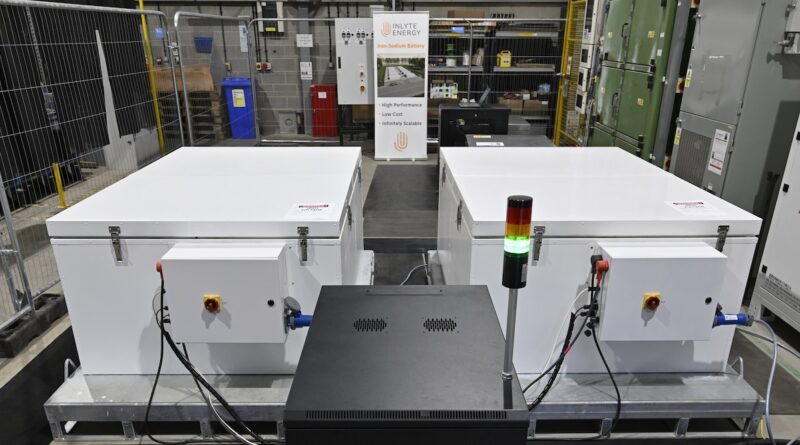
Photo: A new, large scale iron-sodium energy storage system will be manufactured in the US, helping to shepherd more wind and solar energy into the nation’s power generation profile (courtesy of Inlyte via PR Newswire).
Sign up for CleanTechnica's Weekly Substack for Zach and Scott's in-depth analyses and high level summaries, sign up for our daily newsletter, and follow us on Google News!
Have a tip for CleanTechnica? Want to advertise? Want to suggest a guest for our CleanTech Talk podcast? Contact us here.
Sign up for our daily newsletter for 15 new cleantech stories a day. Or sign up for our weekly one on top stories of the week if daily is too frequent.
CleanTechnica uses affiliate links. See our policy here.
CleanTechnica's Comment Policy

