

Level 1 & Level 2 EV Charging Is Expected To Account For 80% Of All EV Charging In 2030
Support CleanTechnica's work through a Substack subscription or on Stripe.
The National Renewable Energy Laboratory expects Level 1 and Level 2 charging to handle 80% of all EV charging duties by 2030. Sufficient energy from the electric grid may be needed to support 33 million EVs on the road by 2030. The majority (64%) of EV charging is estimated to take place at single family homes using L1 and L2 charging, which is typically the most cost-effective and convenient type of charging. DC fast charging infrastructure is expected to support 20% of EV charging needs.
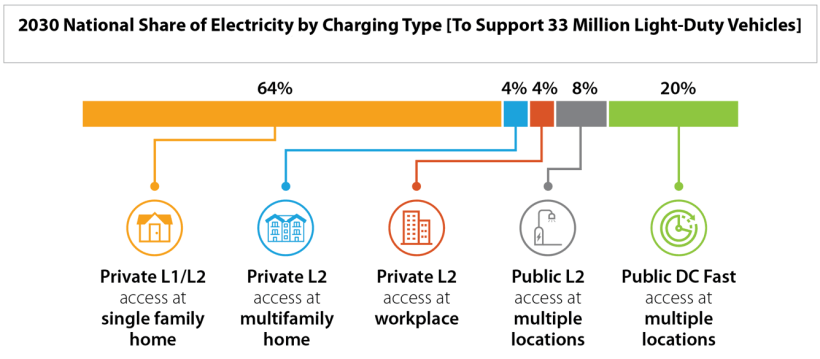
Notes:
- Level 1 (L1) refers to 120v AC charging from a typical US household outlet.
- Level 2 (L2) refers to 240v AC charging like that used for a household electric dryer.
- DC Fast charging in this study refers to charge rates of 150kW or higher.
- Low power DC charging (e.g., 50 kW) is omitted from the study’s baseline scenario on the basis of assumed driver preferences for DC charging that is as fast as possible and 2030 vehicle technology scenarios where batteries are capable of accepting at least 150 kW of peak power.
Source: National Renewable Energy Laboratory, The 2030 National Charging Network: Estimating U.S. Light-Duty Demand for Electric Vehicle Charging Infrastructure, June 2023. Fact #1335 Dataset.
Courtesy of Department of Energy
Sign up for CleanTechnica's Weekly Substack for Zach and Scott's in-depth analyses and high level summaries, sign up for our daily newsletter, and follow us on Google News!
Have a tip for CleanTechnica? Want to advertise? Want to suggest a guest for our CleanTech Talk podcast? Contact us here.
Sign up for our daily newsletter for 15 new cleantech stories a day. Or sign up for our weekly one on top stories of the week if daily is too frequent.
CleanTechnica uses affiliate links. See our policy here.
CleanTechnica's Comment Policy

