Buildings

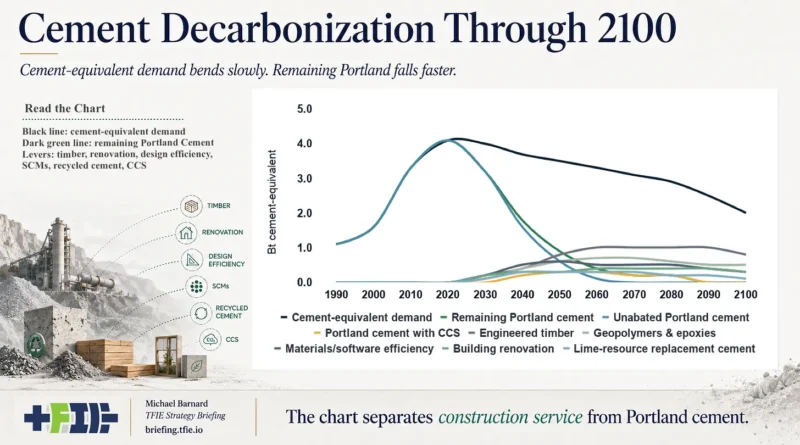
Cement’s Future Is Less Portland, Not One Magic Cement

Cement decarbonization attracts miracle stories. One company has a new binder. Another has a carbon-negative aggregate. Someone else has an electrochemical process, a hydrogen kiln, a low-carbon limestone route, a supplementary cementitious material, a recycled cement process or a carbon-capture retrofit. Some of these ideas are useful. Some will become … [continued]

Molecules Do Not Disappear. Their Market Shrinks.

A lot of energy-transition arguments begin with today’s fossil fuel demand. Coal, oil, and gas still dominate global primary energy, so it is tempting to draw a straight line from the current fuel system to a future molecule system. Replace natural gas with hydrogen. Replace bunker fuel with ammonia or … [continued]

China’s First Build Is Ending, And The World Won’t Repeat It

One of the easiest ways to get long-range energy and materials demand wrong is to treat first-build infrastructure demand as a permanent condition. Countries build their first stock of housing, highways, ports, rail, power systems, water systems, industrial parks, and concrete-and-steel cities once. After that, the demand structure changes. The … [continued]

France Gets Electrification Right, But 2030 Is Doing A Lot Of Work

France has announced a national electrification push that is directionally correct in a way that a lot of energy policy still is not. It is not treating electrification as a side dish to climate policy, a consumer rebate program, or a decorative set of EV chargers beside the real business … [continued]

Steel’s Future Starts With Demand, Scrap, And Electricity, Not Hydrogen

Steel keeps getting framed as a hydrogen problem because hydrogen gives the sector a single shiny lever. Replace coal with hydrogen, keep making new iron, plug it into an electric arc furnace, and declare victory somewhere around the ribbon-cutting ceremony. It is an attractive story for governments, incumbent producers, electrolyzer … [continued]

Ireland’s Energy Poverty Problem Needs Flexible Electric Heat, Not Fabric-First Delay

Ireland’s energy poverty problem is not an electricity access problem. Almost every Irish household is connected to electricity. The problem is whether households can keep a warm, healthy home without cutting back on food, medicine, transport, or other essentials. That makes Ireland different from countries where the main energy poverty … [continued]

Inventions That Capitalism Fails

Every once in a while, reading articles at CleanTechnica, I feel an urge to overcome my reluctance to put myself into the spotlight by writing about my own inventions. I am afraid that Steve Hanley, who happens to be one of my favorite CleanTechnica authors, put up the straw that … [continued]