
Diamane — Extremely Thin Films Of Diamond Can Be Created Without High-Pressure
Support CleanTechnica's work through a Substack subscription, on Patreon, or on Stripe. Help us produce all of the high-quality, original content we publish week after week despite the challenges of content-scraping AI, antisocial media, inflation, and other hurdles.
Diamane — an extremely thin film of diamond only a few atoms thick — can be created without the extreme pressure needed to produce natural gemstones, according to new multi-university research.
These “perfect” sheets of diamond — which have been predicted to be possible for some time, and signs of which have been observed in lab research — possess all of the “superior semiconducting and thermal properties” of diamond, but without the associated costs. Needless to say, there has been a great deal of interest in developing a process to create the material.

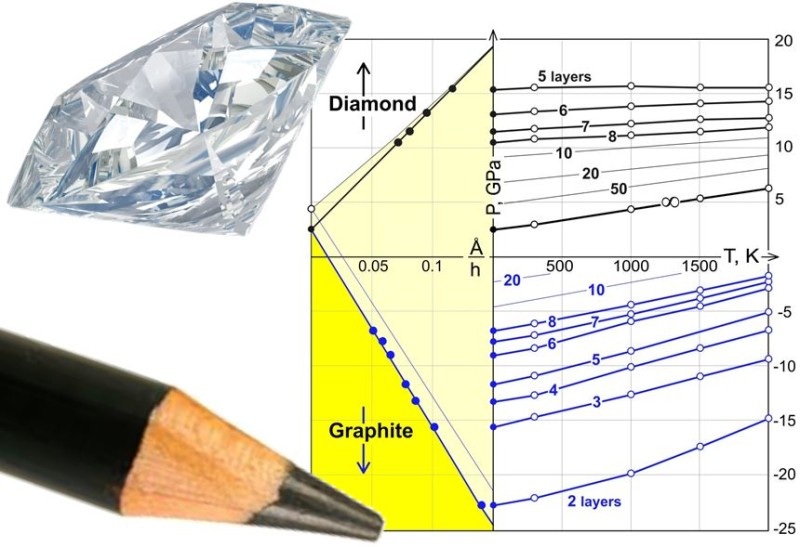
Image Credit: Pavel Sorokin/Technological Institute for Superhard and Novel Carbon Materials
Researchers from Rice University, along with Russian colleagues, have done just such a thing — a “phase diagram” for the creation of diamane has been devised. Which is to say, essentially, that a roadmap has been created for the creation of the material — all of the necessary conditions have been described.
Rice University explains:
It lays out the conditions — temperature, pressure and other factors — that would be necessary to turn stacked sheets of graphene into a flawless diamond lattice. In the process, the researchers determined diamane could be made completely chemically, with no pressure at all, under some circumstances.
The researchers built computer models to simulate the forces applied by every atom involved in the process. That includes the graphene, the single-atom-thick form of carbon and one of the strongest substances in the universe, as well as the hydrogen (or, alternately, a halogen) that promotes the reaction. Conditions, they learned, need to be just right for a short stack of graphene pancakes to collapse into a diamond matrix — or vice versa — via chemistry.
“A phase diagram shows you which phase dominates the ground state for each pressure and temperature,” stated Boris Yakobson, a Rice University theoretical physicist. “In the case of diamane, the diagram is unusual because the result also depends on thickness, the number of layers of graphene. So we have a new parameter.”
Speaking with regard to potential applications, researcher Pavel Sorokin, a former postdoctoral associate at Rice and now a senior researcher at the Technological Institute for Superhard and Novel Carbon Materials in Moscow, stated: “Diamanes have a wide potential range of application. They can be applied as very thin, dielectric hard films in nanocapacitors or mechanically stiff, nanothick elements in nanoelectronics. Also, diamanes have potential for application in nano-optics.”
The new research was just published in the American Chemical Society journal Nano Letters.
Sign up for CleanTechnica's Weekly Substack for Zach and Scott's in-depth analyses and high level summaries, sign up for our daily newsletter, and follow us on Google News!
Have a tip for CleanTechnica? Want to advertise? Want to suggest a guest for our CleanTech Talk podcast? Contact us here.
Sign up for our daily newsletter for 10–15 new cleantech stories a day. Or sign up for our weekly one on top stories of the week if daily is too frequent.


CleanTechnica uses affiliate links. See our policy here.
CleanTechnica's Comment Policy

