CleanTechnica is the #1 cleantech-focused
website
 in the world. Subscribe today!


Market Research electriccost1

Published on September 30th, 2013 | by Shrink That Footprint

16

What’s The Average Price Of Electricity In…

Share on Google+Share on RedditShare on StumbleUponTweet about this on TwitterShare on LinkedInShare on FacebookPin on PinterestDigg thisShare on TumblrBuffer this pageEmail this to someone

September 30th, 2013 by  

Originally published on Shrink That Footprint
By Lindsay Wilson

Average electricity prices $/kWh

Australia and Germany each just had an election.  In both cases electricity prices were an election issue.  That seems fair enough given that in both countries they are paying significant more $/kWh than most countries

But now Nova Scotia is heading to the polls and electricity prices are a key issue because they have ‘rocketed’ to 0.15 $/kWh (Canadian).  That is indeed high by Canadian standards, but it is a bargain globally.

Out of curiosity I thought I’d crunch the numbers to see who really is paying a lot for their power.

Electricity prices around the world in $/kWh

It doesn’t matter where you go in the world, people love to moan about the cost of electricity.

This begs the question, where is electricity actually expensive and where is it cheap.  Or better yet, is my electricity cheap or expensive?

To try and answer this question I’ve collected average electricity prices from 17 countries around the world, and converted them to $/kWh (US).  All the data is based on average prices and exchange rates for 2011, and I’ve graphed them in US cents/kWh to keep it tidy.
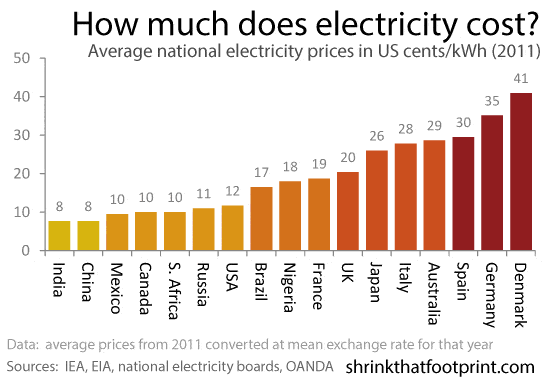
Average electricity rates

Let’s start with the obvious.  Denmark, Germany and Spain have expensive electricity.  In fact in straight dollar terms Denmark is trumped only by small island countries dependent on imported diesel for power.

Canadian electricity is cheap at 10 US cents per kilowatt-hour, which is reflected in their high average electricity usage. US electricity prices at 0.12 $/kWh are also quite cheap internationally.  In India and China they are very cheap.

I find this comparison pretty useful.  And the reasons behind the differences are quite diverse.  But there are two issues with this.  One, electricity prices are on the move in many places, South Africa, Australia and Nigeria come to mind.  And secondly, basic exchange rate conversions aren’t always the best measure of how expensive something really is.

The first is just something to be aware of.  And despite my best efforts I couldn’t gather consistent data for 2012.  The second however can be accounted for by considering purchasing power parities.

The relative price of electricity

Our initial comparison of electricity prices didn’t account for the fact that price levels vary a lot between countries.  For example a US dollar will go a lot further buying goods and services in relatively cheap India than it will in relatively expensive Australia.

If we look at the same average electricity prices for 2011 but this time adjust them to US dollars using purchasing power parity the picture look slightly different.

Relatively electricity prices

Once you adjust for the different price levels between countries Canadians have the cheapest electricity and Germans the most expensive.

Places like Nigeria and India have jumped up the list due to their lower price levels, while countries including Denmark, Australia and Japan have fallen because they are relatively expensive places to live.  In general accounting for purchasing power lessened the difference between countries, but significant differences remain.

Which brings me back to Nova Scotia.  Paying 12 US cents/kWh is expensive in Canada.

Just don’t moan about it abroad!

Keep up to date with all the hottest cleantech news by subscribing to our (free) cleantech newsletter, or keep an eye on sector-specific news by getting our (also free) solar energy newsletter, electric vehicle newsletter, or wind energy newsletter.


Share on Google+Share on RedditShare on StumbleUponTweet about this on TwitterShare on LinkedInShare on FacebookPin on PinterestDigg thisShare on TumblrBuffer this pageEmail this to someone

Tags: , , , , , , , , , , , , , ,


About the Author

Shrink That Footprint is a resource for squeezing more life out of less carbon. We are an independent research group that provides information to people interested in reducing their climate impact. Our core focus is understanding, calculating, and reducing personal carbon footprints.


  • Ralph

    Its not difficult to find this data for developed countries, but do you have accurate and timely data for the Caribbean countries, Central America, and South America? We would love to see a comparative matrix of industrial electricity prices across this region. Thank you!

  • Just wrong

    The prices for Canada are misleading. Looking at wikipedia, for example, will show you that our electricity price is is around 6.3 to 11.8 cents/kwh, but we are also subject to a delivery charge of an additional 11.7 cents approx. In Ontario, when I get a $300 hydro bill, $125 is actual usage of around 9 cents, the rest is delivery, account charges, “debt retirement” charges, and taxes. The local government makes the cost look low, but tries to hide several other costs on our bills.

  • NRG4All

    If we had a modern grid, it seems that the cost of electricity could be standardized within the U.S. at least to some extent. In Phoenix with time-of-use metering we pay $0.10 for off-peak, but we pay $0.26 for on-peak from Arizona Public Service. On top of that APS is requesting that net-metering be abandoned which has the effect of decreasing the benefit of distributed homeowner generated power.

  • http://www.facebook.com/carmen.johnson.5891 Carmen Johnson

    nice this

  • JamesWimberley

    The first graph is wretchedly amateurish, the sort of thing dreamt up by innumerate media types. Do you interpret the electricity price as the area of the house elevation, or the height? It seems to be the height. At least you later switch to non-misleading bar charts.
    Anybody producing charts professionally should read Edward Tufte first.

  • http://electrobatics.wordpress.com/ arne-nl

    This article is misleading its readers by keeping mum on the fact that these are retail prices for households and small businesses. The EEG Umlage in Germany is only paid by these small customers and lets big industries off the hook. They enjoy low energy prices just as industry everywhere in Europe and the world.

    It points more to a different problem that large industries still can dictate their own laws.

  • Ivor O’Connor

    Nothing here shows how painful it is for the citizens to buy their power. For instance if the electricity costs 10 US cents per kilowatt-hour and they spend $60 a month on it and their disposable income is $1000 a month then electricity is costing them 6% of their income. Now if electricity costs the equivalent of 40 US cents per kilowatt-hour and you use $120 a month but you make $6000 a month your electricity is only 2%.

    The simplistic versus the more complete analysis apparently flips Germany’s electricity price from the most expensive to the cheapest. In other words when the cost of electricity used in a household compared to their disposable income Germany is 3x cheaper than in America.

    Seeing the complete picture is important.

    • Bob_Wallace

      I ran some numbers last night for a different reason, but they might add something here…

      Germans pay EUR 0.268, $0.36 per kWh and use, on average 3,512 kWh/year. The average household bill for electricity in Germany is about $105/month.

      American pay $0.1261 per kWh and use, on average 11,698 kWh/year. The average household bill for electricity in the US is over $120/month.

      Germany – $105/month on an average $5,000/month household income. 2.1% of income.

      US – $120/month on an average $4,400/month household income. 2.7% of income.

      Also, it should be pointed out that the price of electricity in Germany was quite high well before renewables became big players on their grid and before the decision was made to close nuclear.

      http://www.economist.com/node/13527440

      Germany has a problem with little competition. Renewables have dropped the wholesale and industrial cost of electricity but the savings are not being passed on to retail customers.

      • Ivor O’Connor

        I was under the impression from the article last week the difference was much greater. Something like 6% vs 2%. Did you look into that as well?

        • Bob_Wallace

          The cost and usage numbers are what I found on line. The sites could be wrong. Do you have different numbers?

          • Ivor O’Connor

            Somewhere I saw those numbers last week. I have been using them since I saw them. Now I can’t find them. Despite using zotero to track my references. Your numbers seem much more believable but I liked their numbers because it really brought home the point Americans spend more for their electricity as a percentage of their paycheck than Germans.

            And if you noticed I replied to somebody last week about that NY Times article too. Basically the way I figured it was that if the guy was real good and saved his electricity each night by using a 5 watt bulb that would allow him to light one cigarette and take a puff before putting it out and doing the same thing the next night. However he would blow his electricity savings for a week if he smoked a single cigarette all the way down to the butt.

            I’m amazed the NY Times makes it so easy. Then again so does the Der Spiegel so maybe it is the same everywhere.

          • Bob_Wallace

            Der Spiegel starts a lot of this crap and other papers pick it up.

      • Lindsay Wilson

        Really interesting numbers Bob

        • Bob_Wallace

          I ran those numbers in reply to a POS article the NYT ran which talked about how Germans were suffering due to the high price of electricity.

          They talked about one unfortunate (employed) guy who was using a 5 watt light in his kitchen rather than turning on a 25 watt tube.

          Running a 25 watt tube five hours a night would have cost him about $1.50 per month. They didn’t bother working that out, it would have hurt their hit piece.

          (Of course the obvious answer would be to get a 7 watt LED, have the equivalent of a 60 watt incandescent, and decent light.)

          • Lindsay Wilson

            Oh it was terrible wasn’t it, more WSJ than NYT. The interesting number for me would be total energy costs as a share of household income. That gets past the issues of what share of energy electricity is.

Back to Top ↑

