CleanTechnica is the #1 cleantech-focused
website
 in the world. Subscribe today!


Cars chevy volt charging review

Published on July 12th, 2013 | by Guest Contributor

114

One Year With My Chevy Volt

Share on Google+Share on RedditShare on StumbleUponTweet about this on TwitterShare on LinkedInShare on FacebookPin on PinterestDigg thisShare on TumblrBuffer this pageEmail this to someone

July 12th, 2013 by  

By Douglas Elbinger, Energy Policy Analyst, GreenLancer

Let me tell you about my Chevy Volt, now that I’ve been driving it for one year.

I remember back in 2011 when the Volt was first announced. I admired the boldness of GM to bring out a range-extended plug-in electric vehicle (PEV) in the midst of such economic uncertainty. In accord with the automotive reviews at the time, I thought the Volt was too expensive.

My previous automotive experience has been with Audi. I’ve had five different Audi’s over the last fifteen years. Before that, I drove Oldsmobile. One of the reasons I got a Volt last year is that the Chevy dealer offered me so much more for my trade-in than other dealers, I thought I’d better sign a deal before they changed their mind. The Volt was the only car on the lot that intrigued me. It turns out they have very affordable three-year lease plans that have improved considerably in the last year. I recommend a two-year lease because if you upgrade, I’m sure the 2016 Volt will be much improved in terms of electric cruising range and performance. I like to think of my Volt as the Model-T of electric cars.

Not having driven an American car in nearly 15 years, I took a test drive and was immediately impressed. The very knowledgeable and patient sales person taught me how to drive it and understand all the dashboard displays that are slightly different from a gas powered vehicle.

Included in the deal is the installation of a 240V in-home charging station. The retail value for the home charging units is $490 (plus installation costs). The home charging unit is a 240-volt (Level II) charger, and, according to General Motors, can replenish the Volt’s batteries in about four hours. Consumer Reports has advised buyers to budget up to $2,000, which I believe to be true, as many older homes, including mine, may need a substantial electrical upgrade since the US National Electrical Code requires that the charger have its own dedicated 220-volt, 30-amp circuit. The whole process took about two months before the inspector approved the installation and turned on the power. In the meantime, I used the 120V charger that came with the car.

What people really want to know is… does it save you money? That being asked, I’ll just bring the bottom line right to the top. Yes and no, but mostly no. You can purchase a car with equal power, performance, and style for much less money. Other than that… the Volt has many redeeming performance characteristics, technology, and value-added features that far exceed saving a few bucks on gas or car payments. Let me summarize based on real-life data. I have a daily roundtrip commute of approximately 44 miles, from Telegraph & Maple in Bloomfield Twp, to the David Stott building in downtown Detroit. On a full charge, when the temperature is above say 50 degrees F (battery range is less in cold weather… you are also running the heater and fan which takes up almost all your electric charge), I get an electric range of 36 miles per charge that covers 80% of my daily commute. At 24 miles per gallon, approximately $4/gal based on my actual results, I save about $40 per month. I should mention here that the gas tank only holds 11 gallons and takes premium. With a full tank and full charge I have a driving range of about 330 miles. If I don’t do any long-distance driving, I only need to fill up once a month. In the first couple months of ownership, I almost forgot how to use a gas pump.

chevy volt charging review

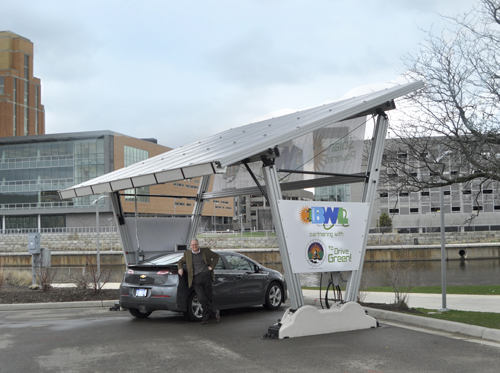
Doug Elbinger poses with his Chevy Volt at the new solar electric car charging station at the City Market in Lansing, Michigan. April 2013.

According to Edmunds.com, the price premium paid for the Volt, after discounting the $7,500 US federal tax credit, takes a long time for consumers to recover in fuel savings, often longer than the normal ownership time period. Edmunds compared the Volt (priced at $31,712) with the same-size gasoline-powered Chevrolet Cruze (priced at $19,656) and found that the payback period for the plug-in hybrid is 15 years for gasoline prices at $3 per gallon, 12 years at $4 per gallon, and drops to 9 years with gasoline prices at $5 per gallon. The EPA rating considers a conversion factor of 33.7 kWh of electricity being the energy equivalent of a gallon of gasoline. With special utility rates (I have a separate meter installed with my charger) for charging during off-peak hours, the cost of electricity is almost negligible. My mileage results vary greatly (on the down side) from the Chevy Volt data published in Wikipedia, but I’m still pretty impressed.

The next thing everyone wants to know is how does it perform?

For me, the true test of any car is how it handles in the worst weather… and we had plenty of that last winter. Compared to the Audi, I felt completely safe driving in white-out blizzards, freezing rain, and icy roads. It has the most responsive braking and steering system, comparable to any luxury car you may be driving. The Chevrolet Volt is packed with standard safety features that include 4-wheel anti-lock brakes with traction control; Stabili-Trak electronic stability control system with brake assist; tire-pressure monitoring system; and 8 total airbags: dual-stage frontal, side-impact and knee for driver and front passenger, and roof-rail side-impact for front and rear outboard seating positions, with a passenger sensing system. A safety cage, built of ultra high-strength steel, surrounds the passenger compartment to keep the space intact in the event of a crash. Crush zones framing the trunk and the engine crumple to absorb crash energy before it reaches occupants.

One of my most pleasant discoveries is how quiet this car is. It is so quiet I often leave the radio and telephone off to just drive and relax in peace and quiet. The other discovery is great ‘pick-up’.

You don’t have to worry about having enough power or speed to pass other cars driving in heavy aggressive traffic.

Talk about connectivity!

The Bluetooth phone feature allows you to keep both hands on the wheel while using the voice-activated phone. I got to like this because the car is so quiet you can talk in a normal voice. On-star comes standard. I used it once when I was locked out and it worked. Satellite radio is a nice add-on feature and the sound system is just a little better than OK. You will be emailed monthly performance reports, such details as the car monitor of tire pressure and when you need an oil change… which isn’t very often. The Volt features an OnStar Mobile application for owners to access vehicle information without being in or near the car. This smartphone application features the ability to check fuel efficiency as well as the vehicle’s current electric range. It also helps monitor the charging, giving owners key information about the current charge level and the amount of time it will take until it is fully charged. The application also is able to control features such as locking/unlocking doors, and acts as a remote starter. A three-year OnStar Directions and Connections service was bundled into the 2012 Volt’s base price.

I could ramble on more about what this car is and isn’t, but on the whole, I very glad I got this automobile. When I first started driving the Volt, I didn’t see many on the road. Just the other day, I saw three of them in one parking lot! Electric cars will really take off when two things happen: 1. The “energy density” of the batteries improves to the point that you can get a range of over 300 miles or more, and 2. The price of gasoline goes above $5/gallon. Then you’ll see a lot more electric cars on the road.

One last anecdote. Late on a freezing winter night, I pulled into a gas station outside Ann Arbor.

A young man at the gas pump next to me smiled and said, “I thought you didn’t need to fill those up?”

I replied, “…that’s why I do it at night.”

DougElbinger_3About the Author: Doug Elbinger’s career spans over 35 years as an innovator in management and corporate communications. For many years, as an environmental journalist and producer for EnvironmentalNewsNetwork.com, he focused his efforts on acquiring an in-depth knowledge of advances and investment opportunities in the renewable energy industry. For more information, comments or dialogue, please contact Doug Elbinger:

delbinger@greenlancer.com
Energy Policy Analyst, Greenlancer Energy Inc.
Greenlancer is a renewable energy engineering and consulting firm in Detroit — http://www.greenlancer.com

Keep up to date with all the hottest cleantech news by subscribing to our (free) cleantech newsletter, or keep an eye on sector-specific news by getting our (also free) solar energy newsletter, electric vehicle newsletter, or wind energy newsletter.


Share on Google+Share on RedditShare on StumbleUponTweet about this on TwitterShare on LinkedInShare on FacebookPin on PinterestDigg thisShare on TumblrBuffer this pageEmail this to someone

Tags: , ,


About the Author

is many, many people. We publish a number of guest posts from experts in a large variety of fields. This is our contributor account for those special people. :D


  • charlotte.landeros

    Testimony of money lending

    The life of witness lots of money if loan a loan contact Mr. conti. Fulgenzio serious because I have my loan of 5,000 euros ( 7.0863 $) at the rate of 2% for beside it until I did so because I thought it was going to get the loan but my banker called me to inform me that my account has been provided and I withdrew the money and changed it so don’t hesitate because taking other amigostambien contact this gentleman now I have my business. Please contact us for more information about this loan. Here is the email: conti.fulgenzio@hotmail.com

  • pjkPA

    My first year cost me less than $275 for fuel electricity and maintenance… I’ve had my Volt for a year and a half now and still have only been to a gas station once and total maintenance has been one tire rotation $12.. no oil changes… and I estimate in my gas car I would have gone to a gas station over 50 times… I’m saving over $1,000 per year. I have a wattmeter on the charger so I know exactly how much the car is costing me. I paid $22,900 for my Volt and that was before the $5,000 price reduction… you can buy a Volt now for under $20K after all incentives. The ride and other benefits of the electric drive are better than any gas car… and I really liked my V8 vehicles… but this Volt is much better than any V8.. I still like my ICE car .. but find I drive my Volt 99percent of the time… it’s just more relaxing.. the smooth quiet power still amazes me.

  • Dennis Embry

    As an owner of oil and gas property plus two electric cars and solar cells on our house, I marvel at the “j’ai acuse” silliness of fossil fuel apologists these postings who are shocked, just shocked, outraged and just indignant that alternative energy efforts have receive a penny of incentives from the federal, state and local governments. It’s just un-American for such efforts, and you know its only the hard-won private sector money that made America a fossil-fuel giant.

    That is a nice illusion or paid distraction. Hey, I know. We checked off the special deductions in taxes for fossil fuels for years in in my family. And, I was happy to do so with the solar and electric cars. At least I am honestly consistent. The apologists for the Koch family herein are not. All of those fossil fuel raided the federal kitty to subsidize their efforts.

    So, there is a simple remedy for this problem. Every single beneficiary who is so “outraged” —from posters here to the Koch brothers— of government tax incentives, tax breaks, or tax loopholes for fossil fuels is hereby invited to write checks back to the US, state and local tax payers. Gosh, those check would bail us out of the horrible deficits.

    In case you don’t believe that we, in America, subsidized fossil fuels a lot more than any alternative energy is hereby invited to spend an evening on a computer reading things from a Google Search, “historic subsidies for oil and gas in the US.”

    Am I unhappy about these? Yes and no. Those subsidies enabled the rise of modern America. Were they abused? Of course. The Koch family would not be rich except for the money they made off of Joe Stalin (just look up “Koch family and Stalin.”

    Oh, BTW, both the Volt and Leaf (which we own) are fabulous cars. And Solar cells on top of the house are fantastic. At the maximum of electricity use during the summary, we paid on $24 — for the house, our office and to power our cars.

  • Dave M

    My answer to the question, am I saving money is a definite YES.
    My old car easily sucked back 400 a month in gas if I was driving it like I drive the volt. (mileage wise) I used to try to avoid driving it because it was so thirsty.I bought my volt 2 years ago, a loaded model, 47,000.00 With my govt rebate and trade in it ended up 40,000.00 which is about what I paid for the previous car. I now go thousands of miles between fill ups. In fact in the past 1700 KM I have used 0.1 liters of gas!
    My daily average commute is 55 KM, and in the warm weather I average 68 – 70 KM of range. In the cold weather it drops to around 50, so for the winter months, the engine runs a little more frequently. Since I purchased the car I have already saved over 7,000.00 in gas, and that is over 2 years. The way I figure it, in less than 10 years the entire price of my Chevy volt will be 100% recovered in saved fuel. For the skeptics that say I could have bought a cheaper car, that is true, but I would still be putting gas in it forever. My volt will be totally recovered in savings, and that is just the gas part. Maintenance costs are also substantionally less due to electric motors not requiring maintenance, brakes last much longer due to majority of stopping using regenerative braking. The engine oil only needs to be changed every 2 years and that is just due to age. Air filter doesn’t need changing, as it isn’t being used much. Very little maintenance other than rotating the tires.

    • Bob_Wallace

      Playing the skeptic-devil…

      Seems like you should compare your Volt expense vs. a ~$20k Prius hybrid.

      When I’ve run the numbers the Prius comes out a bit better for a 13k mile per year driver. But I haven’t run them since the Volt price dropped.

      • Dave M

        Bob, I also own a Prius. A 2006 to be exact. I bought it in 2005 when my work had me commuting through tunnels and over bridges, and I figured it would save me a bundle. It did. My fuel bill dropped from 100.00 a week to under 30.00 a week. That is a substantial savings for sure. Then my work location changed. I now drive to a different compound to pick up my work truck, and I no longer have to sit in bumper to bumper traffic, which is the only place a hybrid, such as the Prius really makes any sense. You see, Hybrids really only save gas in stop and go traffic when they can shut off the gas engine and run on electric power. My new location requires me to drive 1 mile from my house, then 15 miles on the freeway, and about .5 miles from the freeway to work, reverse on the way home. So my gas bill shot up to about 40.00 per week. Still very reasonable compared to the gas guzzler I drove before, but I wanted more. Remember the gas guzzler, well my wife was still driving that. When she was a stay at home mom, all she used it for was taking the kids to school, and going to the store. Then she decided to go back to work, so now she too is commuting, and the gas bill quickly climbed to 100.00 a week on that car again.
        So, enter the volt. Paid 40,000 after trade in, and govt. rebate.
        I put no gas in it for my mostly urban driving to and from work, and all my running around, and have put in a couple hundred of liters of gas for 3 road trips, one to Prince Rupert BC, another to Kelowna BC, and a 3rd to Medicine Hat Alberta. (that’s why I didn’t buy a Tesla, or a Leaf, as I need to go on trips from time to time and a full on electric just wouldn’t do it). My wife now drives the Prius, and she is using just over 40.00 a week in gas, so lets round it to 40.00 for comparison sake.
        A new Prius runs in Canada about 26,000 before taxes. I paid 33,000 for mine 8 years ago incidentally, but lets figure this on the new list price. Assuming 40.00 a week in gas, which is what I put in mine, correction my wife’s Prius now, that is 2080 per year in gas. Over the live of the car, lets say 10 years, that adds up to 20,800 in fuel, plus the 26 grand for the car, 46,800 and I haven’t added taxes onto the car, now maintenance. I just put in 2,000 to get the brakes done on my current 8 year old Prius, but it was the first time the brakes have been done.
        So in 10 years, the cost of the Prius, and gas is more than I paid for my volt.
        My old car that I scrapped used about 100.00 in gas per week, which works out to about 5200.00 per year in fuel. Do the math, about 7.6 years to totally pay off the volt in fuel savings alone, as I am putting no gas whatsoever in my volt, except when I have gone on road trips, and I am not counting that fuel.
        On average I drive about 220 miles per week, or 350Km.
        Any way you add it up, the volt will save money over the long term, and incidentally, even when the car is 10 years old, there won’t be more than a few thousand actual miles on the gas engine, so that will still be like new. Incidentally. I have logged 40,000KM on my volt in 2 years which is about 12.5K miles per year.
        I never considered a plug in Prius, or Ford plug in due to the way these cars operate. In both cases the engines start every time, and run through a warm up cycle, and then they switch to electric. The plug in Prius, which is 35 grand, can then only manage 11 miles on battery, and at speeds less than 52MPH, which means that on the freeway the gas engine is running, and even at lower speeds, you have to drive them like you are transporting nitro glycerine or the engine fires up, just like on my existing Prius, and the Ford plug in also fires the engine to warm up, and then it switches to electric. It can do 80 MPH on electric power, so I would get to work, but with a 20 mile range, I would be driving home on gas power, so that wasn’t the answer. The Volt is the only car that made any financial sense to me, and I didn’t buy a cheap one. Mine was 47,000 before my 5000 government rebate, and my 2000 trade in. An entry level in BC could have been had for about 37, and now with the price drop about 32,000 after the rebate here in BC. They make more sense then ever for anyone wanting to sit down and actually do the math.
        Did I mention that the volt is a BLAST to drive. Unlike the Prius that spends it’s life in the slow lane, as it is gutless. The Volt has lots of ponies under the hood ready to be released. It moves along plenty fast enough for me. Not scary fast like a Tesla or Corvette, but it moves along more than fast enough for me.
        In closing, the volt was an excellent decision for me. When the Prius dies I will buying my wife a full on electric car, such as a Chevy Spark EV, or a Nissan Leaf, as she will never need to buy gas with her short commutes, and having the volt I will always have a car that can go anywhere. A volt and a full electric is a great combination in a 2 car house, and over the long term they will pay for themselves, and it gets me off that f*&%ing oil, which is better for all of us, especially for those with clean generated electricity as we have here in BC.
        For those that claim that coal generated electricity pollutes more, well it actually doesn’t, as it takes more electricity to move oil, and bitumen around from the ports and tar sands to the refineries, so that coal is burning weather you use the energy to charge your car, or to pump the oil to the refinery so you can put it in your tank.

  • Mark Renburke

    “Compared to the Audi, I felt completely safe driving in white-out blizzards, freezing rain, and icy roads. It has the most responsive braking and steering system, comparable to any luxury car you may be driving. The Chevrolet Volt is packed with standard safety features…One of my most pleasant discoveries is how quiet this car is…The other discovery is great ‘pick-up’…enough power or speed to pass other cars driving in heavy aggressive traffic.”

    So if all this is true (not to mention superior handling, ride, exterior and interior design and quality, and tech features) why do otherwise sympathetic authors fall into the trap (laid by anti-Volt media) of cost comparing the Volt to a base Chevy Cruze? Why not instead use an average of the base prices of entry level upscale/luxury cars? (Lexus/Lincoln/BMW/Benz, etc) Volt “break even”is basically day one, which is perhaps why so many defectors are from these brands. Oh, I forgot, Audi too! :)

  • Volt Owner

    You have a rare “Model T” version of the Volt with the ultra rare 11 gallon tank! The rest of us have the more common 9.3 gallon tank.

  • Doug Elbinger

    ya know …when I posted this article I forgot to mention that the Volt does not come in ‘green’!!! –Doug Elbinger

  • Others

    Mr Doug

    Volt with a electric motor will run much smoother than engine based Cruze. The edmunds comparison is bogus.

    So your MY-2011 Volt has 36 mile range and that’s good, Current Volt has 38 mile range and may go even 40 miles with a gentle drive. So if you drive 250 days / year, you are driving 9,000 miles / year on Electricity alone with commute. If I presume that on 50 – 100 week end days, you drive around 10 miles / day for shopping, club, church and so on, that comes to another 500 – 1000 miles.

    So your Volt’s 10,000 miles of Electric Drive will give you not only a smooth drive, wich you can compare with a small luxury car like Audi A4, BMW 3 Series, Benz C series, but also saves you lot of money in gas and reduce lot of pollution.

    In just last 1 week, gas prices has increase from $3.48 / gallon to $3.6 / gallon.

    Enjoy every mile of your ride.

    • 2012 Volt

      I must chime in on the contributor’s article. While I appreciate the fact that he has a Volt and likes it, he must be driving a bit harder than me. I have a 2012 Volt and, although it’s officially rated at 35miles on a charge, I’m actually averaging 48 currently. During the winter months here in Atlanta, GA, which is very hilly, the range goes down to around 40-42. A little about my commute: I travel exactly 20 miles (one-way) to work, 40mile round trip, and with the exception of a few days in winter when the temp. was below 40 (and sometimes below 30) when I would have to travel home in the dark, lights and heater on, for the most part I always made the trip without the car ever switching over to gas. This commute is highway travel with cruise set to 65mph for about 17mi, one-way, with the remaining 3 being surface streets.
      With reference to the cost saving aspect of driving a Volt, I’ve noticed everyone, it seems, ignores another aspect, which I think is huge. Not only do you save money on gas, which can be substantial($200/mo savings for me over previous car, a 2008 VTech Honda Accord, 5speed.), no one seems to consider the maintenance side. I’ve had mine since August of 2012 and the oil life is only down to 93%(started out at %100). So I’ll literally go YEARS(at this rate it would be 10 years) without every having to pay for an oil change. Same will go for tune-ups as there are none on an electric motor. Again, although this one has an ICE as a range extender, it’s rarely if EVER used. No belts to be replaced, spark plugs, oil(on the electric side)…Even on a new ICE car, these things are a part of “scheduled maintenance”. The only thing I’ve had to do was rotate the tires.
      You even use the brakes a lot less, since the elec. motor can be used to slow the car and regenerate electricity to the battery at the same time.
      Then there’s the ‘time is money’ factor. I spend no time at a gas station and no time at a dealer for maintenance, scheduled or otherwise.
      And like someone earlier mentioned, insurance is cheaper for me over my previous car too.

      • Bob_Wallace

        Thanks for that. Are people asking you about the cost of driving your Volt?

  • http://xeeme.com/MrEnergyCzar MrEnergyCzar

    It’s a 9.3 gallon tank and I’d compare it to an entry lux car, Audi A3, BMW 1 series etc… By driving my Volt I save a ton of taxpayer money. Made by Taxpaying American workers and American powered is actually a good thing. I only use a gallon a week, less oil means less military need overseas to protect the oil flows etc… the less oil the country uses, the better for society. Of course the economy is addicted to oil and won’t grow when we use less… catch-22.

    MrEnergyCzar

    • Bob_Wallace

      I’m not sure why the economy wouldn’t grow as well if we used less oil.

      Where do oil profits go now? Not to your local service station. They make little per gallon sold. To the people that own the oil fields? The refineries? The distributors?

      How much of the money we spend for oil stays in the country and gets invested in stuff that spins our economic wheels?

      Seems to me that if we spent less on foreign oil we’d spend more in country. And business costs would drop, making it cheaper to manufacture and ship stuff.

      And we’d have more money in our pockets to spend in restaurants, local stores, for entertainment. For education. Someone who now has a $100/month gas bill would have most of $100 in their pocket each month with electricity/gas savings and fewer maintenance costs.

      • http://xeeme.com/MrEnergyCzar MrEnergyCzar

        We won’t grow because the alternatives cost more and have lower net energy…. our high energy footprint standard of living has to continue to drop.

        • Bob_Wallace

          Wind-electricity is cheaper than paid off nuclear.

          Both wind and solar are cheaper than new nuclear and the “all in” price of coal.

          “Lower net energy” makes no sense. Yes, some sources are more “energy dense” than are others but what counts it the cost at the meter.

          We do need to reduce our energy use.

          As you know moving from petroleum to electricity is a huge energy saver as about 80% of the energy in petroleum gets wasted rather than used.

          Then as we transistion away from fossil fuels the less we have to replace, the easier the task. If we can drop electricity use 20% via efficiency then that’s a whole bunch of renewable generation and storage we won’t need to build.

          We can cut our energy use quite a bit without degrading our lifestyles. Just look at EVs, LEDs, more efficient TVs and refrigerators. Quality of life is still great, energy use greatly less.

          • http://xeeme.com/MrEnergyCzar MrEnergyCzar

            for the few of us that transition to this lifestyle, it works, I’m one of them. The economy is too liquid fuels dependent, we can’t even grow food with our monocrop monopolies without cheap oil, all has to be localized and broken down… toilet seat from China, you know the deal. Debts don’t get paid unless we grow and we aren’t in real terms anyway…
            Peace,
            MrEnergyCzar

          • Bob_Wallace

            There’s very little we do with liquid fuels that we couldn’t do with electricity. Including a lot of our ag work.

            The issue is not the cost of petroleum, it’s the release of carbon into the atmosphere. We use only a small portion of our total oil consumption for agriculture. We don’t have to get CO2 to zero (although it would be good). We can continue to use some oil

            If we quit using petroleum for ground transportation the price of oil would crash. It would make food cheaper.

          • http://xeeme.com/MrEnergyCzar MrEnergyCzar

            Well, it should be an interesting and exciting transition…

    • Others

      MrEnergyCzar

      Appreciation to you for using Volt. I have a Prius and yesterday I filled the gas after 50 days. I do carpooling and have only a 6 mile commute to train station.

      If I can drive longer, then I will also go for some plugin / EV.

      US economy will grow better without Oil, since every barrel of Oil purchase means, we are paying tax to OPEC.

      • http://xeeme.com/MrEnergyCzar MrEnergyCzar

        Oil has been the cheapest energy source ever, all the replacements still cost more, and they don’t do everything oil does… with that 6 mile commute, the plug-in prius would be ideal. It gets 6 all electric miles….

        • Bob_Wallace

          Huh? How do you figure that?

  • albaby2

    So you are crediting the Volt with saving you money and not the “free” promos from the Government, DTE, City of Detroit, etc? You must be a liberal who feels that passing on costs to someone else makes them “free”.

    • Bob_Wallace

      And you must be an ignorant person who does not recognize all the taxpayer money that is used to make things you purchase cheaper.

      Take your electricity bill. Are you aware that taxpayers are paying about a billion dollars a day to cover the health damage caused by coal pollution?

      Are you aware of the very large amount of taxpayer money that has gone into making nuclear energy semi-affordable?

      How about the trillions of dollars we’ve spent keeping your gas prices down?

      • albaby2

        And I guess you are ignorant as to who the taxpayers are? You know, the ones that the money is taken from to make items cheaper for them. Do you know of any other car that is subsided to the extent the Volt is? Do you think it is the governments job to pick winners in a market?

        • Bob_Wallace

          No, I know who the taxpayers are. I’m one.

          One of the roles of our government is to help promising technologies prove themselves. It’s something that has been done over and over. The computer you are posting from right now came into being thanks to government assistance.

          The government always makes choices. It picks winners when it purchases something. When it funds a research project.

          The government did not pick Volt. It created a mechanism for all EVs and PHEVs to enter a mature vehicle market so people could give them a try and see how they liked them. You could have started manufacturing PHEVs and received the same help the Volt got.

          • albaby2

            So why isn’t my Prius or other cars getting $7500 of “free money” from the government? Son you feel that the government should decide the market?

          • albaby2

            You must be one of the Obama disciples who believe “You didn’t create that business etc, you had help!”. That statement came from someone who never created anything but dissent and lies, and had plenty of help from the Progressive Party AKA Democratic Party.

          • agelbert

            You must be one of hose logic challenged Libertarian Looneys that never needed water pipe infrastructure, utilities, roads, schools hospitals, 911 rescue, fire departments, a telephone, GPS, etc. You know, all that “totally unnecessary” stuff that composes the commons and, “shudder”, collectivist thinking that you abhor.
            How’s that cave workin’ fer ya? Man, you must be such a bright industrious “self made man” “job creator” to have gotten those right-of- ways tol ay the fiber optic cable so you could grace us with your wisdom on the internet.

            Have a nice day.
            [img]http://www.pic4ever.com/images/ugly004.gif[/img]

          • albaby2

            You are way off track. I am not a libertarian, but you have done a good job of describing them. Now try reading comprehension.

          • agelbert

            You first. We live on a planet afflicted with toxins from burning hydrocarbons. We have no choice but to stop using the internal combustion engine. Governments must help in doing this. If you cannot get that through your head you are in denial and are a danger to human society.
            Have a nice day.

          • albaby2

            Please state the sources of your information so I can be as well informed as you are. I am apparently mistaken in the belief that the current rush for alternative power sources is bot based on saving the planet but for profit and access to Federal grants, loans etc.

          • albaby2

            Don’t you realize natural gas is a hydrocarbon and is also subsidized? It is also found when drilling for (gasp) oil.

          • agelbert

            You don’t say? Well, there is another source of NATURAL GAS that isn’t subsidized (as far as I know LOL). It’s that methane you manufacture in your descending colon which has somehow managed to leak out of your mouth.

            I guess the fossil fuel industry may become interested in fracking YOU with all that gas you produce. You are a real GAS! Whatever you do, don’t light a match when you are talking. You might hurt yourself.[img]http://www.freesmileys.org/emoticons/emoticon-object-034.gif[/img]

          • albaby2

            What a childish response, but it is what I expected of you.

            Hell hath no fury like a vested interest masquerading as a moral principle
            Representative Barber Conable

          • albaby2

            What a childish response, but I expected no better of someone with your limited knowledge.

            Hell hath no fury like a vested interest masquerading as a moral principle
            Representative Barber Conable

          • albaby2

            No, Al Gore did all that for us.

        • agelbert

          “Do you know of any other car that is subsided to the extent the Volt is?”
          Yes, every single internal combustion engine car has far more embedded subsides due to oil depletion allowances and various government subsides for oil drilling and mining lands.
          ” Do you think it is the governments job to pick winners in a market?”
          Actually, it is. Especially when the fossil fuel oil oligarchy got the U.S. government to declare them the winners by subsidizing every step of the extraction of fossil fuels for over 100 years! And that includes delayed legislation on double hulled tankers that allowed the Exxon Valdez disaster to occur and delayed legislation on oil tanker tank flushing with sea water for decades. you mean you didn’t know that oil tankers were unstable with empty tanks so they would fill their holds with sea water after offloading the crude. Guess what they did (do in many cases still) with that sea water? Yep. they dumped right into the ocean without any regard whatsoever for the aquatic life. All these costs to the environment represent costs that we-the-people have to pay while your fake “free market” rakes in profits.
          I’ll make a deal with ya! You support an end to all subsidies for oil ,coal, gas and nuclear power and I’ll support an end to the puny subsidies for renewable energy and electric vehicles.
          If it’s, no deal, then you are, not just an ignorant person, as Bob said (and I agree!) but you are hypocrite as well. The USA has never had a free market, as far as energy use is concerned. Get that through your head and try using logic for all sides of the energy equation for a change, instead of engaging in cherry picking fossil fuel lackey anti-EV talking points.

          • albaby2

            So how much do you have invested in “renewable energy” companies? Too bad.

          • agelbert

            I don’t own any stocks. I wish I had bought Tesla and Kandi.

          • albaby2

            Yes you did-in some of the solar and battery manufacturers that bellied up after taking our money. And we still own GM stock.

          • Bob_Wallace

            Do you believe that every business start up succeeds?

            And do you understand that the companies we assisted were considered un-financeable by private money? But promising in terms of keeping the US at the forefront in technology.

            That’s why we take a very tiny portion of the US budget and use it to help ideas which can help us maintain our position in a very competitive world.

            Should we be surprised if a few fail? Actually it’s surprising how few fail. Failure rate has been much less than Congress expected when it set up the program.

          • albaby2

            You mean those that succeed because they are propped up by the government with subsidies, grants and mandates requiring use of their non-competitive products like ethanol solar and wind power?

          • Bob_Wallace

            Ethanol, yes.

            Solar and wind, no. They are successfully emerging as our best ways to generate electricity at the lowest prices.

            Not everything that the government backs works out. Nuclear and ethanol haven’t. Wind and solar have.

            Thing is, there is no way to tell in advance what will work and what won’t. If it was clear that an interesting idea would work then private money would step up and finance.

            But there are lots of potentially very valuable ideas that take a lot of time and investment to become profitable and that’s where the government comes in. We use a very tiny amount of money from each taxpayer to create the innovative technologies that helps us keep ahead of other countries.

            Cut out federal financing of emerging technologies and we’ll sink into being a second rate country.

            There’s hardly anything in your life that wasn’t assisted by government money along the way. From the electric grid, railroads and highway system to computers, the internet, GPS, satellite communication and modern medicine.

            We did not get where we are by leaving things up to the ‘free market’.

          • albaby2

            It was investors who risked their capital who made these things possible. The government has no money to risk. They risk yours and take your money from and “invest” it without your permission. Where private capital is too smart to risk their money, the government will risk yours.

          • Bob_Wallace

            How’s that computer working out for you?

            Enjoying posting your stuff on the internet?

            Like how the grid is powering you up?

            Thank the government for doing the heavy lifting that made it possible.

          • albaby2

            So you feel the government is smarter than you are? Or are you a dependent/employee of the government? The grid is a conglomeration of connections between public and investor owned utilities and is controlled and operated by them for their and our mutual benefit. They make no money if they can’t sell power. I have no doubt you are a Socialist and a believer that Big Government is the answer to our problems rather than the cause of them. It is because of Big Government and people who think like you that we pass huge debt onto our children, grandchildren, great grandkids etc. I see no end to debt when a government as reckless as the Obama administration keeps printing money and financing losing propositions in the name of our children-just like they are trying to capitalize on the shootings of children etc.

            The internet was devised so that communications could be conducted in the event of an attack on the United States, not invented by Al Jazeera Gore so we could post on the internet. If you want to talk about power distribution or Nuclear Power, have at me. I was in that field for 30 years.

          • Bob_Wallace

            Having worked for and with multiple state governments and the federal government I recognize that, like any organization, there is a mix of quite intelligent, average and even a few stupid folks.

            You think I’m a Socialist? That’s funny. But if it makes you turgid, go for it.

            You were an employee of the nuclear industry. That explains a lot. That you stayed in that industry for 30 years, well, …..

            BTW, I suppose you don’t keep up with the news. (You probably listen to Fox.) So, here’s a flash for you. Under the stewardship of PBO both the national deficit and national debt are dropping.

          • Bob_Wallace

            We still own 211 million shares. GM’s price right now is $33/share and it has been rising. We’re likely to sell the remainder of our holdings by the end of 2013.

            The cost of the GM bailout will probably be under $10 billion. Considering that approximately 1 million jobs were saved that comes down to $10,000 per job.

            Care to calculate how much per person we would have spent in unemployment, welfare, etc. had we let Detroit go bust? (And, remember, Ford would have likely gone down with GM and Chrysler. That’s according to Ford executives.)

          • albaby2

            You do realize that natural gas is a fossil fuel, contains hydrocarbons and is subsidized. It is also found when drilling for (subsidized) oil. You don’t think there is an equal and opposite reaction to solar panels and wind power? And try and stop the name calling and focus on the topics. Wind and solar power are not competitive even with the subsidies, and government mandates that utilities buy a certain percentage of their power from alt energy sources

          • agelbert

            “Wind and solar power are not competitive even with the subsidies, and government mandates that utilities buy a certain percentage of their power from alt energy sources”

            I have successfully and step by laborious step, with historical references and scientific, peer reviewed papers, studies and other nuts and bolts EMPIRICAL tests and research done by U.S. Government agencies, Columbia University, Edison Laboratories, The U.S. Navy and several other goldmines of objective scientific data, showed conclusive proof the above assumption by you about wind and solar power versus fossil fuels is, not simply incorrect, but exactly backwards.

            It’s a long article. After the article there are over 40 pages of comments and subsequent articles explaining various types of renewable energy devices as well as a debate of every false assumption (like the idea that fossil fuels are now or ever were “cheap”) in the public eye. You are welcome to come and read the article and debate any part of it. I didn’t write a snow job; I went into excruciating detail of EROEI and the methodology used in the formula to produce happy numbers for fossil fuels and the opposite for biofuels and other renewable energy sources. I also discuss the Marshal Institute (a propaganda think tank) in more recent follow up articles. Why? Because propaganda has been instrumental in perpetuating pseudo-scientific half truths to slant the energy market playing field in favor of fossil fuels. This particular think tank specializes(since 1989) in denying global warming science is “settled” by falsely claiming there is “still a debate” (The Tobacco Strategy”) to keep liability away from the fossil fuel industry and avoid the total banning of this fossil fuel technology that is poisoning our planet. It’s really quite clever and has been, to the detriment of Homo sapiens, quite successful.

            The science is settled. Even if we stop all fossil fuel burning today, we are still stuck with about 1,000 years (this is not hyperbole – graphs are available from atmospheric inertia studies). We are in for horrendous weather thanks to fossil fuels and the industry is in total denial about it and determined to avoid liability. This is a cost that they have always dodged to come up with the false claim that fossil fuels are “cheap”.

            I don’t ask that you agree with a thing I say. I simply ask that you debate the merits, case, by case at the Doomstead Diner. Why there? Because we are accustomed to long, detailed posts and debates with multiple references using video and other graphics in the posts. The threads never go away due to the format and you can pick up where you left off a debate a day or a week later in the forum area. You can also write your own articles and post them. You do not have to be an approved writer to do so.

            As a small example of what I have researched, I can prove to you with hard scientific data that ethanol is more economical than gasoline and has always been a superior fuel requiring absolutely no mixing with gasoline to avoid engine harm, does not require a catalytic converter and only requires a slightly higher compression combustion chamber. I repeat: I have the hard data. Now this is not what you have assumed, is it?

            One more example and then I’ll give the article and the link (you can post as a guest or sign in and get a password – there is no censorship whatsoever). 100% of the concrete well casings in fracked gas wells crack within 5 years guaranteeing aquifer contamination by methane and heavy metals. I don’t think the gas companies are planning to pay for this cost. That’s criminal. Buffalo University did a study to prove fracking aquifer contamination with heavy metals even before the well casings crack. By the way, the data on the well casings is from the gas fracking companies themselves so they cannot pretend it isn’t so.

            Renewables, why they work and fossil fuels NEVER DID.

            http://www.doomsteaddiner.org/blog/2012/07/17/hope-for-a-viable-biosphere-of-renewables/
            Let’s see if you walk the objective scientific data talk. I will not resort to ridicule as long as you avoid sweeping, data free assumptions based on pro-fossil fuel propaganda.

          • albaby2

            You refer to Doomsday sites as scientific reference? You’ve lost all credibility with me. Another thing-science is never settled. Some would like to make that claim to avoid discussion and want others to accept their theories. Al Gore and others who have a financial stake comes to mind.

            Ethanol is corrosive and absorbs water, both of which will cause damage to fuel systems in many autompbiles not designed for the fuel. Economical? Ethanol has less energy per unit volume than gasoline. A car running on E-85 will get about 30% less miles per gallon than the same car equipped to burn E-85 will on Regular grade gasoline. Not only that, Ethanol produced from corn or other land based products reduce land available for the production of food and raise the cost of food for both humans and animals used as food for humans. As far as some studies, I like to look at who paid for the study and see what outcome they expected for their investment.

          • agelbert

            Last try. Those articles are stored there but the links are to government and scholarly university scientific studies. Here’s the last bit I’ll give you on ethanol. Believe the propaganda if it makes you feel better but you are only fooling yourself:

            Scientific Investigations of Alcohol Fuels 1890 – 1920

            Studies of alcohol as an internal combustion engine fuel began in the U.S. with the Edison Electric Testing Laboratory and Columbia University in 1906. Elihu Thomson reported that despite a smaller heat or B.T.U. value, “a gallon of alcohol will develop substantially the same power in an internal combustion engine as a gallon of gasoline. This is owing to the superior efficiency of operation…”62 Other researchers confirmed the same phenomena around the same time.

            USDA tests in 1906 also demonstrated the efficiency of alcohol in engines and described how gasoline engines could be modified for higher power with pure alcohol fuel or for equivalent fuel consumption, depending on the need.63

            The U.S. Geological Service and the U.S. Navy performed 2000 tests on alcohol and gasoline engines in 1907 and 1908 in Norfolk, Va. and St. Louis, Mo. They found that much higher engine compression ratios could be achieved with alcohol than with gasoline. When the compression ratios were adjusted for each fuel, fuel economy was virtually equal despite the greater B.T.U. value of gasoline. “In regard to general cleanliness, such as absence of smoke and disagreeable odors, alcohol has many advantages over gasoline or kerosene as a fuel,” .[/b]the report said. “The exhaust from an alcohol engine is never clouded with a black or grayish smoke.”64

            USGS continued the comparative tests and later noted that alcohol was “a more ideal fuel than gasoline” with better efficiency despite the high cost.65

            The French War Office tested gasoline, benzene and an alcohol-benzene blend in road tests in 1909, and the results showed that benzene gave higher mileage than gasoline or the alcohol blend in existing French trucks.66

            The British Fuel Research Board also tested alcohol and benzene mixtures around the turn of the century and just before World War I, finding that alcohol blends had better thermal efficiency than gasoline but that engines developed less brake horsepower at low rpm.67

            On the other hand, a British researcher named Watson found that thermal efficiencies for alcohol, benzene and gasoline were very nearly equal.68

            These experiments are representative of work underway before and during World War I. The conclusions were so definitive that Scientific American concluded in 1918: “It is now definitely established that alcohol can be blended with gasoline to produce a suitable motor fuel …”69 By 1920, the consensus, Scientific American said, was “a universal assumption that [ethyl] alcohol in some form will be a constituent of the motor fuel of the future.” Alcohol met all possible technical objections, and although it was more expensive than gasoline, it was not prohibitively expensive in blends with gasoline. “Every chemist knows [alcohol and gasoline] will mix, and every engineer knows [they] will drive an internal combustion engine.”70

            And then Prohibition saved the day for gasoline. How convenient.

            Quote
            Alcohol from grain and potatoes, at about 25 to 30 cents per gallon, was far too expensive to compete with petroleum, but alcohol from Cuban molasses, at 10 cents per gallon, was thought to be competitive.

            Some observers suspected a conspiracy in the fact that Standard Oil of New Jersey had financial ties to the Caribbean alcohol market. The influence of an oil company over the alcohol industry was “a combination which many will regard as sinister,” said Tweedy.59

            In 1942, Senate committees began looking into the extent to which the oil industry had controlled other industries, including the alcohol industry and the rubber industry. Attorney General Thurmond Arnold testified that anti-trust investigations had taken place into the oil industry’s influence in the alcohol industry in the 1913-1920 period, in the early 1920s, and between 1927 and 1936. “Renewed complaints in 1939 were brought to the anti-trust division but because of funds no action was taken,” Arnold said.60

            Then the investigation of 1941 which exposed a “marriage” between Standard Oil Co. and the German chemical company I.G. Farben also brought new evidence concerning complex price and marketing agreements between du Pont Corp., a major investor in and producer of leaded gasoline, U.S. Industrial Alcohol Co. and their subsidiary, Cuba Distilling Co.

            The investigation was eventually dropped, like dozens of others in many different kinds of industries, due to the need to enlist industry support in the war effort. However, the top directors of many oil companies agreed to resign and oil industry stocks in molasses companies were sold off as part of a compromise worked out with Arnold.

            http://www.environmentalhistory.org/billkovarik/research/henry-ford-charles-kettering-and-the-fuel-of-the-future/

            Ethanol WAS ALWAYS a superior fuel to gasoline even WITHOUT the horrendous pollutants that an ICE burning gasoline produces. And ethanol requires NO CATALYTIC CONVERTER.

            Every nasty, negative naysaying thing you have heard about ethanol from it using up food crops to having a “low” EROEI to corroding engines from increased water vapor to it being less economical than gasoline is DISINFORMATION and I can prove it point by point.

            Quote

            **”The gasoline engine became the preferred engine for the automobile because gasoline was cheaper than alcohol, not because it was a better fuel. And, because alcohol was not available at any price from 1920 to 1933, a period during which the sale, manufacture, and transportation of alcohol was banned nationally as mandated in the Eighteenth Amendment to the United States Constitution. The amendment was repealed by the Twenty-First Amendment on December 5, 1933. In time to produce alcohol fuels during World War II.

            By the time World War II ended, the gasoline engine had become “entrenched” because gasoline remained cheaper than Alcohol, and widely distributed – gas stations were everywhere.”
            Hang on to your fairy tales of you wish but the history is clear. You have been, and continue to be used by the fossil fuel industry.
            Have a nice day..

          • Dennis Embry

            Thank you for the careful documentation.

          • agelbert

            You are welcome. Full and detailed breakdown of EROEI formula flaws here along with proposed Renewable energy Transition scenario here:

            Hope for a Viable Biosphere of Renewables

            Why They Work and Fossil & Nuclear Fuels Never Did
            http://www.doomsteaddiner.net/blog/2012/07/17/hope-for-a-viable-biosphere-of-renewables/

          • Dennis Embry

            I shall check it out. I’m scientist and entrepreneur/business owner who also happens own some oil and gas rights, but I used that income to buy solar for our house plus a Volt (wonderful car) and a Leaf (also wonderful). It appears we will break-even on these investments in about 5 years. In the worst of the heat of Arizona, we only pay about $20 for electricity.

            Owning oil and gas in my family since 1948, we have real knowledge of the huge subsidies at every level of the business model. Those subsidies are largely invisible to most people, such as the depletion allowances—which is most amusing given the current posture arch oil and gas advocates that we will not every run of it. If that is so, then why did they press for those tax breaks that are predicated on running out. Every business seeks to minimize its taxes, though that can be harmful in the end to common pool resources that make the economy work. Elinor Ostrum’s Nobel Prize in Economics covers this problem well.

            I’m very amused by the faux outrage by oil and gas folks about any kind of government policies that help other energy forms like solar, wind, hydro, biomass, etc.. Oil and gas production was never, and is not now, clean of using government policy to make their efforts profitable. In fact, most oil and gas companies would have never been profitable in the Ayn Rand sense of pure capitalism. One need not turn further than Koch Industries to learn that, an entity and family I have known personally over the years. For fun, one would do well to google “Koch Industries” AND Stalin to learn just how they got rich—they sold and built refineries for Stalin—who was not a capitalist, the last time I heard. None of this is made up, and is known many people who who lived in Wichita in the past.

            So for folks to think they are politically and spiritually clean by driving a gas car that presumptively is free of past and current histories of oil and gas subsidies coming from taxpayers have been hypnotized sadly—by the same sort of faux controversy initiated by tobacco companies to protect their money train.

            There is no significant financial incentive, when you are selling oil and gas, to reduce demand for oil and gas—except if there are externalities organized around the protection of a common pool resource or some sort of spiritual epiphany. If I make make a living grazing cattle from public grasslands or those owned by others, why should I curtail my cattle to save the land or the future? That is the type of problem we are dealing with, the problem of the commons. By fostering diverse technologies as a matter of policy, there will be ones that work better than others—selection by consequences, which is well familiar to those engaged in foster oil, gas and coal production and distribution in another era. From a pure immediate selection by consequences, it is in the best short-term consequences of oil and gas or related industries to do everything possible to discredit cars or other related products that might seriously reduce their corporate income. As the famous movie line says, just before the murder: “Nothing personal; it’s just business.”

          • Bob_Wallace

            Thanks for that. I hope you hang around and re-post those comments at appropriate times.

          • agelbert

            I certainly agree that is the “real politik” position of a business but now with global climate change, the commons is under attack and that means we have stop burning fossil fuels within 20 years or we are all dead. I hope we all band together to stop this insanity. We CAN switch to renewable energy. It’s just a matter of common sense and basic survival instinct.

          • albaby2

            You’re relying on tests performed in the early 1900’s? The U. S. was largely rural and gasoline then was not the same as the gasoline now. Neither was the test equipment and methods. Goodbye, and say hi to your fellow scammers in the alternative energy industry.

          • Bob_Wallace

            So you’re claiming that in the 21st Century physics does not follow the same laws as it did in the 20th Century?

          • albaby2

            I’m saying that the 21 century physicist are better educated and have better equipment. The scientists of the time probably thought they had all the answers too and declared their scientific closed.
            Since you are such a scientific expert, maybe you can school me on the “equal and opposite reactions” of wind, solar, ethanol etc. Surely there are some.

          • Bob_Wallace

            You mean Newton’s Third Law of Motion?

            I can give you a link or two if you’d like to read up on it.

          • albaby2

            So there are no adverse consequences to solar or wind power, right? Tell me, where does the needed power come from when the sun isn’t shing and the wind isn’t blowing? Battery backup? For how long. Doe batterys require replacement. Are toxic materials used in the manufacture of them etc.?

          • albaby2

            Sure, you ahead and post it-if it isn’t from a wind turbine manufacturer.

          • agelbert

            Perhaps you should brush up on entropy. It’s a fascinating subject.

          • albaby2

            Tell me how entropy beneficially affects wind and solar power-or Ethanol production and usage.

          • agelbert

            Well, entropy means all energetic processes go from order to disorder (a lower energy level). When you can avoid thermal inefficiencies in energy transfer processes you avoid losses of over 80%. That is not a trifling amount. For example, gasoline energy density, once converted to mechanical energy, loses over 80% of it’s energy to the entropy of the combustion process so you get about 18% mechanical energy per gallon. Ethanol goes through the same inefficient process BUT it doesn’t need a catalytic converter so, given it is oxidized in a high compression chamber, you get more mechanical energy (maybe 1%) from not having the additional entropic energy process called a catalytic converter involved.

            Now, consider that ethanol was grown in a plant, not drilled for, extracted as crude or refined and you begin to see that the entropy (order to disorder) that involves the various stages to obtain crude and refine it in cracking towers is far more energy intensive (and wasteful) than just processing a plant to extract ethanol. Then there are the ocean going tankers with crude as opposed to a farmer getting ethanol from a farm near where he lives. That’s more entropy involved with fossil fuels. It all adds up to a horrendously wasteful energy source.

            Now, consider what happens in a wind turbine or PV. There are NO high temperature thermal processes involved so much less disorder (entropy) is involved in extracting energy. Before industrialization, the west was settled with renewable energy from windmills for milling crops and pumping water (as well as other functions). These windmills lasted upwards of fifty years and, in Texas, they are still being manufactured and maintained. Wind turbines and PV are more efficient than internal combustion machines at converting the energy they harvest into electrical or mechanical energy. That simply means less entropy and more durability. Everyone knows the main cause of engine failure is friction from combustion and moving parts at high temperatures.

            That is why humans are designed to operate at a strict temperature range. Our enzymes are catalysts that only function if the temperature stays in a certain range for the millions of biochemical reactions we undergo to keep us alive and our muscles moving. Yes, we oxidize sugars just like an engine burns fuel BUT we don’t undergo explosive oxidation. That’s why we are so efficient in comparison to the internal combustion engine. The future lies in energy transfer processes that have low entropy. That is why the internal combustion engine will eventually give way totally to the electric motor.

            [embed=640,380]http://www.youtube.com/watch?v=_PDoAvOA18E#[/embed]

            Electric motors, already over 70% efficient, are now being made with cast copper rotors (instead of Aluminum) using a new process. Billions of electric motors in thousands of applications from EVs to household appliances to manufacturing will now benefit from a radical INCREASE in efficiency accompanied by a DECREASE in thermal waste. This means, for a given amount of energy output, the motors will last more than twice as long and weigh less as well as previous electric motors. This amounts to massive energy savings worldwide and another step in eliminating the internal combustion engine (ICE) pollution and heat scourge from civilization.
            Moving things with explosive rapid oxidation introduces ruinous entropy. We need to be much more efficient in every energy capture process we use to run our civilization. Global climate change requires that we do this or perish. we can’t be piggies anymore. It’s just that simple.

          • http://www.poetryfoundation.org/poem/171598 BeachbikerCA

            I’ve been interested since the 70s in developing ethanol as an alternative to gasoline, but have not been in agreement with the use of corn as a medium for the process to produce ethanol. I believe other sources of biomass should be looked into– scrub pines in many of the Southern states– as in SC and GA– or sawgrass in the vast array of salt marshes on the SE Atlantic coastal areas. GA’s coast, for one, has almost no beach area– it’s 100 miles of salt marsh full of sawgrass- a so-called “fugitive” species that gets relegated to that type of ecosystem. I recall reading a number of years ago where that state could be a leading producer of biomass energy from sources of this type. Corn-produced ethanol has had the unfortunate consequence of also producing higher food prices, which has had deleterious effects globally. It’s also a boondoggle here in the US benefitting (corporate mostly) corn growers who line their pockets at consumers’ expense… Nevertheless, having said all that, caution exploiting even these sources of biomass fuel must be done carefully. Coastal estuaries are sensitive and very significant and productive areas for numerous marine food webs.

            The gist of the 1st and 2nd Laws of Thermodynamics– and the Gibbs energy equation– is that there’s no free ride! Anywhere. With Anything! Even plugging your electric car into a power grid supplied by oil or coal is nearly the equivalent of burning oil or coal in your car.

          • Bob_Wallace

            With our weather becoming more extreme and more variable we can’t afford to use food-producing land for fuel. We’re going to suffer far too many crop failures from flood, drought, late frosts and heat waves going forward.

            Probably the best solution is to move as much transportation as possible to electricity. We can do at least 90% of our personal driving with electricity and we can move our moderate air travel to electrified high speed rail.

            We don’t use oil to generate electricity and we’ve cut coal from 57% of our electricity generation to 37%. We can take it to zero. And then we’ll have to start cutting out natural gas. That is doable.

            We will need some liquid fuel. There are multiple feedstocks. Wood waste. Plantation grown wood – the places we used to grow wood for pulp back when we used a lot of paper. Perennial grasses such as switchgrass which grows on marginal land and without irrigation once established. Growing oil seed crops like canola in between wheat crops. Algae.

            I suspect we can grow enough fuel to take care of our cross-ocean flights and farming/industrial needs that can’t be met by electricity.

          • agelbert

            Lemna minor (duckweed) grows in stagnant shallow ponds a few feet deep that can be placed over thousands of square miles of non-arable terrain. This, the smallest angiosperm known to man, is low in lignin and uses virtually all of it’s photosynthetic energy on leaves (where the ethanol is obtained from processing) instead of extra energy on stalks and roots. Pig feces will fertilize it very nicely and it doubles its mass every 24 hours. Nothing but algae and bacteria grow faster and nothing increases plant mass faster. Corn ethanol is crap in comparison. Brazil gets double the EROEI that we do from corn with sugar cane. Corn ethanol was made to fail, bro. Duckweed can be fed to animals, is edible for humans and can be dried and pelletized for furnaces too. Check it out.

            And yes there are thermodynamic shortcuts with lower temperature, non-combusting energy harvesting techniques. Your example of the EV running on a coal fired ICE power plant neglects the fact that, because these power plants use secondary steam capture, they are 60% efficient instead of 18% like the one in a passenger car. So you DO save energy by running an EV instead of and ICE. Google it. When that power plant is solar or wind powered we will get more mechanical energy out of the system for the same amount of input because of less entropy and greater efficiency. That’s what the laws of thermodynamics mean in energy transfer processes. The absolutely worse way to get mechanical energy is with an internal combustion engine. The energy math is clear. Sell the hog and buy n EV bike. They’ve got more pickup. are quiet and go just as fast. :>)

          • http://www.poetryfoundation.org/poem/171598 BeachbikerCA

            Duckweed! I was trying to remember the name of that while writing that last post… Thanks for that. Google is fairly useless these days for some reason– bloated and full of cheesey ads.

            On other fronts… I was recently riding through eastern Oregon– naturally noticed all the wind turbines around there. Got curious regarding whether and how much of a net benefit wind power really is– i.e., since it begins life with a carbon deficit from the manufacturing, construction and other processes. Found one older study from Europe:

            http://www.infra.kth.se/fms/utbildning/lca/projects%202006/Group%2007%20(Wind%20turbine).pdf

            The good news, it does pay for itself over its life cycle. The other interesting info was the source of power used in construction– fossil fuels used lessen the overall efficacy, but hydro-power tends to maximize it… Your previous outline of EV’s charged even from FF sources having less of an impact than straight ICE’s was interesting.

          • Bob_Wallace

            “The energy balance of a wind power plant will show the relationship between the energy requirement over the whole life cycle of the power plant (i.e. to manufacture, operate, service and dispose) versus the energy generated by the wind power plant. This energy payback period is measured in months, where the energy requirement for the life cycle of the power plant equals the energy it has produced…..

            For wind turbines the breakeven time of for instance a V80-2.0MW wind power plant is 8.6 months for low wind conditions. Over the life cycle of a V80-2.0MW wind power plant it will return 28 times more energy back to society than it consumed over its life cycle. So when 1 kWh is invested in a wind energy solution you get 28 kWh in return.”

            http://www.vestas.com/en/about-vestas/sustainability/sustainable-products/life-cycle-assessment/comparing-energy-payback-1.aspx

            That same turbine placed in a high wind area can payback the energy invested in it in as little as three months. Something like an 80 kWh return for each kWh invested.

          • agelbert

            Thanks for the LCA article on wind turbines. The EROEI on them goes up, according to Charles Hall, no friend of renewables, with MW size. They are now making 6 MW monsters so they must have an EPBT of a couple of a years or less. Also, remember that every country that makes wind turbines ALREADY has at least 15% and up to 100% renewable energy penetration of the electric grid. Electric arc furnaces can handle ALL the high temperature industrial steel processes, no fossil fuel run furnaces needed, thank you very much. So a percentage of the juice to make the turbine is already renewable energy.

            Check out this eye opening chart!

            http://www.renewableenergyworld.com/assets/images/story/2013/5/16/1-large-penetration-of-renewable-energy-in-selected-markets.jpg

            I wrote an article about how we really do have the ability to switch to 100% renewables even though it will involve some pain. Saving the climate for our descendants is worth it. My industrial model for this massive enterprise is the first mass produced ship, the Liberty Ships of WWII.

            I posted it as a comment to an article on humanity’s dismal future at the Automatic Earth web site:

            You will have to scroll down the comments to find it. It involves with a critique of a fossil fuel energy expert’s talking points after discussing her successful farming and 90% reduction in energy use:

            Link here:

            Open letter to Nicole Foss
            http://www.theautomaticearth.com/Energy/widely-visible-symbols-of-human-folly.html
            I discuss energy pay back time (EPBT) of wind turbines and PV as well. It’s long but it is well researched. If you like it, pass any part of it along with or without attribution. The main thing is to tell people the truth. All these critiques of wind turbines and PV leave out the massive amount of fossil fuels used each year to build and maintain internal combustion machines. It’s A LOT MORE ENERGY to build those high temperature alloy pigs than renewable energy machines. It torques me off that the ICE, which is 100% carbon in the hole when it is built, then proceeds to use more fossil fuels for 20 years or so. That’s horribly wasteful when you can build something that uses ZERO fossil fuel to generate electricity once it is manufactured. We just need to mass produce renewable energy machines like we did with the internal combustion engine and they will be cheap as dirt! Goodbye fossil fuel dependency!

          • albaby2

            Now about the effects of the additional chemicals on land and water used to increase crop yield? The waste generated in the production of Ethanol? The air pollution? BTW, The New Energy Ethanol plant is not too far from me. It stinks to high heaven and so does the effluent it pours into the sewers. It went bankrupt when subsidies were decreased and is being fevived by another firm ( that will probably get the subsidies renewed) I don’t understand how you feel that subsidies and grants are not a cost of production. Do you feel the government is smarter than the investors? Why should investors invest in the development of new products when their government subsidizes their competition? Sure they too can apply for grants and subsidies but they also realize that results in obligations to the government and may not involve making a better product, but in deciding who they can hire etc. The amount of these “gifts” also involves returning part of the money to lobbyists and the politicians who gave them the taxpayers money.

          • agelbert

            And Thomas Edison was a crackpot too, right?
            And Einstein was wrong about the Photovoltaic effect he discovered then, right?
            And modern physics and the discovery of relativity, the laws of thermodynamics and ALL the principles of the internal combustion engine that were developed then were wrong, right?
            Now I understand perfectly! The laws of thermodynamics have changed since 1900 and fossil fuels and the biosphere don’t have to deal with entropy any more.

            [img]http://www.pic4ever.com/images/ugly004.gif[/img]

          • albaby2

            Haven’t all those inventions been improved upon? Didn’t private industry and competition lead to the improvements or did the government do all these things.

          • agelbert

            Gasoline is still the 90 to 95 octane long chain hydrocarbon it was a hundred years ago. They added that horror, tetra-ethyl lead when ethanol was outlawed because they needed high octane (like ethanol) fuel for aircraft and truck high compression engines. Ford’s model T was 70 hp and got 26 mpg. The tweaking with fuel injection and electronic ignition is an advance but they haven’t made ANY progress in modifying the enthalpy of gasoline with some additive. Of course dragsters use alcohol injection for some strange reason. LOL! Actually, fuel economy after the model T just got worse until the 1950s 8 mpg finned land yachts. My Camry gets about 23 mpg. It’s a 1997 car. That’s about 90 years since the model T. You’ve got air bags, disc brakes, abs, gps, better suspension, lighter metals, etc. but combustion is still the same poisonous and inefficient process. That’s why it has to go!
            As to private industry and competition, I suggest you read about the patent process here for the past century and how our tax dollars for research on thousands of innovations got handed off free or very cheap to “connected” people in corporate America.
            The computer industry is one of the few industries where that dynamic of completion actually functioned. The auto industry became ossified in the 1930s when planned obsolescence and yearly model changes were introduced. Reliability and parts were de-engineered so they would wear out sooner to keep the factories running. In durability and hardiness, very few cars have ever topped the model T.
            Your idea of progress being a linear thing in our country is wrong. Overall, things move forward in spite of the status quo corporate structure in private enterprise, not because of it.
            The modus operandi is to crush new competition by buying and burying patents on innovations.
            If you research this stuff your hairs will stand on end when you find out why suspension systems and safety features like disk brakes took decades to come to passenger cars when race cars routinely used them.
            The corporate world hates progress while it claims the reverse. I could go on but suffice to say that the lead acid battery for cars was the cheapy choice. Thomas Edison, a friend of Ford’s had a better one (nickel iron)but it cost a little more. Do you honestly think they could not have improved upon that battery in a hundred years? Of course they could.
            They can radically improve our transportation and living conditions now if they wanted to. They don’t. So it goes.
            Only people like Elon Musk can be trusted to force genuine innovation and not that silly new model year pig lipstick that was started by General Motors.

          • albaby2

            Fracking has been in use since the 40’s. Used in Michigan for over 50 years. Doesn’t it seem odd that the only ones that have a problem with it are liberals?

            http://www.michigan.gov/documents/deq/deq-FINAL-frack-QA_384089_7.pdf

          • Bob_Wallace

            Actually it doesn’t at all.

            Today’s conservatives are not the conservatives who were interested in keeping the country and planet in good shape.

            Today’s conservatives actually seem to care nothing about the planet and care nothing for how generations that follow us will suffer from what we pass on to them.

            Today’s conservatives seem to be concerned only about their dollars. They seem to care about no one else, not even their grandchildren.

            If they can hang on to a couple of bucks by cutting education, food aid for poor children, medical research, etc. they are all for it.

            “Fracking makes me money? Frack, baby, frack!!!”

          • albaby2

            You are sooooooo full of it that you almost sound like Jay Carney or one of Obama’s cheerleaders. I am a conservative leaning independent and I do care about all those things. It’s the Liberals that are trying to capitalize on imagined crises.

          • albaby2

            Fracking heats your house, fuels your car, provides fuel for the farm equipment and trucks that deliver the food for those poor children etc. You are truly a pitiful individual. Highly idealistic-but also highly misinformed-or maybe just high.

          • Bob_Wallace

            Look, you want to engage in discussions here? Fine.

            Stow the personal attacks.

          • agelbert

            “Fracking has been in use since the 40’s.”

            Yeah, and quite a few aquifers when fracking is done for Uranium mining have been permanenantly poisoned.

            ” Used in Michigan for over 50 years.”

            Not horizontal fracking and not with the same toxic chemical mix.

            “Doesn’t it seem odd that the only ones that have a problem with it are liberals?”

            Now that really takes the prize for gross generalizations. And you claim I’M childish.

            I suppose all these scientists from this Columbia University paper are “librels’ duh too.

            http://www.columbia.edu/~jeh1/2008/TargetCO2_20080407.pdf

            Target Atmospheric CO2: Where Should Humanity Aim?

            James Hansen,1,2* Makiko Sato,1,2 Pushker Kharecha,1,2 David Beerling,3

            Valerie Masson-Delmotte,4 Mark Pagani,5 Maureen Raymo,6 Dana L. Royer,7 James C. Zachos8

            None so blind as those who refuse to see.
            Have a nice life and remember me when you stop enjoying the weather, pal. Just ignore it. The biosphere must be a librel, duh.

          • albaby2

            No, their value to the university depends on how much money they bring to the table. Like race baiters, they have to keep the problem alive to keep getting more grant money from the government. I was aware of a cushy grant from a power company to a noted university to study the effects of the plant on it’s water source. The study was to last 5 yrs. before the plant went into operation and continue 5 yrs. after the plant was on line. This was paid for by the power company. I was shown a letter from the university that indicated the preliminary findings were not favorable to the plant and that favorable results could not be possibly be determined unless data was collected for another 5 years. They got their extension.

          • Bob_Wallace

            It’s possible that you encountered an incidence of researcher misconduct. It’s quite rare at the university level, people lose their careers over stuff like this.

            With corporate research things are different.

          • albaby2

            I know another person who works for a research scientist at a prestigious Midwest University. He says the scientists greatest accomplishments are applying for and getting grants. He does his research on Golf courses all over the world while graduate students do the actual work. Perhaps he’s helping OJ find his wife’s killer.

          • Bob_Wallace

            Well, he fed you a line of bull.

            A research scientist’s greatest accomplishment is publishing a piece of groundbreaking research. Grants are what one needs to get the funding to do the research.

            Yes, it is true that some leave most, or even all, of the work up to their grad students. The person you know seems to be a real slacker.

            I had a major professor who left the research up to his students while he wrote textbooks. I’ve also had professors who busted their butts in the lab and teaching. I’ve spent time in multiple universities and I’ve never seen anyone attempt to get away with playing their time away.

          • albaby2

            So you know all about the guy I’m talking about and the person who told me about him? Gee, you must have my house bugged. LOL

          • Bob_Wallace

            I know blowhards like the guy who spoke to you.

            People who make outrageous statements devoid of the truth or such exaggerations that they make Pinocchio’s nose seem wee.

          • albaby2

            Maybe YOUR professor was the exception.

          • Bob_Wallace

            I’ve either been a student at or on the faculty of seven different universities. I’ve spent time at several others on research/teaching projects.

            I can assure you that your source was full of crap.
            —-

            Now, how about we talk a bit about why you are here.

            This is a site about finding solutions for climate change and getting us off fossil fuels. It’s not a site for doughnut shop babble.

            How about you try to find something constructive to add to the conversation.

          • albaby2

            It figures. You are someone who has never actually worked for a living, but expounded your theories and babble to young people at the taxpayers expense and under the guise of “academic freedom”. I’d bet you never had a position of responsibility where you were held accountable for anything. Period.

            This site is about finding solutions for climate change? Is this part of your research? How much was your grant? You sound like a professional student.

          • Bob_Wallace

            Amazingly wrong you are.

          • albaby2

            But of course.

          • agelbert

            Sure, there’s LOTS of corruption and bribery out there. So?
            What proves that your argument is one sided and biased is your inability to see that dynamic of gaming the energy resources market by the fossil fuel industry to destroy the renewable energy competition by hook or by crook (but not by actual, objective laws of thermodynamics).
            It is laughable to believe that a prestigious University like Columbia would engage in subterfuge although I’m sure many second tier universities or fossil fuel funded propaganda mills like Rockefeller University are certainly guilty of it.

            Why don’t you write to Columbia University and this scientist if you are so sure of your “facts” and challenge him on PV competitiveness with fossil fuels? Put your money where your mouth is.

            Vasilis Fthenakis is a senior chemical engineer and director of the Photovoltaics Environmental Research Center at Brookhaven National Laboratory.

            He also holds a joint appointment with Columbia University as professor of earth and environmental engineering and the founder and director of the Center for Life Cycle Analysis.
            He is the author of 300 publications, member of the Editorial Boards of Progress in Photovoltaics and the Journal of Loss Prevention. He is a Fellow of the American Institute of Chemical Engineers and a Fellow of the International Energy Foundation.

            He can be reached at vmf@bnl.gov.
            If you think HE is a bought and paid for shill, you are in denial.

    • Here We Go

      Note to others interested in this article. Professional detractor and troll, Albaby 2 begins derogatory off topic comments from this point. Likely a paid shill for the dirty energy companies.

      • Bob_Wallace

        If you have proof that albaby is being paid to troll then present it. Otherwise this is over the line.

      • albaby2

        Here we Go cannot debate the topic and resorts to name calling, rtypical ofa person with an agenda but no knowledge. Likely someone who lost a debate with me and signed in under a different name.

      • albaby2

        Wrong. I’m retired and have no ties to any “dirty energy” companies or dirty politicians.

      • albaby2

        HWG likely lost a debate and signed in under a different name for this name calling episode. Typical.

        • Bob_Wallace

          You’ve played this out long enough.

          Please get on topic or go away.

          • albaby2

            You mean that because I don’t agree with you, I should go away? I didn’t realize this was a mutual admiration society discussion. You sound like a liberal racist who labels everyone else a racist if they don’t agree with their every statement.

          • Bob_Wallace

            No. Get back on the topic of clean energy and how we minimize climate change.

            Any more name calling and you’re gone.

          • albaby2

            What name calling are you talking about? How about admitting you have a financial interest in alternative energy? Funny how the Climate change “scientists” claim those that counter their claims are deniers and are doing the bidding of Big Oil but never admit that their findings are doing the work their sponsors, Big Government, expected from them.
            Deny that. Are the “Deniers” the phonies, or are you? I suppose, in true liberal fashion, you will try to have me banned from further postings?

          • Bob_Wallace

            What financial interest do I have in alternative energy?

            If you stay on topic, are willing to support your claims, and play nicely you can stay.

          • albaby2

            Won’t admit your financial interests, eh. So you’re playing the Obama game? You believe in free speech as long as you are the one doing all the talking? You’re not talking down to a student, Mr. Professor. I can see that you believe in the free exchange of ideas. While people in your profession like to claim that those researchers that receive money from private firms are agenda biased, those that receive money from the government are not representing the governments agenda. ( of course we know that the governments agendas are all about good things for the masses)

            Wasn’t it wonderful that the minute Al Gore discovered we were all going to die because of carbon based fuels,. he created the Chicago Carbon Exchange so polluters could continue to pollute as long as they paid a tribute to the CCE? ( The CCE would then heel in a few seedling trees in the Amazon Rain Forest and all would be good.)

  • Vatcha

    Of course very few people actually care whether it saves YOU money. What they’re really asking is, would it save them money. And your answer would have to be, if you can get all the same rebates and subsidies and do the same amount of driving it could save you money. $268/month with no down is not competitive lease on a $38,000 vehicle. Someone is absorbing the loss on that. Someone is paying for the free charger. Someone is paying for the free electricity at the charging stations. If insurance is actually less for a more expensive Volt, then someone is paying for it.

    So a potential buyer has to do their homework and find out for their own situation what financial aid is available and what prices can be negotiated.

    • Fred

      No one ever mentions rebates available from certain states. I guess that’s because some states have none. In my case, Illinois offers 10% of the purchase price which means a $4,000 rebate. You get this as a check and don’t have to wait until tax time to get the 7,500.
      In addition, Illinois offers a 50% rebate on the purchase and installation of a 240V, 30A charger. Most studies indicate a cost of approx $1.50 for a full charge at home although electric rates vary arround the country and with the time of day. My work is putting in charging stations which effectively doubles the possible range if you charge at work and charge at home each night. My round trip commute is 30 miles so I am right in the Volts wheelhouse. I go 8 months without buying gas but am forced to buy some in the winter when the temps go way down. The author said the sound system is just ok. Must not have the optional Bose speakers!

      • albaby2

        Would you have bought the Volt if it didn’t have all the “free” stuff and if you didn’t install charging stations for a living?

        • Boo Boo

          Your rabid hate of anything (and anyone) progressive is making you imagine things…. Fred said that his work is installing charging stations for employees’ use, NOT that installing chargers is his job….
          And stop whining about people getting free stuff…. As if YOU don’t…. you frigging HYPOCRITE!!!

          • albaby2

            So you feel that the government should take your money and give it back to you in “free stuff”? You see me as a hypocrite but I see you as a non-taxpaying government dependent living in subsidized housing, food stamps, and posting via your kids government subsidized computer, all of which are paid for by “hypocrites” like me. It’s the lifestyle of the progressives.
            BTW-if installing charging stations for employees use is his work, how is that different from his job?

      • http://zacharyshahan.com/ Zachary Shahan

        I actually do normally mention state incentives, as CA (where most EVs are sold) offers a $2,500 rebate (which you also don’t have to wait long for). Even some cities offer incentives.

  • Vatcha

    I don’t think comparison to $19.6K Cruz is valid. A comparable Cruz its going to be more like $25K. If the only criteria is cost, then a Cruz shouldn’t even be used. It should be a little Kia or a Chevy Spark or similar.

    • Others

      Volt is much bigger than little Kia or Spark.

      Car with motor is far superior in drive when compared to engine. So you can never compare blindly. Edmunds is a pro Oil site, that’s why you don’t see any EV / Plugin in its Forums.

      As more people around us start using EVs/Plugins, we will get a chance to know about those superior vehicles.

      I guess you read about Tesla making waves.

Back to Top ↑

