

Biking & Transit Soar In Washington, DC
Support CleanTechnica's work through a Substack subscription or on Stripe.
This article was originally published on Bikocity.
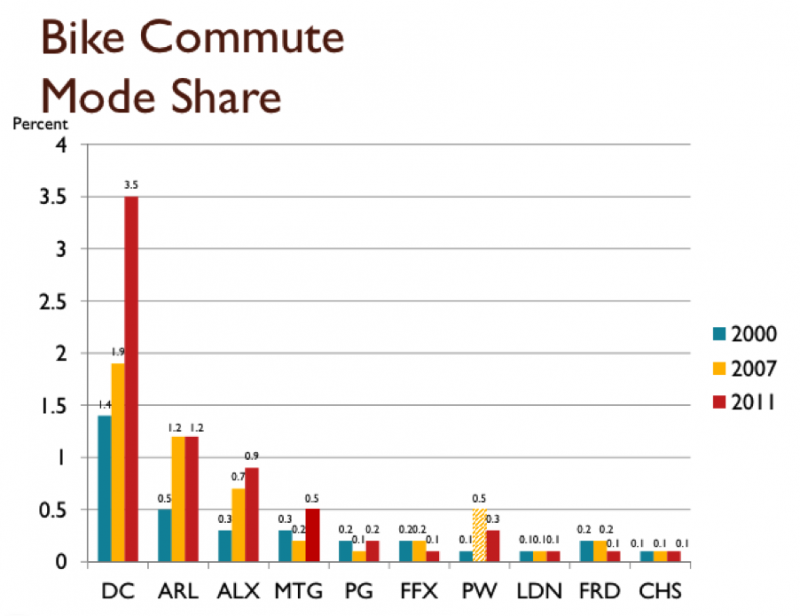
DC has been growing its bicycling bragging rights and swagger over the past few years. New commuting data just add to that. Bicycle commuting in the city more than doubled between 2000 and 2011.
Tanya Snyder of Streetsblog Capitol Hill writes:
In DC, cyclists now make up 3.5 percent of commuters, a big jump since the 1.2 percent mode share of 2000. The next-highest bike mode share is in Arlington, with 1.2 percent, frozen since 2007. Across the region, biking has a 0.7 percent mode share — an increase from 0.3 percent in 2000, but with such a low percentage, it’s hard to read much into the numbers.
Walking to work hasn’t grown the way biking has, but it enjoys a relatively stable 3.2 percent mode share regionally, with 11.5 percent within the city limits. Again, Arlington is the closest runner-up with 5.5 percent mode share.
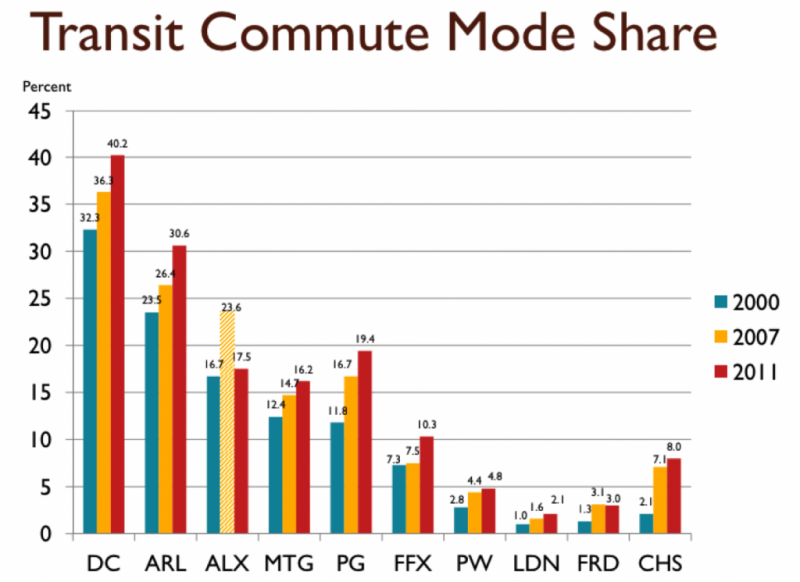
Transit commuting was also way up (see chart above). It actually increased the most, from 11.8% mode share to 15.4%.
Working from home increased from 3.7% to 4.7%.
Carpooling decreased from 13% to 9.7%.
Driving alone dropped from 67.2% to 65.8%, a sobering look at how much room there still is for improvement.
Notably, however, the survey used for collecting this data is highly flawed. From Tanya:
All of these statistics suffer from the problematic phrasing of the Census and American Community Survey questionnaires, which ask how the person “usually” got to work the week before. If more than one mode of transportation was used, the person is directed to only report the one used for the greatest distance. Biking to transit, for example, only counts as transit in most cases. The same principle applies if someone bikes two out of five days per week.
Not ideal.
For more information and insightful commentary, check out Tanya’s full piece.
Sign up for CleanTechnica's Weekly Substack for Zach and Scott's in-depth analyses and high level summaries, sign up for our daily newsletter, and follow us on Google News!
Have a tip for CleanTechnica? Want to advertise? Want to suggest a guest for our CleanTech Talk podcast? Contact us here.
Sign up for our daily newsletter for 15 new cleantech stories a day. Or sign up for our weekly one on top stories of the week if daily is too frequent.
CleanTechnica uses affiliate links. See our policy here.
CleanTechnica's Comment Policy

