CleanTechnica is the #1 cleantech-focused
website
 in the world. Subscribe today!


Cars BetterPlaceEVsCharging

Published on August 8th, 2011 | by Adam Hurwitz

13

First All-Electric Subscription Plan: Car 2.0 Pricing

Share on Google+Share on RedditShare on StumbleUponTweet about this on TwitterShare on LinkedInShare on FacebookPin on PinterestDigg thisShare on TumblrBuffer this pageEmail this to someone

August 8th, 2011 by  

BetterPlaceEVsCharging

“August marks the true premiere of electric vehicles to the world”

Recently

Recently, Tesla, a trailblazer in revolutionizing the current era of electric cars announced the end of production of the original Roadster. Tesla is phasing out the Roadster, which cost over $100k the past few years, and phasing in its new Model S, which will have a version as low as $57,400. As Tesla spokesperson Khobi Brooklyn explained in a Fast Company article titled “The End of an Era” that the roadster made huge advances in the all electric vehicle (EV) industry as a whole by proving that an EV can outperform traditional combustion vehicles as well as by moving along the research and development process to drive down the cost of EVs. This transition towards the cheaper and more family-oriented 4-door Model S represents the larger industry move towards electric vehicles for the mass market, not just the rich sports car enthusiasts that also happen to care for the environment.

Start of a Revolution

“20%-35% cost savings in annual expenses with EVs versus combustion engines”- Better Place

Better Place is at the heart of the movement for affordable EVs with the technology we currently have by separating the ownership of the extremely costly lithium battery with the vehicle. One of Better Place’s slogans is “we don’t make electric cars, we make electric cars convenient.” As explained in my previous article, Car 2.0 Overview, this new infrastructure of battery-swapping stations allows buyers of EV vehicles to pay significantly less for the vehicle because the user pays for the amount of usage, similar to how a traditional driver pays for gas. Since the battery is separated from the vehicle and no longer needs to be built within the car, the user does not have to worry about the high upfront costs that come with a lithium battery.

A similar example is how cell phones are sold. The cost of a cell phone is heavily subsidized by the companies selling them because they do not make money in selling the actual device,.. they make money off of people paying a monthly subscription. When you purchase a traditional combustion vehicle, you pay for gasoline as you need it, not the entire oil well, Shai Agassi points out (inventor of the battery swapping system). He claims these innovations in the production, operation, and business models of electric vehicles are arguments against the high costs and impracticality critics cite in an all-electric solution.

Back to the cell phone analogy: One may only pay around $100 for a phone that would normally cost $500 without agreeing to a 2-year term. Many may complain about the two-year term, but at the same time, it is rare to come across a person these days without a cell phone. According to this system of subscriptions, Better Place will make EVs affordable to the masses in a top-down business strategy, as opposed to companies like Tesla, that started out with a very costly solution and are trying to work their way down.

Big or Bust?…

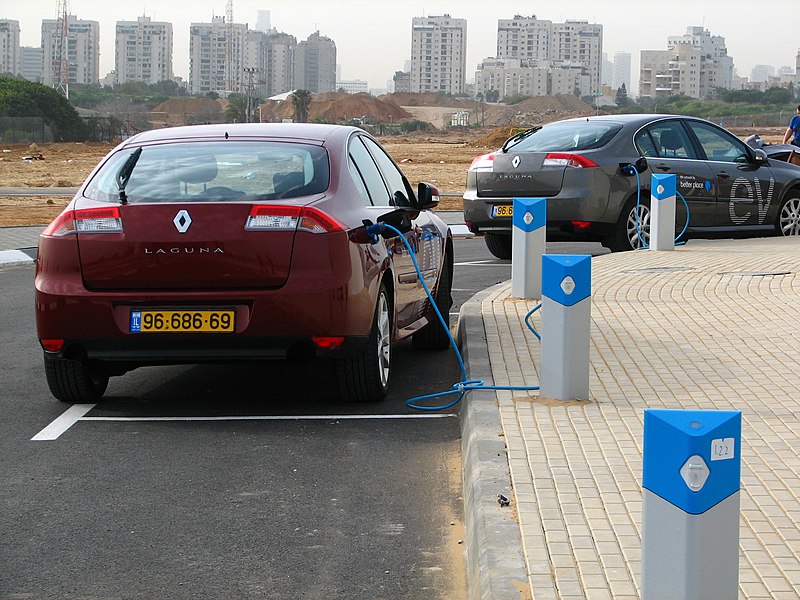
August marks the true premiere of electric vehicles to the world with the first commercial launch of Better Place to the world. In May, Better Place released its subscription prices for its August launch in Israel, claiming a 20% cost savings in annual expenses with EVs versus combustion engines. This will be the first commercial launch of Better Place; all of the other locations across the world — Denmark, Japan, Hawaii, the US, and so on — are conducting feasibility and taxi tests, or still planning their launch timeline, like in Australia, where there will be massive launch ($100 million of the federal government’s money has already been funded in order to prepare smart-grids) and Renault, another true innovator with a “cradle to cradle” approach to operating, will be supplying the 115-mile range EVs.

–>> Continue Reading about the Better Place Launch in Israel on Page 2

Keep up to date with all the hottest cleantech news by subscribing to our (free) cleantech newsletter, or keep an eye on sector-specific news by getting our (also free) solar energy newsletter, electric vehicle newsletter, or wind energy newsletter.


Share on Google+Share on RedditShare on StumbleUponTweet about this on TwitterShare on LinkedInShare on FacebookPin on PinterestDigg thisShare on TumblrBuffer this pageEmail this to someone

Tags: , , , , ,


About the Author

I am driven by an interest in entrepreneurship and technological solutions in sustainability. My passion to create and learn has led me from developing an apparel invention to researching sustainable solutions in the automotive industry.


  • Adam Hurwitz

    To Bob Wallace’s point, “Dropping battery prices and longer ranges work against the BP model. There’s nothing to indicate that we will be locked into expensive 100mile range batteries for long.” as well as to Joebloggs point:

    It is more convenient to just charge your EV at home. This is why with the Better Place package one gets a home charging station as well as another station in the location of their choice, usually a work location. This makes the need for battery-swapping virtually unnecessary.

    Even with cheaper longer range batteries the need for battery swapping stations will be needed. For example, even though we have very highly efficient cars that are hybrid electrics they still require gasoline stations on occasion. The way Better Place’s business plan is designed is to provide the entire system which relies more heavily on charging stations as opposed to swapping stations.

    The x-factor in a business plan so heavily dependent on infrastructure is the government support. Government support in terms of investment as well as logistics is a major factor, yet it is also a major benefit. The benefit is once a government’s support is given Better Place has the business security in that market of a utility company.

  • Joebloggs

    In reply to SODA:
    How can it be convenient when you have to drive out of your way every time you want to swap battery. Is it not MORE CONVENIENT just to plug-in your EV when you get home in the evening??

  • Pingback: First All-Electric Subscription Plan: Car 2.0 Pricing | CleanTechnica

  • Anonymous

    As I’ve posted before, I don’t think Better Place’s model works for long.

    BP needs real estate, buildings, and machinery for its battery swap stations, they need staff, and they need a supply of extra batteries. They aren’t buying one battery per EV, they’re buying somewhere between one and two batteries for each EV on the road.

    When (I don’t think it’s “if”) battery capacity improves enough to give us 200 mile range, few people are going to want to pay to swap batteries when they could charge while parked for small change. They’ll be fine with paying a premium for a Level 3 rapid charge on the occasional long trip.

    Then when battery prices drop (again, not “if”) buyers are not going to find the cost of a new EV as onerous as they now are. And Better Place is still going to be stuck with the facility/staff costs.

    Battery prices don’t have to drop much before payments for an EV are about the same as payments for an ICEV plus the gas differential. Same amount of money out of your pocket until the EV is paid off and then major savings each month.

    Better Place might survive only in places (countries) where people don’t have a place to plug in while parked. I just don’t know where those places might be. It would not be difficult to install outlets in place of parking meters along our city streets for those who don’t have a garage or driveway.

    • Agl

      You half to understand that Better Place also builds the nextwork of charge spots that consumers will use, you have the option to switch if you want, or you can charge anywhere, they pay to build the charge spots, its included with your membership, they estimate that consumers will only need to switch batteries about 15 times a year.

      • Angusclark

        No they don’t! GE, BYD,Delta, ABB, Sanyo, Siemens,Eaton, Aker Wade, Levitron, Tepco, Coloumb, Ecotality, and about 1000 others are or will be selling Level II and III EVSE equipment. Drivers will pay $5 + juice (Kwh) for the convenience of a quick charge. Swapping Stations require the batteries be maintained at full state; something they don’t like…Also, If a driver wants to drop at another station, each station will have to shift inventory around to maintain appropriate levels. Car batteries will be $375/Kwh soon with a 4000 cycle Warranty or 10-Years/100K miles. Vehicle OEM’s won’t build cars with swappable batteries as it’s better for weight & balance to have them inside the frame with crash protection. If the OEM’s really believed in Better Place they would already be on-side. Renault only built these cars ’cause BP PAID for them! Also, if I swap for a nice battery (performance is apparent), why would I want to “roll-the-dice” and take it back and swap it for a crappy one? There may be a Better Place somewhere, but the people and cars are made of recycled BS.

    • Anonymous

      As far as I know, the number of additional batteries they will need in the switch stations is about two percent of the overall number of batteries in the EVs they have in subscription.
      They have also a cooperation with the israeli gas station operator Dor Alon. Better Place will build some of the switch stations at the gas stations. So real estate to build the switch stations is not a problem.
      The switch stations are controlled remotely and operate without staff (except for maintenance and repair).
      Lets watch how this works out in Israel, Denmark end Australia.

      • Anonymous

        It takes real estate, even if gas stations are providing it. And even if there are no employees on site there is a labor cost. There are humans in the loop, even if they aren’t standing beside the battery swap machines. (And they will for a while, at least.) These are costs which add to the overall cost of utilizing a switching system.

        If extra battery requirements are as low as 2% of total batteries, that’s much lower than I expected. I’m not sure they could operate with that low a margin in an area where people tend to make longer holiday trips. Israel is small enough, and boarder-limited, to make switching a possibility.

        I suspect that Better Place switching could work in Israel, but if swapping does not work in the larger world then the market is not likely to build battery swap-able for that small a market.

        Dropping battery prices and longer ranges work against the BP model. There’s nothing to indicate that we will be locked into expensive 100mile range batteries for long.

        BP has been pushing their concept for a number of years. And we’re not seeing EV designs coming to market with swap-ready batteries outside of the Renault especially designed for the initial test. I don’t get the feeling that the industry sees things going in this direction but toward longer range, cheaper batteries, and Level 3 chargers for all-day driving.

        Certainly we’ll watch. We’re all just guessing how things will spin out.

        • sola

          Although, I find their prices pretty much inflated, I don’t think the Better Place concept is bad.

          Their system would really make EVs convenient.

    • Angusclark

      Exactly Bob-I’m tired of I’ll-Informed “wannabe” journalists drinking the Better Place “Kool-Aid”

  • Freealex1

    In your analysis of Better Place’s service plans, you’re making a comparison against driving costs in the USA. However, gasoline/petrol costs more than twice as much in Israel as it does in the USA. ‘BP’ (unfortunate abbreviation, I know) is making a savings claim against Israeli (not American) fuel PLUS maintenance costs; on that basis, they seem sound.

    Of course, they are going to charge as much as they can on a per kilometre basis, as their margin is the spread between the price of electrons / kilometre and the cost of gasoline / kilometre.

    Margins would likely be smaller in the USA as gasoline is cheaper. But then again, electrons are also likely cheaper, though I don’t know offhand by how much.

    • Agl

      Ya, gas comes out to about $9/gallon in Israel, and most of this comes from Egypt, which means there is a constant threat of $50 a gallon should the Egyptian gov decide to cut Israel off.

    • Adam Hurwitz

      Freealex1, Israeli gas prices being significantly higher is a very valid point. Better Place’s claim is not just limited to Israel though, it is a savings claim for this system to work across the entire world. That is why battery swapping is currently being tested in Australia, Japan, Denmark, as well as the United States. That being said, because gas prices around the world are higher than the states in most places as well as the factor of maintenance costs, it may be a feasible claim. It will be very interesting to see how this launch goes!

      By the way, I thought about using that abbreviation multiple times as well. I wasn’t sure if I was comfortable with it. :-)

Back to Top ↑