Einstein Refrigerator Making a Comeback?
Support CleanTechnica's work through a Substack subscription, on Patreon, or on Stripe. Help us produce all of the high-quality, original content we publish week after week despite the challenges of content-scraping AI, antisocial media, inflation, and other hurdles.
 Albert Einstein is probably most remembered by the public for his General Theory of Relativity, but how many remember his 1930 invention of a refrigerator that used no electricity? I wasn’t there when it was introduced, but I knew several people who had one, and they weren’t all that happy with it, primarily because it wasn’t that efficient.
The idea was great, it operated without electricity, using ammonia, butane and water. The principle being that water boils at a much lower temperature at high altitudes where air pressure is lower than it does when you’re at sea level, where air pressure is higher.
Malcom McCulloch, an electrical engineer at Oxford University in the U.K., is leading a team in a three year project to produce appliances that can be used in places without electricity. Or, for that matter, places with electricity, why not?. That’s when McCulloch latched on to Einstein’s fridge idea.
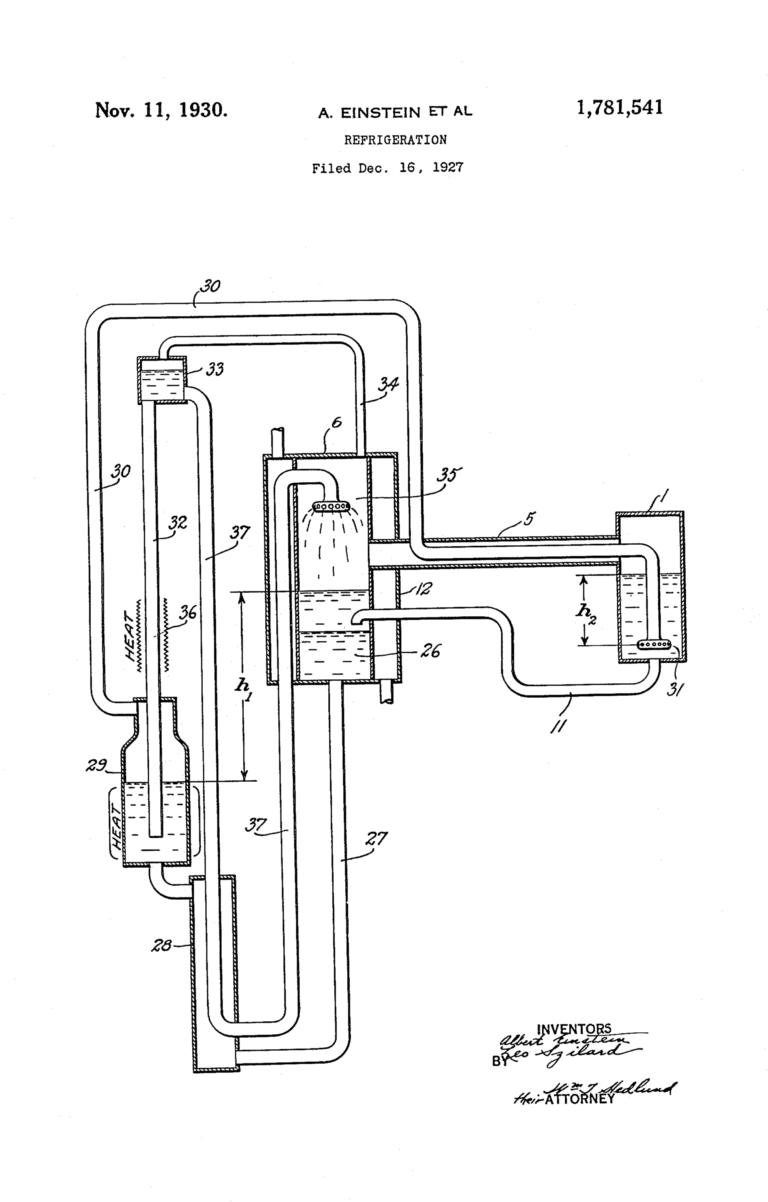
Einstein’s concept, shown in the image above, works thusly. At one side is the evaporator, a flask that contains butane. “If you introduce a new vapor above the butane, the liquid boiling temperature decreases and, as it boils off, it takes energy from the surroundings to do so,’ says McCulloch. ‘That’s what makes it cold.”
But, like I said, it wasn’t all that efficient and by the time Einstein died in 1955, his invention had been replaced by the system we now use, a freon gas, or replacement, and a compressor run by electricity. Freon has been linked to its eventual effect on the ozone layer above the South Pole, and has been phased out of use by the automobile industry in favor of less or non-polluting gasses.
To offset the use of electricity to operate the system, McCulloch is investigating the use of solar energy to operate a heat pump. He says, “No moving parts is a real benefit because it can carry on going without maintenance. This could have real applications in rural areas.” The team is also tweaking the original design and replacing different gasses to improve efficiency.
Camfridge, a Cambridge-based start-up company, has a fridge that uses magnetic fields to cool things. Managing Director Neil Wilson put it this way, “Our fridge works, from a conceptual point of view, in a similar way (to gas compressor fridges) but instead of using a gas we use a magnetic field and a special metal alloy.” He went on to say, “When the magnetic field is next to the alloy, it’s like compressing the gas, and when the magnetic field leaves, it’s like expanding the gas.” He added: “This effect can be seen in rubber bands – when you stretch the band it gets hot, and when you let the band contract it gets cold.”
The creation of greener refrigeration systems can have a huge effect on the environment and lifestyles of millions, as outlined by Greenpeace U.K Chief Scientist, Doug Parr. “If you look at developing countries, if they’re aspiring to the lifestyles that we lead, they’re going to require more cooling – whether that’s air conditioning, food cooling or freezing. Putting in place the technologies that are both low greenhouse-gas refrigerants and low energy use is critical.”
How soon will a non-electric refrigerator or cooling system being humming..or whatever it does..at your place? McCulloch admits his fridge is in the very early stages. “It’s very much a prototype; this is nowhere near commercialised,” he said. “Give us another month and we’ll have it working.”
Posts Related to Refrigeration
Refrigeration Goes Solar To Help The World
GE’s Ecomagination: Green is Universal
GreenBuildingTalk: Energy Efficient Appliances
Tapping the Wind and Sun to Save Water
Sign up for CleanTechnica's Weekly Substack for Zach and Scott's in-depth analyses and high level summaries, sign up for our daily newsletter, and follow us on Google News!
Have a tip for CleanTechnica? Want to advertise? Want to suggest a guest for our CleanTech Talk podcast? Contact us here.
Sign up for our daily newsletter for 15 new cleantech stories a day. Or sign up for our weekly one on top stories of the week if daily is too frequent.


CleanTechnica uses affiliate links. See our policy here.
CleanTechnica's Comment Policy