


Support CleanTechnica's work through a Substack subscription or on Stripe.
Betting against China in space has become one of those comfortable Western assumptions that deserves to be retired. It sits beside earlier assumptions that Chinese solar would remain second tier, Chinese EVs would remain cheap copies, and Chinese batteries would never define global cost curves. The pattern is familiar. Analysts focus on one product, one milestone, or one charismatic founder, then miss the system being built underneath.
China is not winning space through spectacle. It is building space as national infrastructure. That is the more important point. The question is not whether China can beat NASA or SpaceX at every technical frontier this year. It cannot. The question is whether China is building sovereign, improving, scalable capability across every strategic layer of the space economy. On that test, the answer is increasingly yes.
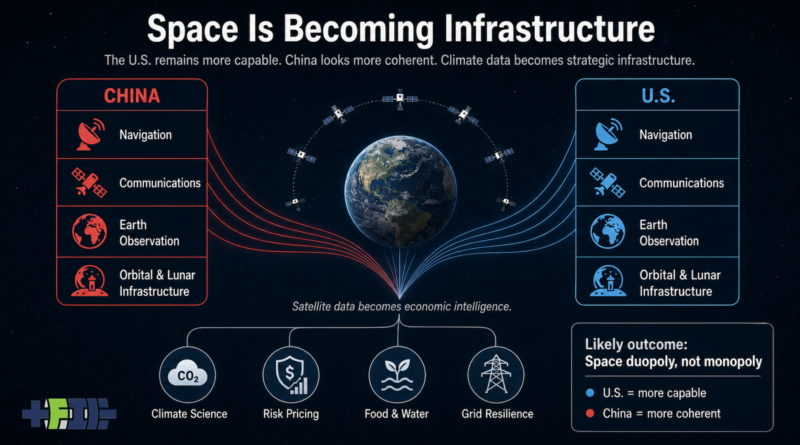
BeiDou is not merely a GPS competitor. It is independence from U.S.-controlled positioning, navigation, and timing. Tiangong is not a smaller ISS vanity project. It is independence from Western crewed orbital infrastructure. Gaofen, Yaogan, Jilin, and Chinese radar constellations are not just imagery satellites. They are independence from Western commercial and military Earth observation. Guowang and Qianfan are not just Starlink copycats. They are attempts to ensure that low-Earth-orbit broadband does not become another U.S.-controlled layer of global communications.
The same pattern appears beyond Earth orbit. Chang’e made China a serious lunar power, including the first far-side sample return. Tianwen put China into the top tier on Mars by combining orbit, landing, rover operations, and a planned sample-return path. Tiangong gives China a sovereign platform for microgravity science, materials work, life sciences, and in-orbit manufacturing experiments. None of these systems has to be best in class on day one. They have to be good enough, domestic, operational, and improving.
That is what many Western takes miss. China’s achievement is not one miracle. It is compounding. Navigation supports missiles, logistics, finance, aviation, shipping, agriculture, and phones. Launch capacity supports constellations. Constellations support communications, imagery, weather, and military resilience. Space stations support science and materials development. Lunar relay satellites support future lunar operations. Earth observation supports disaster response, crop monitoring, methane detection, coastal planning, and geopolitical influence. The pieces reinforce one another.
China’s own policy language makes this clear. Its space white paper describes space as part of the country’s overall national strategy. That is not decorative phrasing. Chinese official reporting said China conducted 92 space launches in 2025, up 35% from 2024, and pointed to 2026 activity across crewed missions, reusable rocket tests, satellite internet deployment, Tianwen-2, and commercial space. That is an industrial program, not a press release.
The United States still has the higher ceiling. SpaceX is an extraordinary advantage. Falcon 9 changed launch economics, Starlink changed satellite communications, and Starship could change mass-to-orbit if it proves routine reuse, upper-stage recovery, large-scale cryogenic refueling, and high-cadence operations. NASA science remains deeper than China’s. JPL, APL, NOAA, USGS, the National Reconnaissance Office, Space Force, U.S. universities, national labs, venture capital, commercial imagery firms, and allied partners together form a system China cannot yet match.
But the U.S. system has become high variance. It can produce SpaceX. It can also produce budget chaos, mission cancellations, climate science attacks, and overreliance on one founder-controlled private company. That is not a small concern. Space leadership depends on continuity, not just brilliance.
Starship captures both the opportunity and the risk. If it works as promised, it could give the United States an advantage in heavy launch, Starlink V3 deployment, lunar cargo, military proliferated constellations, space stations, large telescopes, and maybe orbital manufacturing. It is one of the most important engineering efforts in the world. But importance is not the same as certainty.
Starship has not yet proven the full package. The hard problems are not promotional videos of stainless steel towers and dramatic launches. They are upper-stage reuse, heat-shield durability, safe and rapid turnaround, orbital propellant transfer, pad infrastructure, methane and oxygen logistics, regulatory cadence, and lunar mission integration. NASA’s inspector general has identified Starship lunar lander delays and in-space cryogenic refueling as major Artemis risks. Reuters has reported that SpaceX has spent more than $15 billion on Starship and still faces major issues in ground infrastructure, heat-shield reuse, and refueling.
A rational U.S. strategy should want Starship to succeed while refusing to build national plans on Musk timelines. That distinction matters. A rocket can be transformative and still late. A company can be brilliant and still represent concentration risk. A founder can be useful to national capability and still be the wrong place to locate public accountability.
The private hands problem is now serious. SpaceX provides launch, crew transport, cargo transport, Starlink communications, Starshield and government services, and the Artemis lunar lander. That concentration is efficient when interests align. It is risky when national capability depends on one company, one governance structure, one founder, and one political relationship. The answer is not to punish SpaceX. That would be foolish. The answer is to make sure SpaceX is not a single point of national failure.
That means redundancy. It means keeping Blue Origin, Rocket Lab, ULA, Stoke, Sierra Space, Axiom, Vast, Northrop Grumman, Lockheed Martin, and others in the game where they can create real alternatives. It means stronger continuity clauses in critical communications contracts. It means government step-in rights where public infrastructure is being delivered privately. It means NASA and the Department of Defense need enough in-house technical competence to judge contractor claims instead of buying narrative wrapped in renderings.
NASA science is also not optional. It is often treated as separate from the space race, but it is part of the strategic base. NASA science creates instruments, mission managers, datasets, engineers, scientists, universities, contractors, international partnerships, and credibility. Cutting it does not just save money. It weakens the measurement and talent system that makes later achievements possible.
This matters most for Earth observation and climate. NASA, NOAA, USGS, and Europe’s Copernicus form much of the trusted public data layer for the planet. That layer supports weather forecasting, climate science, methane monitoring, crop assessment, wildfire risk, drought analysis, sea-level monitoring, disaster response, and infrastructure planning. Treating climate science as expendable is not fiscal discipline. It is strategic self-harm.
Climate data is becoming strategic infrastructure because the physical economy is becoming harder to manage without it. Insurers need flood, wildfire, hail, wind, and coastal exposure data. Farmers need crop stress and soil moisture signals. Utilities need wildfire and heat risk. Ports need sea-level and storm-surge planning. Oil and gas firms face methane measurement and repair requirements. Cities need heat, drainage, and emergency response intelligence. Militaries need climate-aware basing, logistics, and operating data.
The investment implication is not simply “buy space.” That is how people lose money in stylish ways. Hardware is hard. Satellites fail. Launch schedules slip. Government contracts change. Unit economics matter. Customer willingness to pay matters. The more durable thesis is that trusted planetary measurement and climate intelligence will become more valuable as physical risk becomes more expensive.
The investable areas are the layers that turn observation into decisions: methane detection and repair, geospatial AI, flood and wildfire risk analytics, insurance and reinsurance models, crop monitoring, water infrastructure intelligence, grid resilience, maritime monitoring, disaster-response platforms, and carbon measurement, reporting, and verification. Public science provides the reference layer. Private firms can provide resolution, speed, workflow integration, and analytics. Damage the public layer and the private layer does not automatically thrive. It inherits weaker calibration, weaker validation, and weaker trust.
China understands the geopolitical side of this. It can offer satellites, ground stations, financing, training, weather services, and disaster-monitoring partnerships to countries that need them. For a country facing drought, flood, crop loss, cyclone risk, weak domestic monitoring capacity, and limited capital, that is useful. If the United States weakens its public climate-data institutions while China shows up with tools, training, and infrastructure, influence shifts. Not because China won an abstract argument, but because it provided an operating capability.
This does not mean Chinese data should be trusted blindly. State-directed systems carry risks of opacity, selective release, military overlap, and political incentives. But the answer is not to degrade Western science. The answer is to make the open-data stack stronger, more redundant, more international, and harder to politicize. Europe’s Copernicus matters for that reason. NASA and NOAA matter for that reason. Japan, India, Canada, Australia, universities, and commercial providers all matter for that reason.
The most likely future is not Chinese dominance or continued U.S. monopoly. It is space duopoly. The U.S.-led stack will remain strong in commercial dynamism, elite science, allied integration, open research, venture-backed experimentation, and reusable launch if Starship matures. The China-led stack will be strong in state continuity, sovereign capability, industrial policy, infrastructure export, and geopolitical alignment with countries that want alternatives to U.S.-controlled systems.
The useful summary is simple. The United States remains more capable. China looks more coherent. That should focus minds. The next space race will be less about who plants a flag and more about who can measure, communicate, navigate, launch, observe, and operate continuously. China is treating that as national infrastructure. The United States still can, but only if it remembers that brilliance is not a substitute for strategy, and that public science is not a decorative expense.
Sign up for CleanTechnica's Weekly Substack for Zach and Scott's in-depth analyses and high level summaries, sign up for our daily newsletter, and follow us on Google News!
Have a tip for CleanTechnica? Want to advertise? Want to suggest a guest for our CleanTech Talk podcast? Contact us here.
Sign up for our daily newsletter for 15 new cleantech stories a day. Or sign up for our weekly one on top stories of the week if daily is too frequent.

CleanTechnica uses affiliate links. See our policy here.
CleanTechnica's Comment Policy