

Support CleanTechnica's work through a Substack subscription or on Stripe.
Originally posted on The Conversation.
By and *

The famous inventor Edwin Land said, “It’s not that we need new ideas, but we need to stop having old ideas.” He seemed to be telling us that solutions lie just beyond our old habits of thinking.
Cities, states and countries around the world are committing to clean energy economies that run on very high levels — even 100% — of renewable energy. In New York state alone, four competing bills target 50% to 100% renewables by or before 2040.
Realistically, only two renewable energy resources are large enough to meet these very high-penetration objectives on the supply side in the U.S. – solar (by far) and wind.
Both, however, are variable resources, driven by weather as well as daily and seasonal cycles. Therefore, they must be “firmed” – that is, capable of delivery power on demand – in order to replace fossil resources which can be dispatched as needed. Based on our research, we contend that this firm power transformation is not only possible, it is also affordable – if we stop having old ideas.
One entrenched, and very prevalent, idea – likely a result of historically high renewable energy prices – is that all the power generated by renewable resources must be sold as it is generated. The idea of discarding available wind or solar output is anathema, imposed on power producers when production from these sources exceeds what the grid can accept.
This old idea ignores a fundamental proposition: oversizing and proactively curtailing wind and solar. However counterintuitive, a study our colleagues and we conducted shows that these steps are the key to the least expensive path to an electric grid powered largely by solar and wind.
Weighing Against Energy Storage
The reasoning behind overprovisioning solar and wind is straightforward:
- Energy storage is the one essential ingredient needed to fill renewable energy variability when the sun does not shine or the wind does not blow. These gaps include intra-day periods, such as hours of peak demand during the day and nights, and more importantly, larger multi-day and seasonal gaps from sustained low-sun or low-wind conditions. For storage, grid operators – the organizations that ensure power supply matches demand as it rises and falls during the day – typically rely on water reservoirs called pumped hydro or, for shorter periods, batteries.
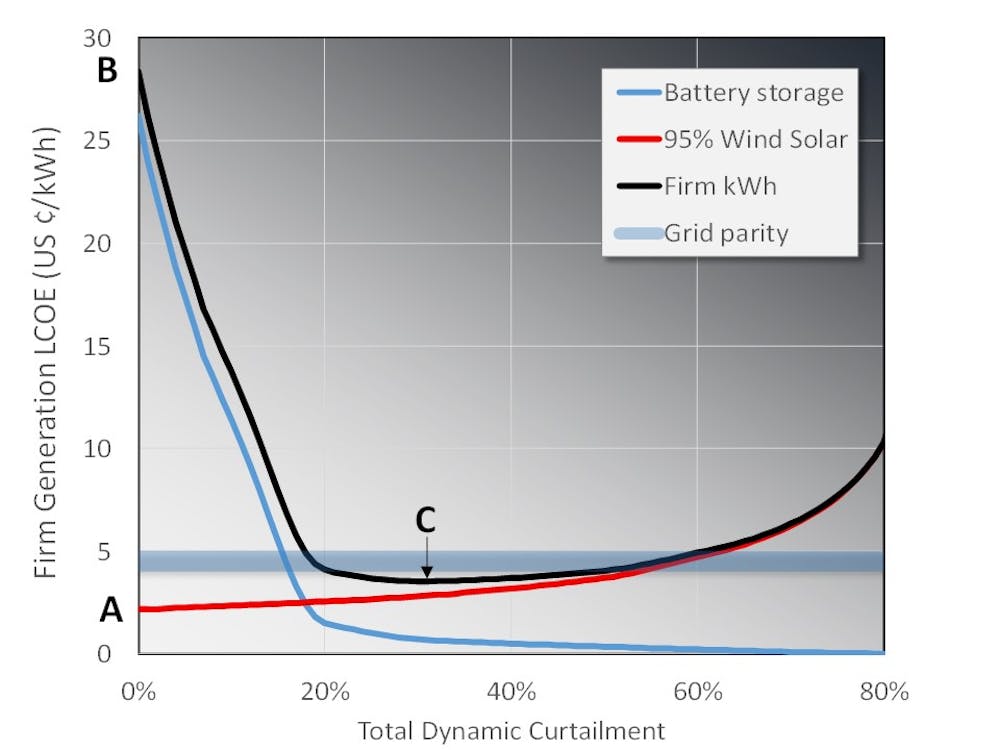
- Storage is getting cheaper, but even assuming the most optimistic long-term cost projections, our study led us to conclude that applying storage alone to firm wind or solar will remain prohibitively expensive because of the size of multi-day and seasonal gaps. Wind and solar are becoming much less expensive as well, especially solar, to the point where overbuilding is increasingly affordable. This is true even when the output from wind and solar generators is essentially dumped, or “curtailed,” and not fed into the grid.
- Oversizing reduces production gaps because more energy output is available during periods of low solar and wind availability. Overbuilding also reduces storage requirements.
“Firming” With Overcapacity
Today, the current regulatory practice for solar and wind-generated electricity favors maximizing production at all times. The companies that operate these facilities seek to sell all their output at the highest prices, so curtailing output is seen as a revenue loss.
That old operational idea inhibits the transition to relying on solar and wind as firm, on-demand sources, since all their output is used only when it is available. This approach also keeps renewable energy at the margin.
How would a grid with overbuilt solar and wind resources work in practice? Let’s say the operator of a regional electricity grid needs X megawatt-hours/day to meet demand. Today the solar farms in that region can meet or exceed this demand only on days of the highest production, such as clear days in the summer. On other days, the production gaps are met by storage.
By contrast, when the solar resource is oversized, that solar generator can meet the X MWh/day demand more days of the year and there are fewer gaps — hence there are fewer times that energy storage is need to fill the gaps.
Once firmed up through a combination of overprovisioning and storage, variable renewable energy resources become effectively dispatchable — able to provide power when as needed — and functionally equivalent to traditional power plants. In this way, renewables can replace these generators without major grid reengineering.
Our team has modeled a high-solar and overbuilt solution for the not particularly sunny state of Minnesota. The goal was to determine the least costly combination of grid-connected solar, wind and storage necessary to provide round-the-clock, year-round energy services.
The study demonstrates that overcoming the natural variability of solar and wind can be accomplished at costs below current grid costs (so-called “grid parity”) by overbuilding solar and wind resources and adopting a grid operating strategy of allowing about 20% to 40% curtailment of excess energy generation. Energy storage is also used in our model, but the superior economics directly result from substituting excess curtailable generation for more expensive storage.
A legitimate question to ask is what would be the area required for a full deployment of oversized solar PV. For Minnesota, in the most extreme 100% PV generation scenario assuming oversizing by a factor of two – or doubling the solar needed to meet current demand – this area would amount to 435 square miles, assuming solar panels with state-of-the-art efficiency of 20%. This area represents less than 1% of the state’s cultivated crops and half of the high- and medium-density urbanized space.
Tweaking How The Bulk Power Grid Is Run
In addition to oversizing, curtailment and storage optimization, several operational and planning practices, some of which are already done now, would further enhance the value and performance of a high-solar grid and foster its realization with minimal disruptions. They include:
- Exploiting the complementary performance and variable operating profiles of solar and wind. In most locations wind and solar have complementary diurnal and seasonal production profiles – wind higher at night and in winter, PV higher in the daytime in summer.
- Utilizing demand management – the practice of reducing power use at electricity customer locations – as a way to minimize supply and demand gaps.
- Enabling grid operators to have authority over renewable energy siting and production management within their regions so that decisions over when curtailment occurs or storage is applied are made on a regional basis to minimize gaps in supply and demand.
An attitude of maximizing renewable energy production and avoiding curtailment made sense when variable solar generation was extremely expensive and firming solutions were even more expensive. However, recent and forecast reductions in turnkey solar, grid management and storage costs are changing the optimal solution set, starting with overbuilding solar.
Marc Perez, senior researcher at Clean Power Researcher, who wrote his dissertation at Columbia University on this subject, contributed to this article. Morgan Putnam, VP of Solar Analytics at REsurety, also contributed.
*Richard Perez is Senior Research Associate in Atmospheric Sciences Research Center, University at Albany, State University of New York
*Karl Rabago is Professor of Law; Executive Director, Pace Energy and Climate Center, Pace University
Sign up for CleanTechnica's Weekly Substack for Zach and Scott's in-depth analyses and high level summaries, sign up for our daily newsletter, and follow us on Google News!
Have a tip for CleanTechnica? Want to advertise? Want to suggest a guest for our CleanTech Talk podcast? Contact us here.
Sign up for our daily newsletter for 15 new cleantech stories a day. Or sign up for our weekly one on top stories of the week if daily is too frequent.

CleanTechnica uses affiliate links. See our policy here.
CleanTechnica's Comment Policy