


Support CleanTechnica's work through a Substack subscription or on Stripe.
After the December end-of-incentive sales rush (NEVs are no longer exempt from purchase tax this year), and the following sales slump, high gas prices and a never ending wave of new models has allowed April to reach record EV market share, with plugins surpassing the 60% barrier for the first time!
But while in the past it was achieved thanks to record EV sales, this time, this is thanks to a significant ICE (internal combustion engine) crash. The overall market dropped 22% year over year (YoY), to around 1.4 million sales. ICE-powered models were at the epicenter of this disruption, crashing 37% YoY, but plugin hybrids (PHEVs) were also down 25% in April, and even extended-range electric vehicles (EREVs) dropped, albeit a more moderate 11% YoY.
The only thing that grew in April? Pure electrics. Despite having fewer incentives, BEVs were up 2% YoY, to 579,000 sales. So, this meant that BEVs scored a record 42% BEV share in China!
Adding PHEVs (13% share) and EREVs (6%) to the tally meant that in April a record 61% of all cars sold in China had a plug!
This result pulled the 2026 share to 49% (in the same period last year, it was at 48% share). BEVs on their own were also up, to 32% (30% BEV in Jan–April ’25). Expect to see plugins north of the 50% mark, and BEVs over 33%, at the end of the first half of the year.
Another interesting statistic is that the breakdown between pure electrics and plugin hybrids is shifting, to the profit of BEVs. At the beginning of the year, PHEVs were profiting from the incentive-derived BEV drop, but pure electrics are returning with a vengeance. April showed a 68% vs. 32% breakdown, to the benefit of BEVs, significantly above the 65%/35% average of 2026.
Having a quick look at Chinese exports — even here plugins are breaking new ground. EV share scored a record 53%, or 406,000 units, in April alone. And with Chinese OEMs fast winning share overseas, markets where they are present in large volumes are also being quickly electrified….
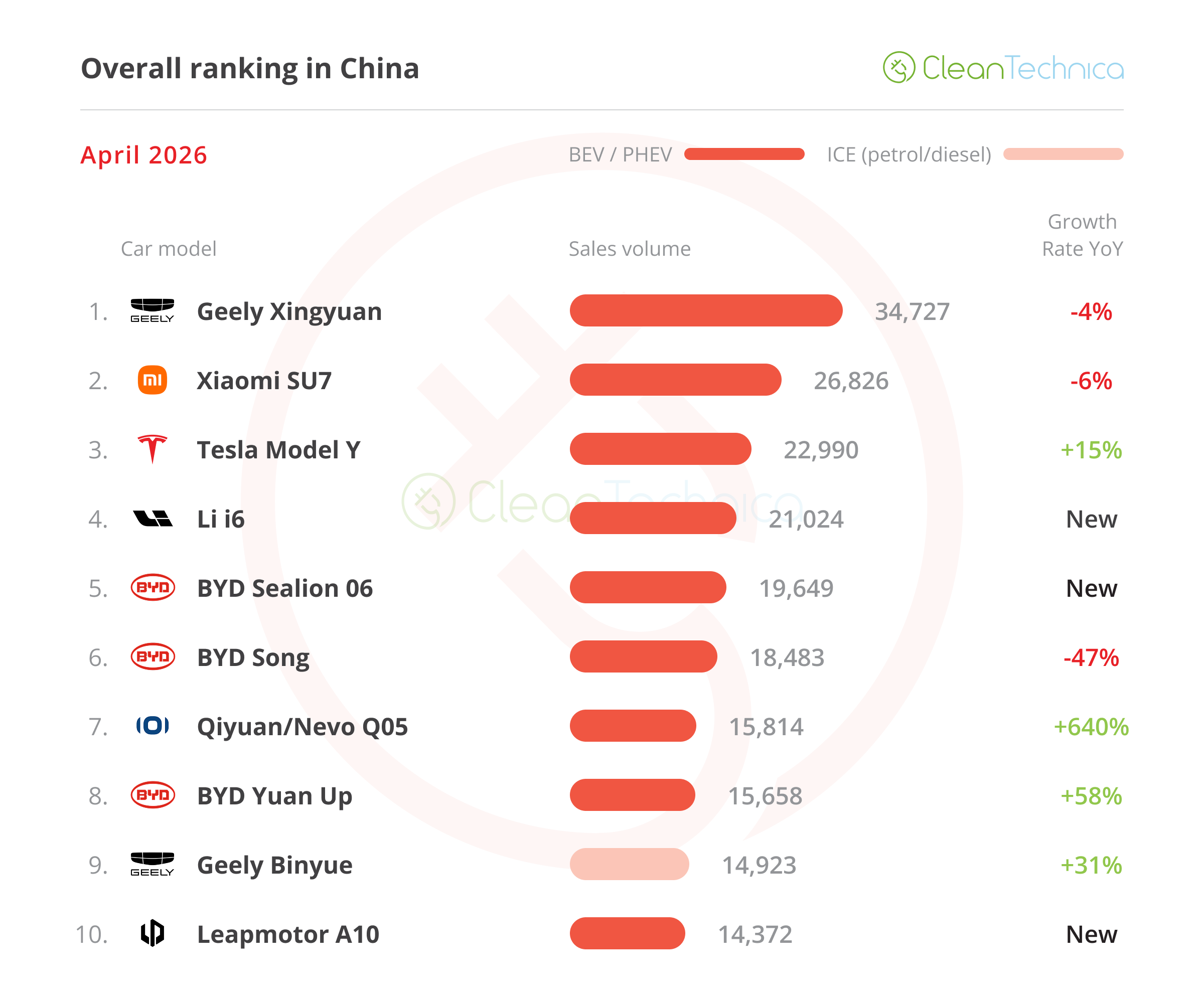
All these disruptions are visible in the overall ranking. In the first months of the year, ICE models were populating the top positions, but April saw them reduced to just one representative, and it was only in 9th (the small Geely Binyue).
Which also meant that there were no representatives from foreign legacy OEMs among the top 10 models in the overall market in China…. Yep, there is no way to hide the bloodbath anymore.
Six years ago, the Chinese top 10 was made of 6 foreign legacy OEM models (1 Nissan, 3 Volkswagens, 1 Toyota, and 1 Buick), next to 4 models from local brands (2 Geely, 1 Haval, and 1 Changan). Now the best selling model from a foreign legacy brand is only … 19th overall (VW Lavida).
And while foreign brands still represent a sizeable chunk of the disappearing ICE sales, looking just at plugins, local brands already represent 80% of sales! If nothing is done to revert this trend, in four years, foreign brands could own just 20% of the Chinese car market!
Another trend is the BEV push being quite visible in the top 10. The top 4 models are pure electrics, and 7 out of the 10 models on the table are BEVs, with the remaining being one ICE model and two mixed models (BEV+PHEV).
With this in mind, it’s only a question of time until we see a 100% plugin top 10 (June?), with the next question now being: When will we see a fully BEV top 10?
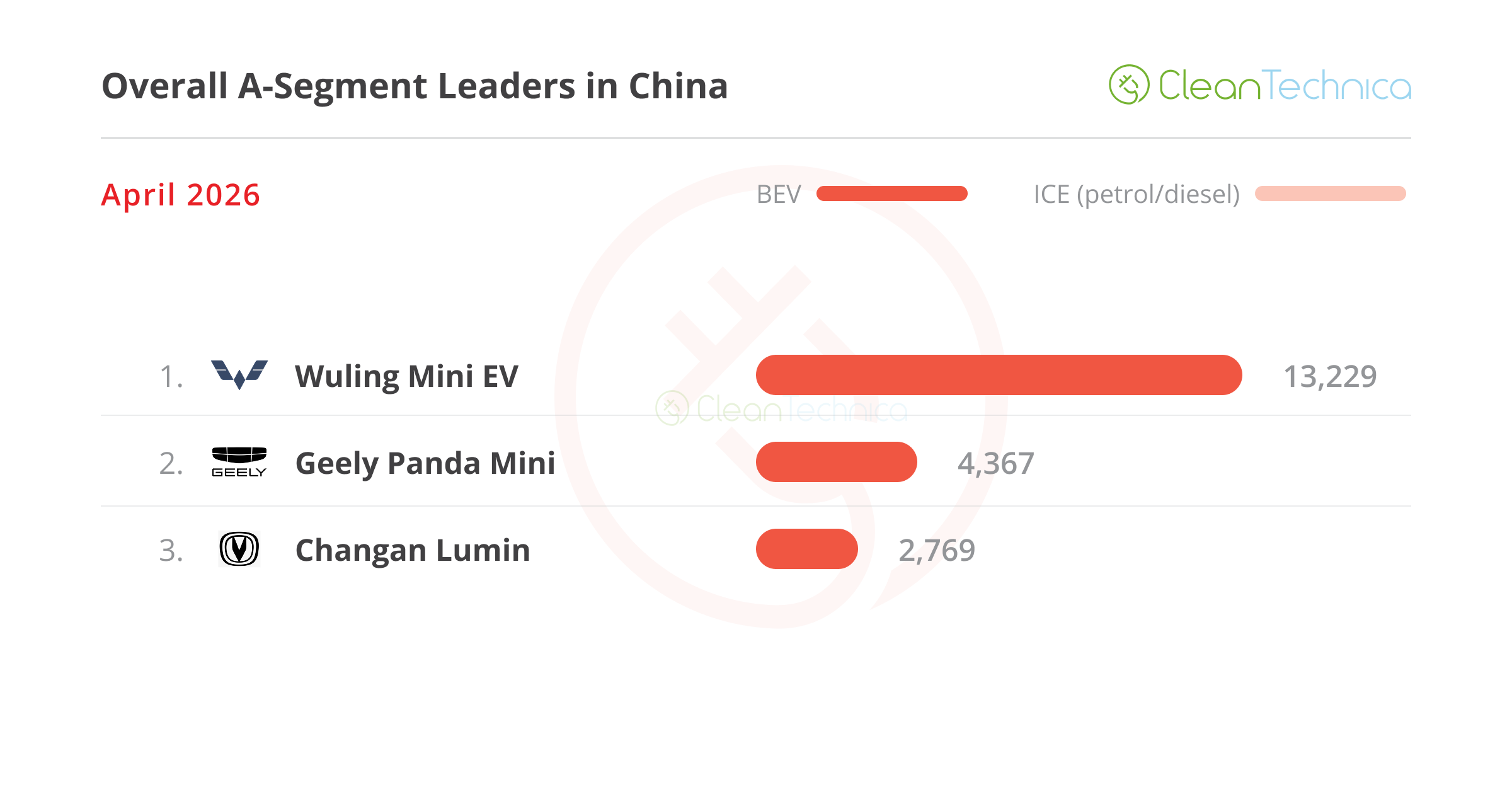
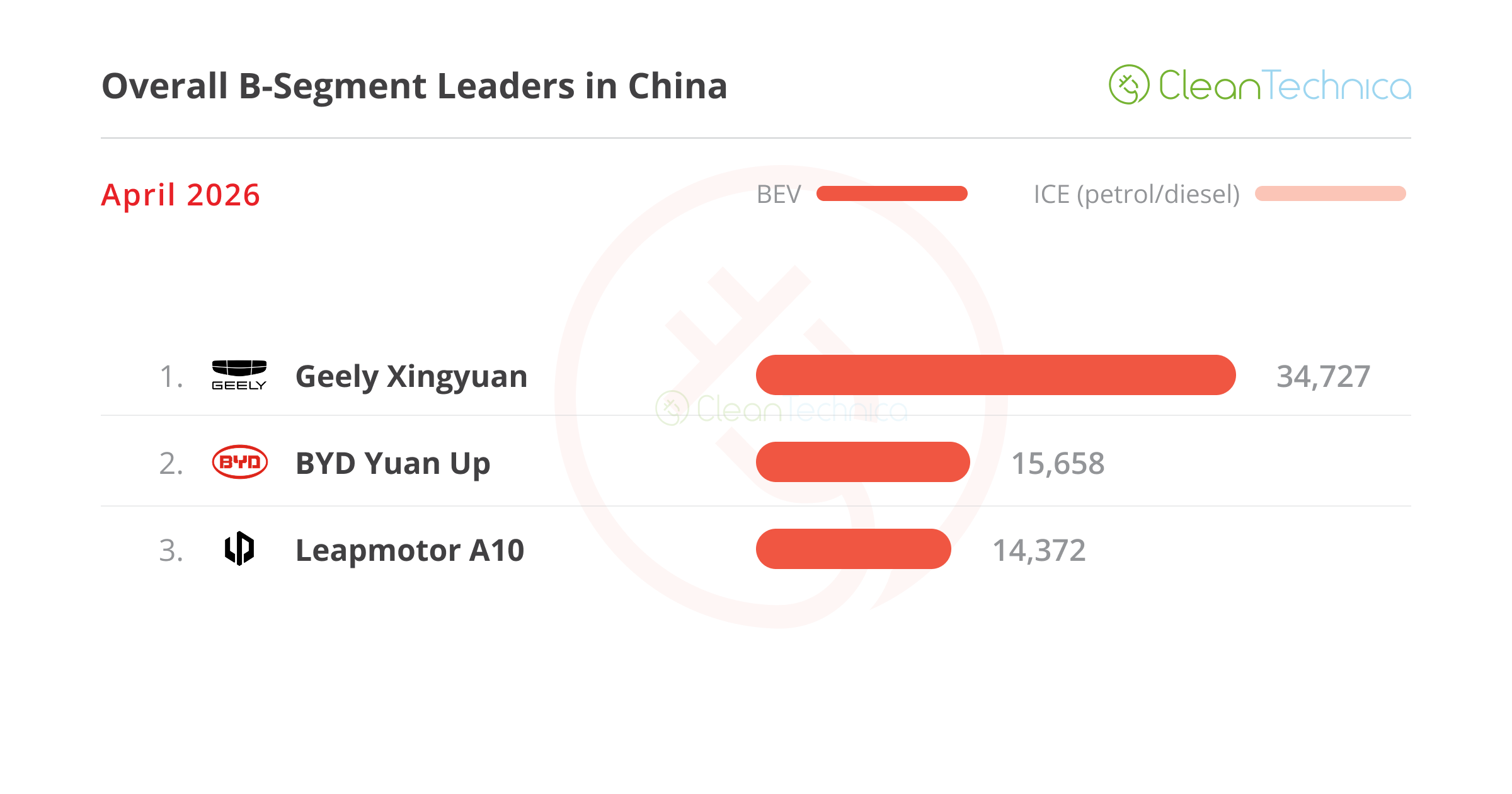
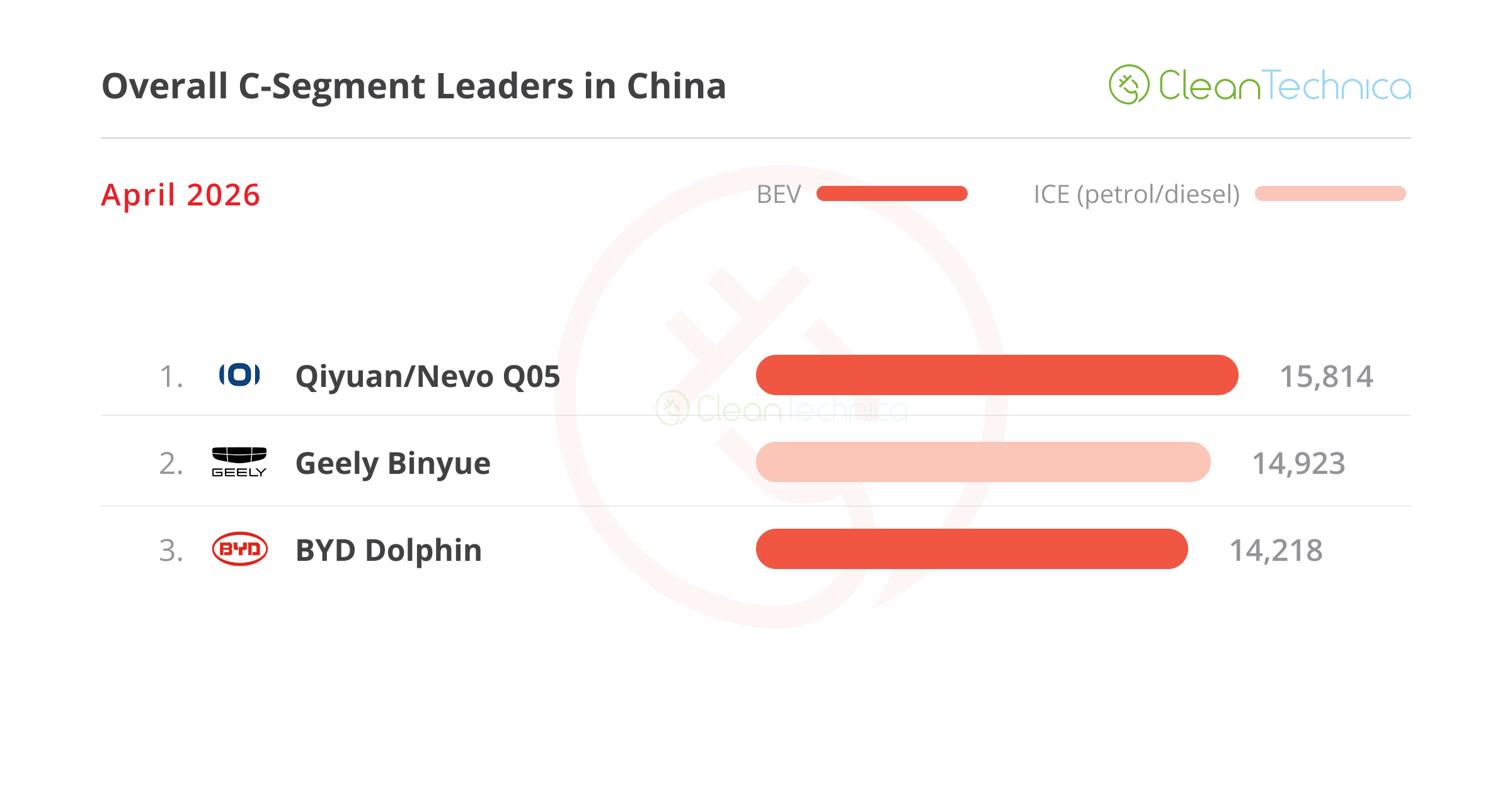
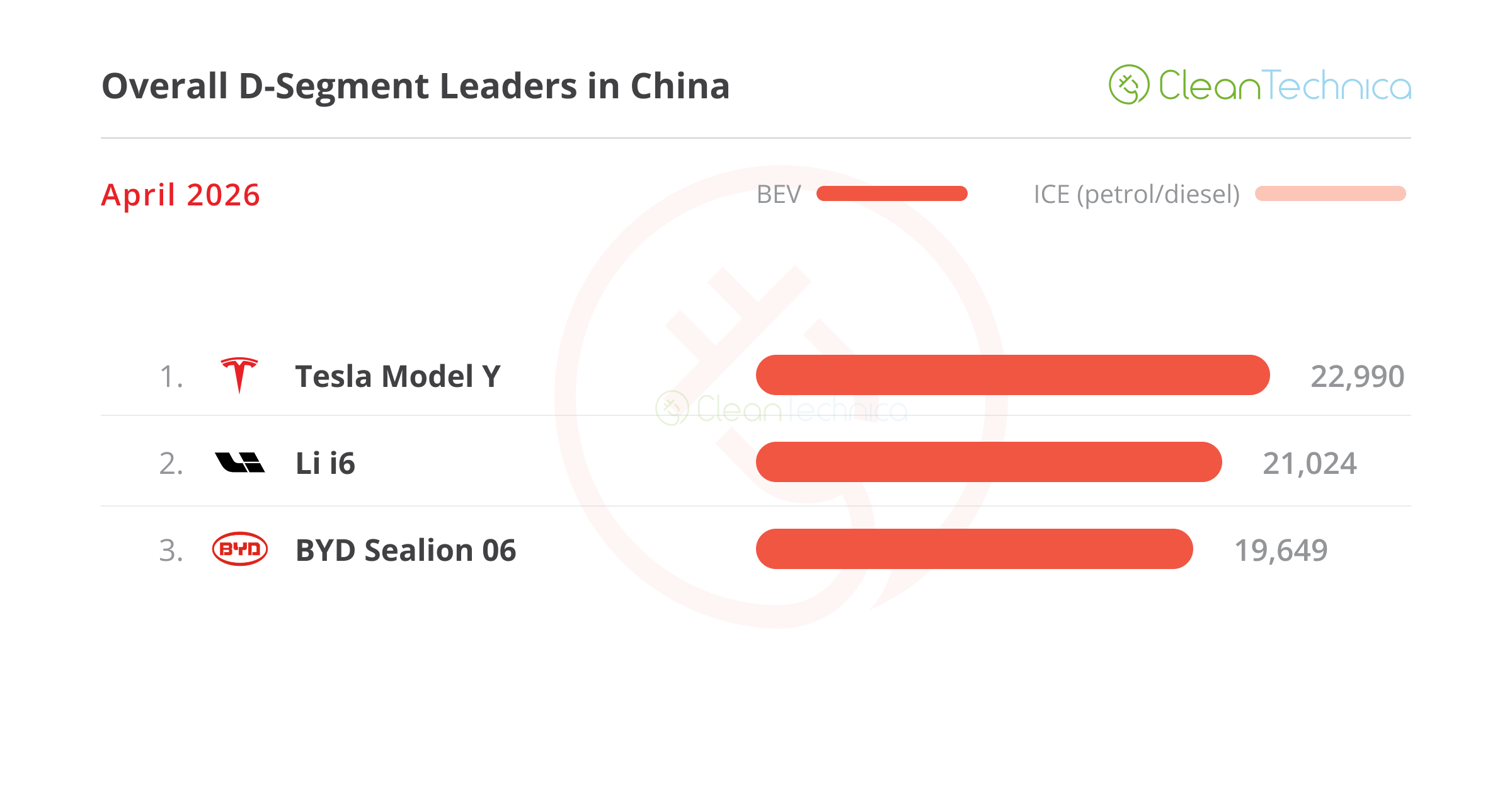
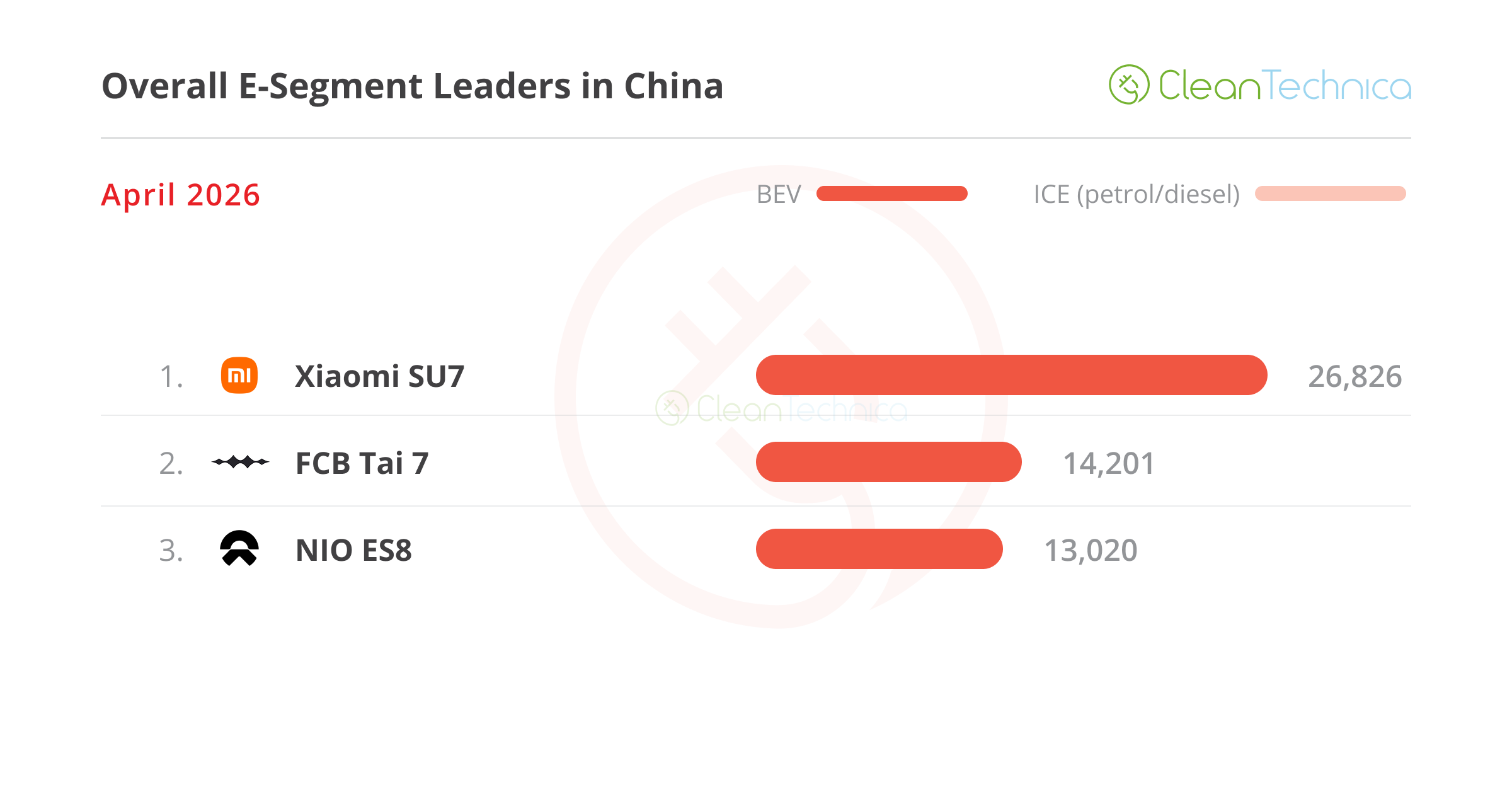
Looking at the best sellers in several size categories, the EV push is also quite visible, as even the C-segment (compact cars) has a BEV majority. In fact, there was only one ICE model in all five categories (the Geely Binyue, in the C segment). As such, it’s only a question of time until ICE models are removed from all the podium positions, with the next target now being removing mixed powertrain (BEV+PHEV) models.
Also, a note for policymakers in China: the category most affected by the subsidy cut was city cars, with the category having dismal results since then. Only the Wuling Mini EV has sold in half-decent numbers. Just to give an idea of the sales drop, this month’s 3rd placed Changan Lumin scored fewer than 3,000 units, while in the same month a year ago, it had 13,000 … and wasn’t even on the podium! Maybe it would be a good idea to create some kind of Kei-car category to revive sales of city cars?
Looking at individual models, the biggest surprise was the Xiaomi SU7 winning the full size category. Thanks to a recent refresh, Xiaomi’s sporty sedan left its competitors, including its YU7 sibling, in the dust. Will this be a one-time thing, or is the SU7 back for good?
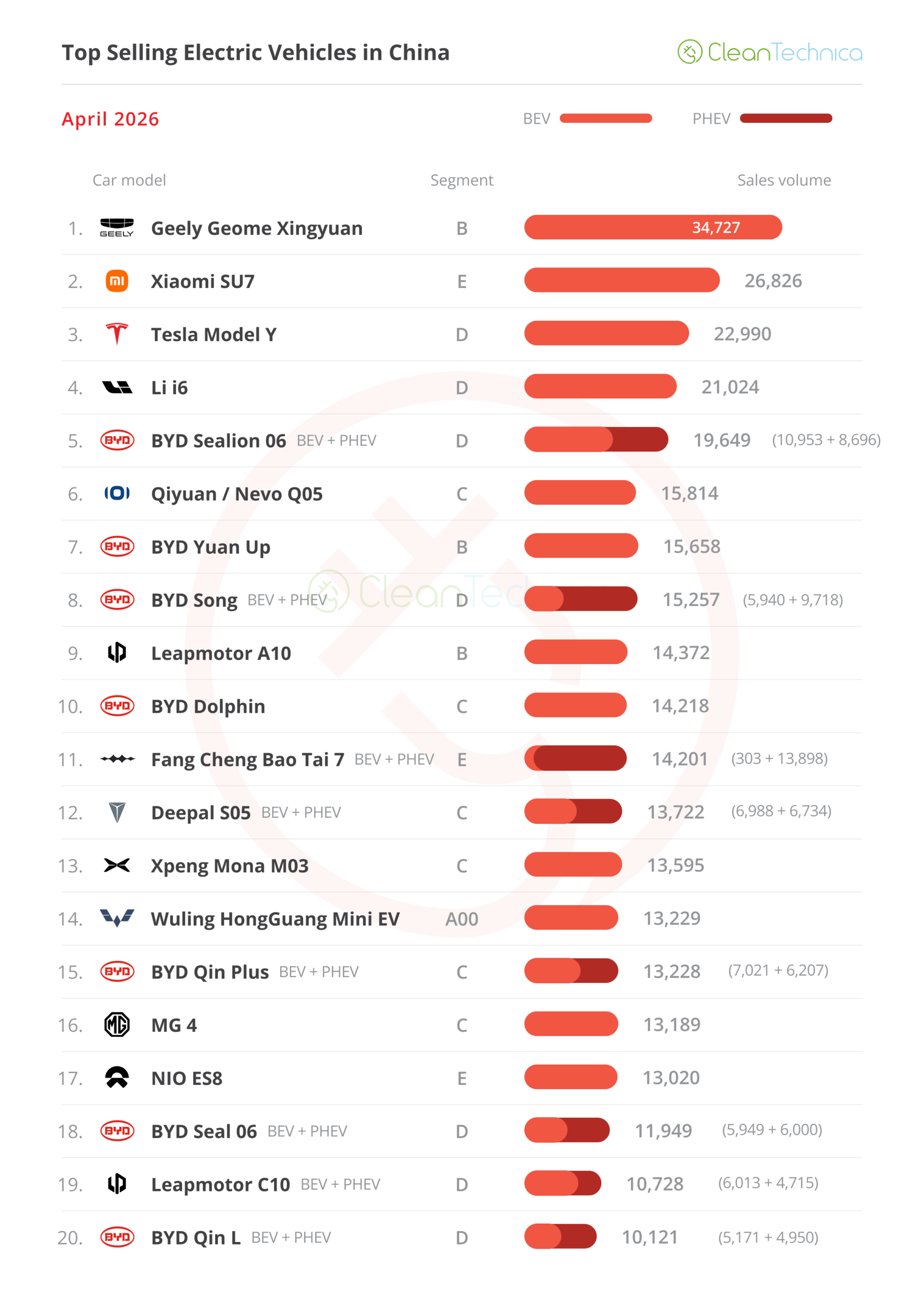
Here’s more info and commentary on April’s top selling electric models:
#1 — Geely Geome Xingyuan
A BYD Dolphin for BYD Seagull money ($10,000 USD). At least, that’s how Geely’s internal memo might have described the Geome Xingyuan when developing its latest hatchback. And it’s got an interesting name, as Xingyuan translates as “wishing upon a star.” It seems that Geely had its wish granted. The small hatchback has finally given the Hangzhou OEM the much coveted Best Seller status, not only beating its BYD nemesis but also the rest of the competition. In April, the Geely model was #1, with 34,727 registrations, which represented a slight 4% drop. With the focus now being in export markets, the small hatchback is now at cruising speed, in its home market.
#2 — Xiaomi SU7
The poster child of the Chinese EV market joined the top 5 in April thanks to 26,826 registrations, a 6% drop compared to the same month last year. This was its best result in 11 months nevertheless, thanks to the recent refresh. That means that it was the best selling sedan in China, just behind the much cheaper Geely Xinguyan. With a Porsche Taycan–like design, but for Tesla Model 3 money, the startup’s EV success is undeniable. Having said that, it has plenty of peaks and valleys, not unlike a former US startup….
#3 — Tesla Model Y
The extended wheelbase version, imaginatively called “L,” is helping the Model Y’s fortunes in China. In April, deliveries were up by 15% YoY, to 22,990 units. The long wheelbase version is proving to be a real lifeline for the US crossover, keeping the Model Y’s sales afloat — especially compared to its sibling Model 3. With just 3,000 deliveries last month, the Model 3 has seen its sales drop to less than half of what they were in April 2025.
#4 — Li Auto i6
After a strong start to the year, things continue to go well for the midsize model, with the startup EV securing another top 5 presence thanks to 21,024 registrations. With a high amount of space, comfort, and luxury for just $35,000 USD (for reference, the cheapest Tesla Model Y in China starts at $36,000 USD), the i6 offers an extensive list of equipment (air suspension, refrigerator, advanced self-driving — including Lidar). It also has a strong focus on space (three-meter wheelbase) and comfort. It’s a model that offers full size luxury in a midsize-priced EV.
#5 — BYD Sealion 06 (BEV+PHEV)
BYD’s new midsize crossover scored 19,649 registrations, allowing it to win another top 5 standing. With the BYD Song in a transitional stage, as the new, flash-charging capable, Ultra body is ramping up, the Sealion 06 is BYD’s current breadwinner in this domestic market. It is positioned at around 150,000 CNY (around $22,000) and has the standard BYD qualities of value for money, design, and connectivity. On the EV specs side, the PHEV version has an above-average 27 kWh battery, and the BEV version’s top battery has an unimpressive 79 kWh. Also, the 800V architecture is a plus at this price point. This means that the Sealion 06 has enough value for money to have a good career, but it is no star player.
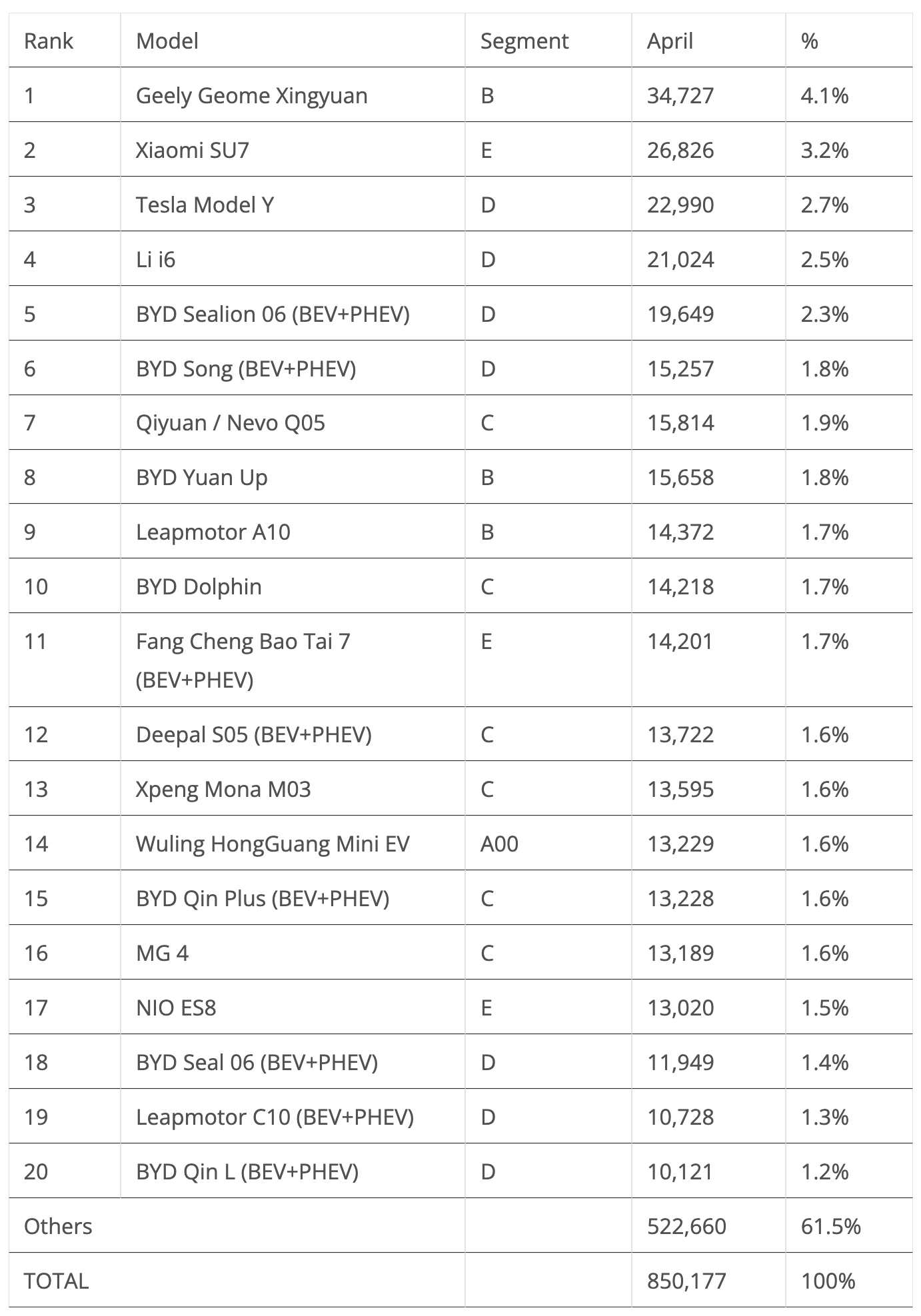
Looking at the rest of the best seller table, let’s see what the highlights show.
A model on the rise is the #7 Qinyuan/Nevo Q05, with Changan’s mainstream EV brand benefiting from a new generation of its compact crossover to score a record 15,814 registrations, its second record result in a row! Similarly, its premium cousin, the Deepal S05, had another table presence, 12th place, highlighting a positive month for the Chongqing OEM.
The other major highlight is Leapmotor’s new baby, the small A10 crossover, which surged to 9th in only its second month on the market. It scored 14,372 sales. Is this the best seller that the startup was waiting for?
Outside the top 20, a Toyota model deserves a mention. The BZ3X compact crossover scored 10,027 sales in April, its best result in 9 months. Is Toyota finally waking up?
April brought a number of relevant landings, with the three most important ones being:
- A new Chery QQ3 EV. Unlike its predecessor, which won the Best Seller title in China on two different occasions (2011 and 2013), the new QQ3 is no longer a tiny city car transformed into a cheap, but not cheerful, EV. The new one was created from scratch to run with the best of BYD (Seagull and Dolphin) and Geely (Xingyuan). With an interesting design, the cheap and cheerful Chery landed with relevant volume (8,494 units), so a top 20 position seems likely. Will it be able to run with the best of Geely and BYD?
- Leapmotor has gotten Land Yacht Fever and launched the D19. Almost 5.3 meters long, which is Cadillac Escalade-like, the 80 kWh battery is the biggest ever fitted into an EREV, which kind of begs the question: Why would you want an ICE engine on top of a 80 kWh battery? Anyhow, it has one, as well as a 0–100 km/h time of 3 seconds (again — why?…). All of this excess comes for the price of just US$33,000…. (With examples like this, no wonder US makers want to keep Chinese OEMs out of their domestic market.) It landed with 4,455 sales.
- Still in Land-yacht-stan, we have the VW ID.ERA 9X. Volkswagen’s take on the XXXL EV SUV, the 9X is just a couple of centimeters smaller than the aforementioned Leapmotor D19, so still Cadillac Escalade-like. And it is based on a SAIC platform (IM Motors, to be precise), hence being the first EREV model for the brand. With a choice of 51 and 65 kWh batteries, it has the usual long electric range + ICE range, as well as the mandatory luxuries of the category. Now the price — it starts at US$45,000. So, this or the longer range, US$12,000 cheaper Leapmotor D19? Hmm … tough choice, isn’t it? No wonder the big Volkswagen has landed with almost half of the registrations (2,326) that the Leapmotor had….
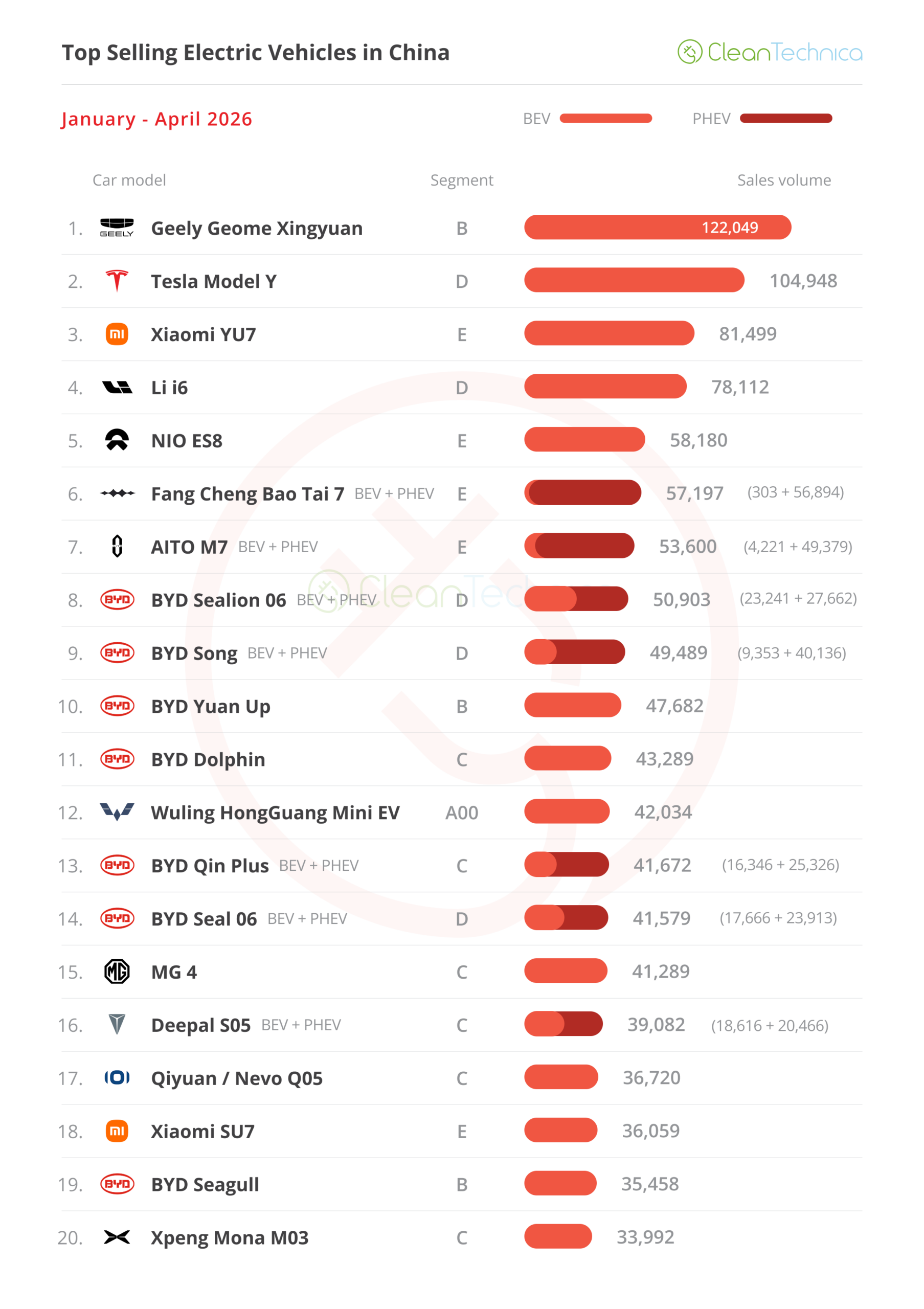
Looking at the 2026 ranking, there were no major changes on top. Although, the Xiaomi YU7 had a slow month, which means that the sporty crossover is now being closely followed by the #4 Li i6.
Below the podium positions, profiting from another slow month from the AITO M7, the Fang Cheng Bao Tai 7 surpassed it and is now 6th, fewer than 1,000 units behind the 5th placed NIO ES8.
Still in the BYD stable, the Sealion 06 climbed another position, into 8th, while the BYD Dolphin was up to 11th and the old dog BYD Qin Plus jumped two spots to #13.
But it wasn’t only BYDs that were on the rise. One should also highlight the MG 4 climbing to #15, and the Deepal S05 going up two positions to #16.
And the last positions saw three new entries. On top of the Deepal S05, Changan now also has the Qiyuan/Nevo Q05 on the table, joining it at #17. Meanwhile, the Xiaomi SU7 returned to the top 20, at #18, allowing Xiaomi to have both of its models on the table.
Finally, XPENG placed its Mona M03 best seller back on the table, in 20th.
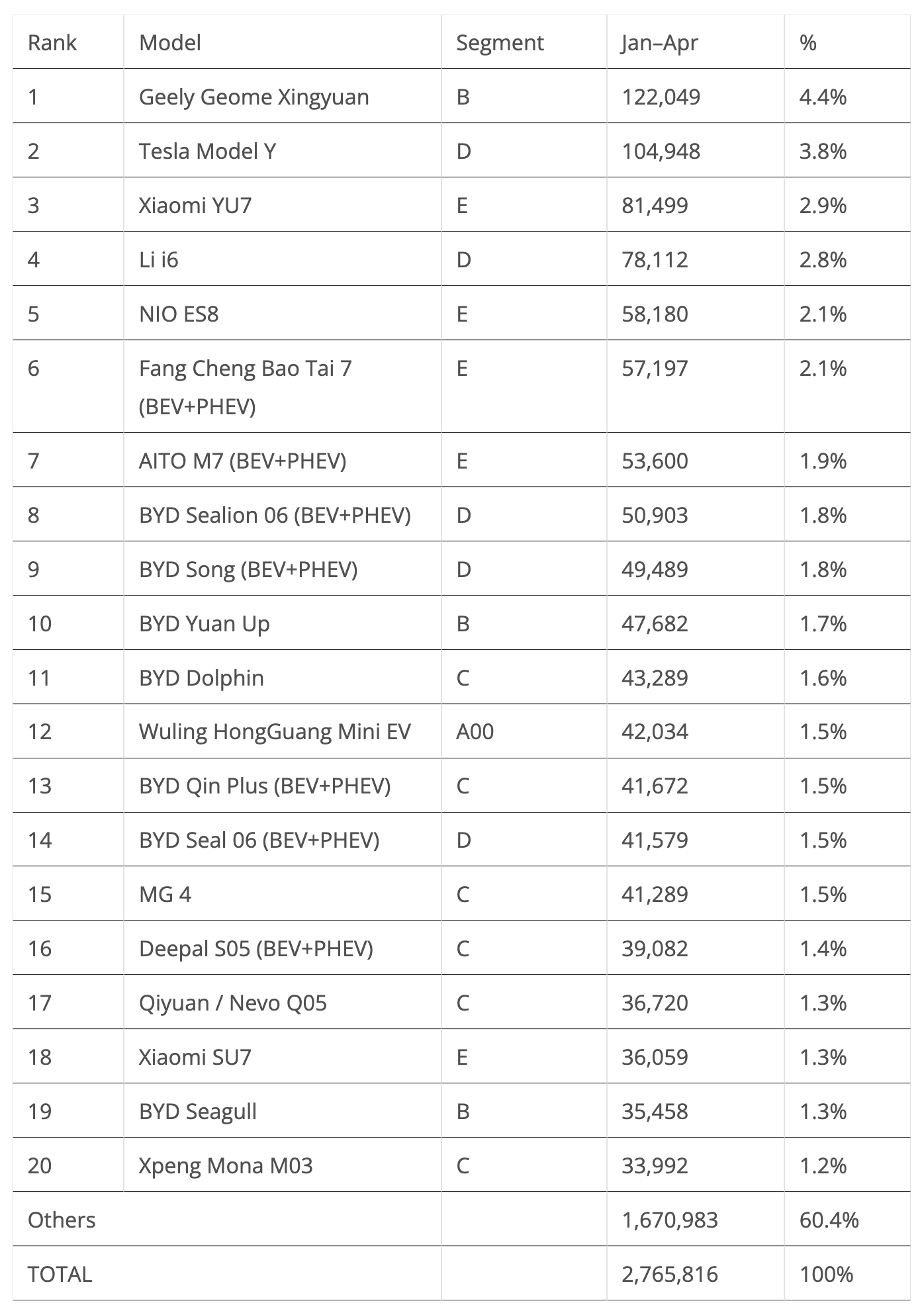
For these new models to join, others had to leave the table, with one of them being … the Tesla Model 3. Yep, now the Tesla Model Y is the only foreign model on the table. Sure, the Model 3 will return, probably in June, but with sales down 46% YoY, the fate of the Tesla sedan into oblivion seems certain. And to think that a year ago, the Texan was 9th in China…. Now, not even a top 20 spot.
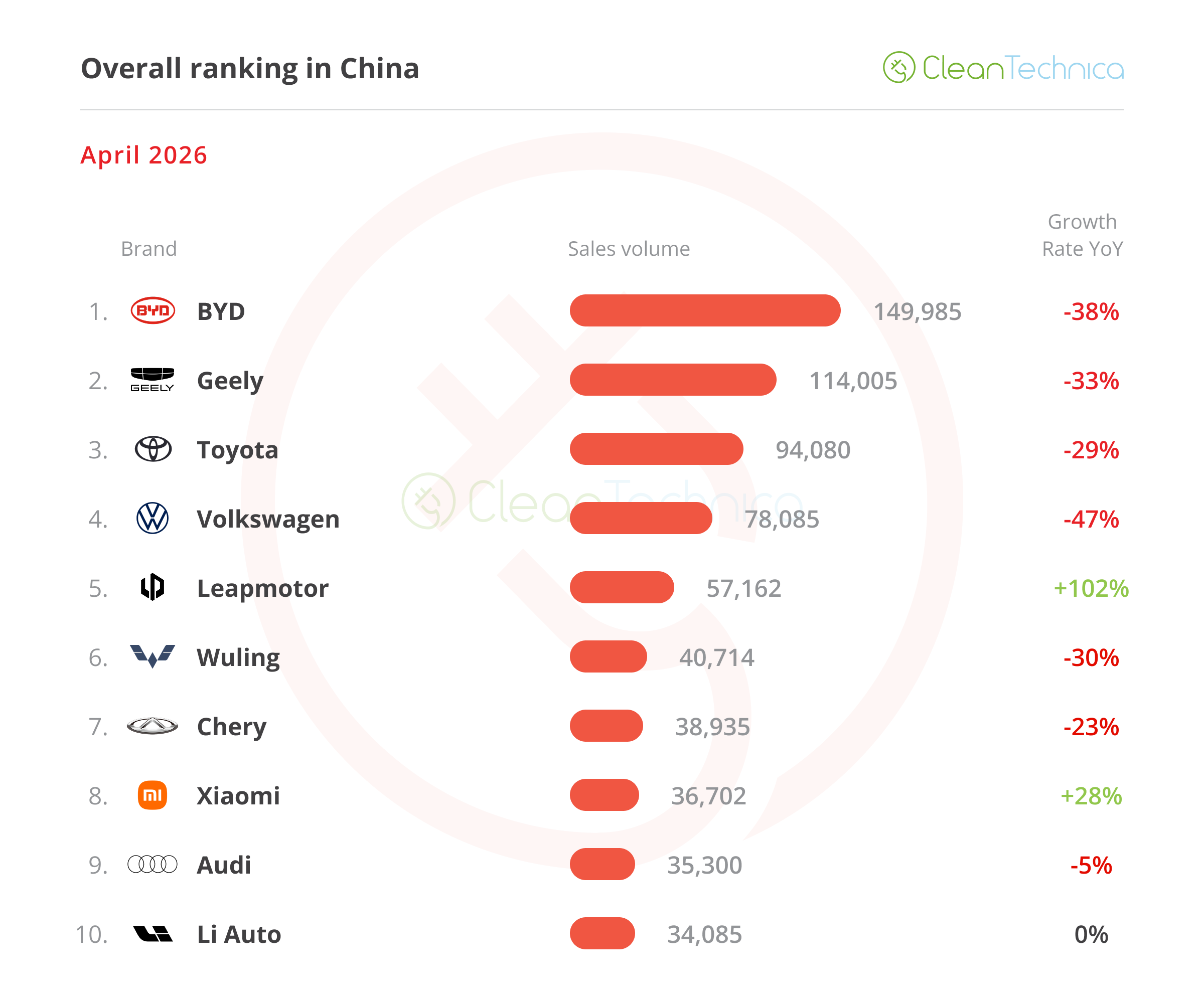
Looking at the overall manufacturer ranking, everything seems normal. BYD is on top, followed by Geely, Toyota, and Volkswagen.
Only, it’s far from being normal. BYD sales were (again) down 38% YoY. That 2nd generation of the Blade battery cannot come soon enough….
And six of the top 10 brands experienced 20%-plus losses, with Volkswagen even crashing 47% YoY!
So, if the big boys on top are bleeding sales, who is winning?
Answer: Startups. #5 Leapmotor was up 102% YoY, to 57,162 registrations, all thanks to the A10’s success. At #8, Xiaomi is also rising, up 28%. Finally, Li Auto. It was #10 in April, and despite its sales being flat, when everyone else is crashing … you win.
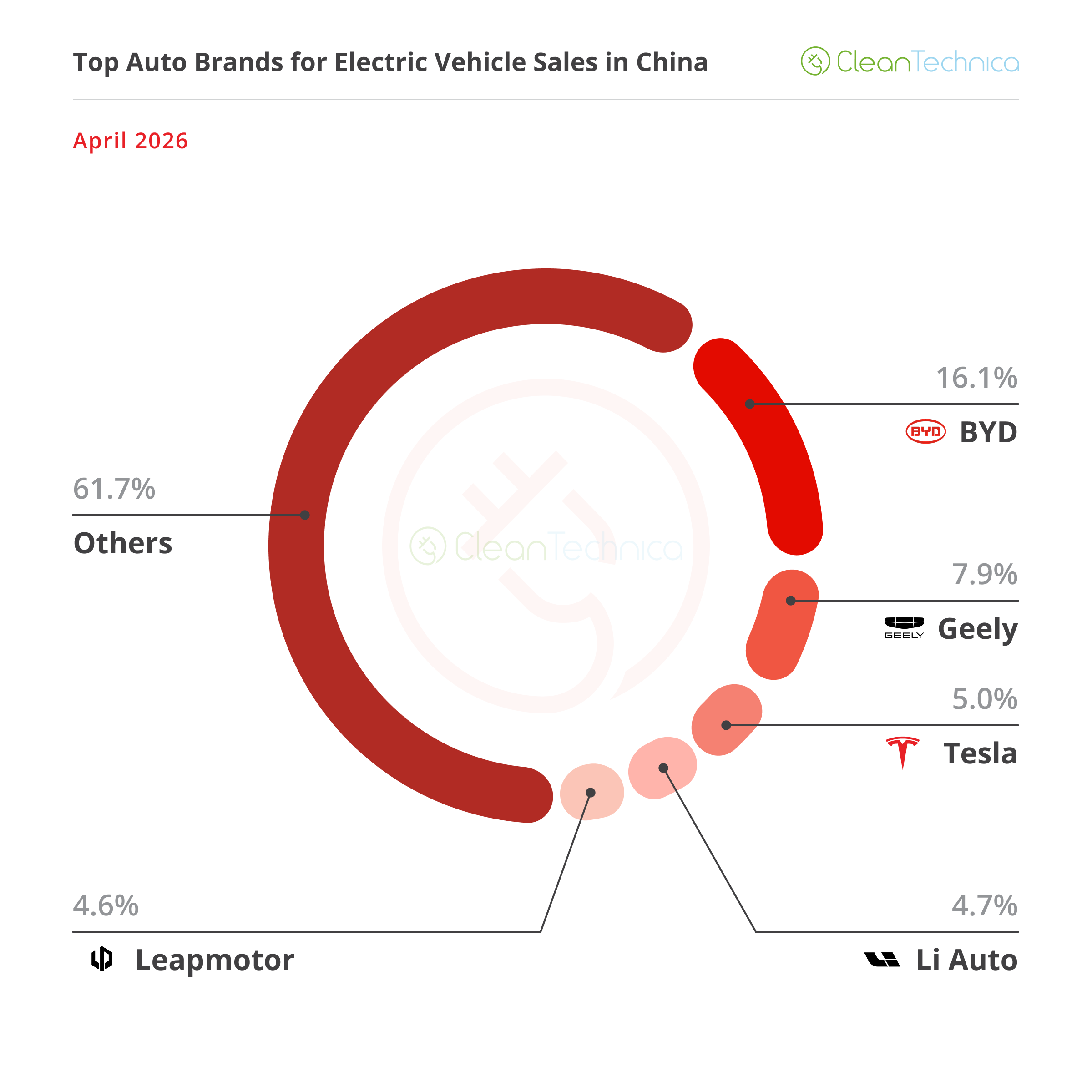
Looking at the auto brand ranking, there’s plenty of news. Leader BYD (16.1%, up from 15.8%) is gaining ground over runner-up Geely (7.9%, down 0.4%).
Tesla (5%, down from 5.9% in March) held steady in 3rd, but now has 4th placed Li Auto (4.7%) close. Meanwhile, Leapmotor climbed to 5th, profiting from Wuling being kicked off the table.
Below the top 5, the highlight is Xiaomi (4.2%, up 0.1%), now in 7th place. Will the startup be able to rejoin the table in the coming months?
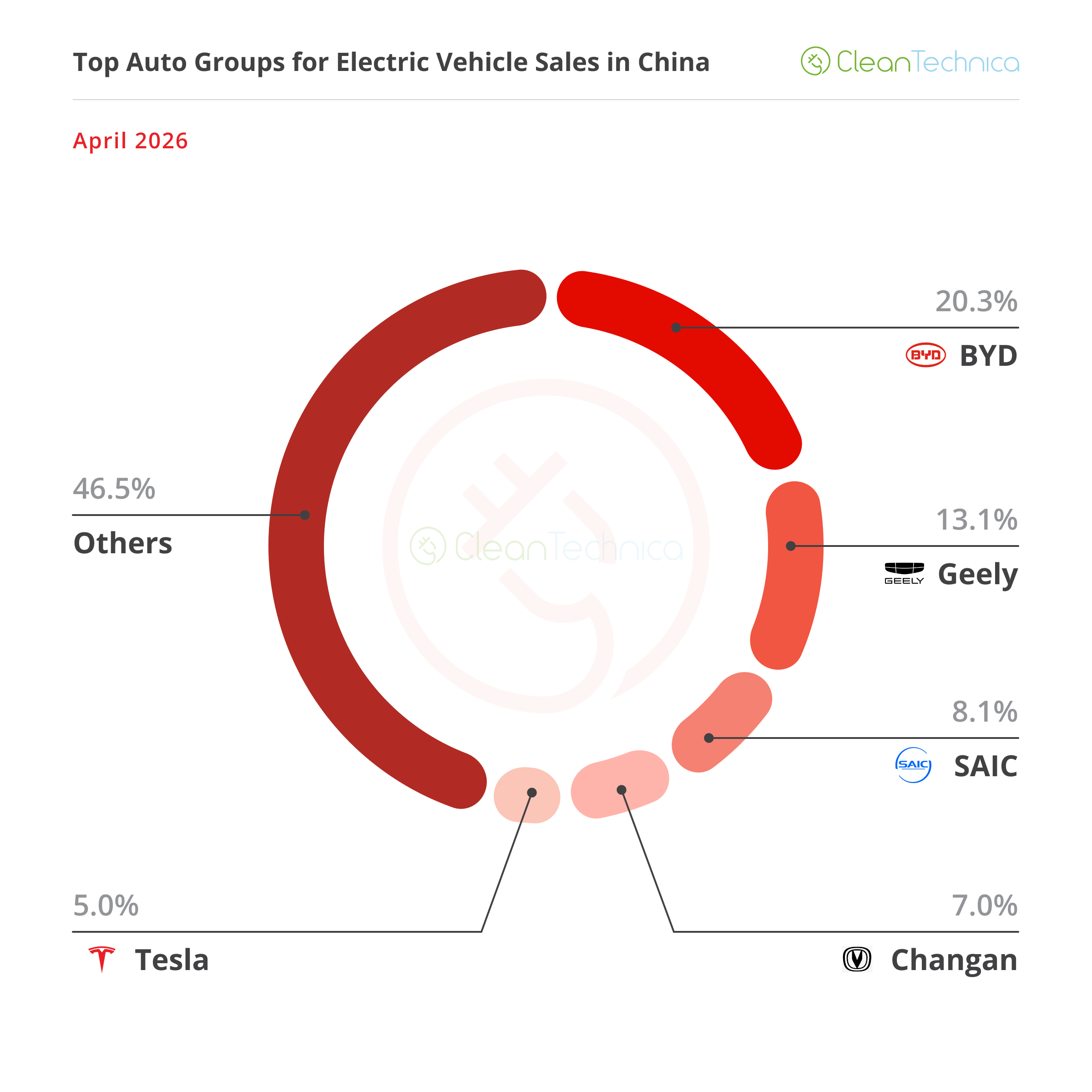
Looking at OEMs/automotive groups/alliances, BYD is leading, with 20.3% share of the market. It’s up 0.5% compared to the previous month, not only thanks to the namesake brand, but also thanks to its premium arm, Fang Cheng Bao, which was up 111% YoY in April. Meanwhile, #2 Geely lost 0.8% share and got down to 13.1%, seeing BYD put more distance between it in the race for #1.
Far from runner-up Geely, #3 SAIC (8.1%) continued to slide, as most of its brands continued in the slow lane.
With a rising Changan (7%, up 0.3%) closing in, it wouldn’t be surprising if Chongqing could reach the podium next month, or by June.
Finally, Tesla stayed in the top 5, in 5th, with 5% share. But with #6 Li Auto (4.7%) and #7 Leapmotor (4.6%) close by, the Texan will have to sweat in order to keep it’s top 5 spot.
Sign up for CleanTechnica's Weekly Substack for Zach and Scott's in-depth analyses and high level summaries, sign up for our daily newsletter, and follow us on Google News!
Have a tip for CleanTechnica? Want to advertise? Want to suggest a guest for our CleanTech Talk podcast? Contact us here.
Sign up for our daily newsletter for 15 new cleantech stories a day. Or sign up for our weekly one on top stories of the week if daily is too frequent.

CleanTechnica uses affiliate links. See our policy here.
CleanTechnica's Comment Policy