


Support CleanTechnica's work through a Substack subscription or on Stripe.
XPeng spins off robotaxi unit as China’s EV race shifts toward autonomy
Chinese electric vehicle maker XPeng has taken a decisive step toward commercializing autonomous mobility, establishing a standalone robotaxi unit that signals a broader shift in strategy from car manufacturing to full-stack transportation services.
The new unit, reported by Yahoo Finance, will focus exclusively on operating driverless ride-hailing services, separating the business of fleet operations from XPeng’s core vehicle and technology development. It marks the clearest structural move yet by the company to treat robotaxis not as a feature of its electric vehicles, but as a distinct and potentially dominant revenue stream.
The decision reflects how quickly the competitive landscape is evolving. What began as a race to electrify vehicles is now becoming a race to remove the driver altogether.
CleanTechnica asked our XPeng contacts more about this strategy. They said that the standalone robotaxi arm is geared to handle fleet deployment, service operations, and commercialization strategies, including partnerships and scaling. By isolating these functions, the company can accelerate rollout timelines while maintaining focus within its main organization on advancing autonomous driving systems, artificial intelligence, and vehicle platforms. It is also a readiness for the Chinese EV maker to focus on the non-EV technologies it currently is strongest at: AI and robotics.
For EVs, XPeng is aggressively scaling its global footprint, now spanning over 46 markets — with a laser focus on Europe, Southeast Asia, and the Middle East. Models like the G6 — fresh off a 5-star Euro NCAP rating — the G9, and the P7 are driving explosive international sales growth in 2025, especially in Norway, Denmark, Germany, France, and Belgium, where it has emerged as a top Chinese EV brand. Now that is a solid enough base.
This separation of business units also mirrors a broader industry pattern, where companies are beginning to distinguish between building autonomous systems and monetizing them. In XPeng’s case, the robotaxi unit becomes the bridge between technology and real-world revenue.
The move places XPeng in more direct competition with autonomous mobility players such as Baidu through its Apollo Go service as well as startups like Pony.ai. It also positions the company ahead of traditional automakers that remain largely focused on electrification rather than autonomy-led services.
XPeng has already laid significant groundwork for this transition. The company has been developing a full-stack autonomous driving system supported by its in-house Turing AI chips, while preparing multiple robotaxi-ready vehicle models targeted for release around 2026. Pilot testing in China is underway, with regulatory approvals gradually expanding as local governments open pathways for driverless operations.
The establishment of a dedicated unit suggests XPeng believes the technology is nearing commercial readiness, at least in controlled urban environments. It also reflects confidence that robotaxis could evolve into a scalable business model, particularly in dense cities where ride-hailing demand is high and labor costs remain a constraint.
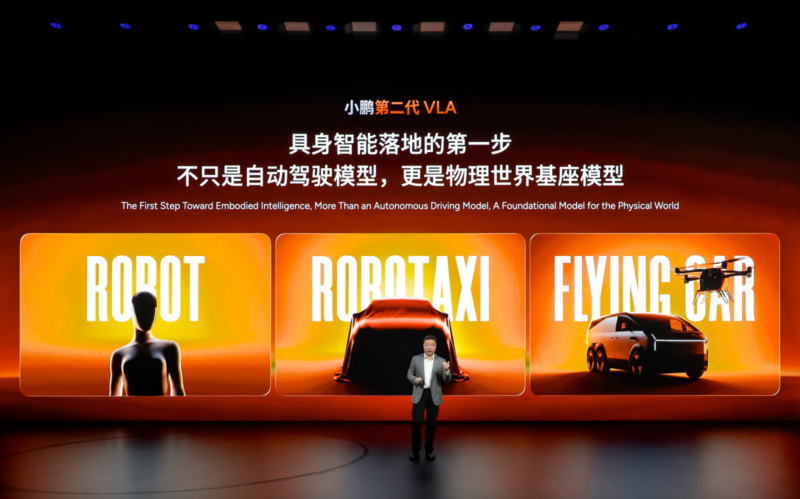
More broadly, the move aligns with XPeng’s push into what it calls “physical AI,” a strategy that integrates intelligent vehicles, robotics, and autonomous systems into a unified ecosystem. While the company has also been investing in humanoid robots and advanced manufacturing, the robotaxi business offers a more immediate path to monetization.
For the global clean transport transition, XPeng’s pivot underscores a critical inflection point. Electrification addressed emissions, but autonomy could redefine utilization. A robotaxi fleet, operating continuously and efficiently, has the potential to reduce the number of vehicles needed per capita while accelerating the shift away from private car ownership.
In Europe, for example, the company’s expansion is methodical: right-hand drive operations in Norway, Sweden, Denmark, Netherlands, Belgium, Germany, France, and Spain, with the UK next on deck.
Smartly localizing production via partnerships in Europe and a new plant in Malaysia targeting 2026 output, while rolling out ultra-fast charging networks starting in Thailand and Hong Kong, makes XPeng all set to outpace rivals. In its earnings call, He Xiaopeng, Chairman and CEO of the company, announced 380 overseas stores and a localized service network to rival European and American giants, as well as a Volkswagen alliance.
Sign up for CleanTechnica's Weekly Substack for Zach and Scott's in-depth analyses and high level summaries, sign up for our daily newsletter, and follow us on Google News!
Have a tip for CleanTechnica? Want to advertise? Want to suggest a guest for our CleanTech Talk podcast? Contact us here.
Sign up for our daily newsletter for 15 new cleantech stories a day. Or sign up for our weekly one on top stories of the week if daily is too frequent.

CleanTechnica uses affiliate links. See our policy here.
CleanTechnica's Comment Policy