

Progressive Funders Need to Reassess the Breakthrough Institute

There was a time when a progressive or center-left foundation could back the Breakthrough Institute and tell a coherent story about why. Breakthrough presented itself as a pro-technology, pro-modernization, pro-development corrective to parts of environmentalism that had become too focused on scarcity, guilt, and procedural obstruction. It was abrasive, but it was still possible to see it as a useful critic inside the broad decarbonization tent. That story is much harder to sustain today. Breakthrough did not just publish another contrarian essay. It filed an amicus brief against a climate lawsuit challenging Trump administration actions, then defended that intervention in a piece that framed climate litigation as anti-democratic lawfare. That should be a jump the shark moment for any progressive funder still writing checks out of habit, nostalgia, or inattention.
The reason this should matter is not that think tanks must agree with every Democratic policy, climate advocate, or environmental lawsuit. Serious institutions should criticize allies, challenge weak arguments, and reject bad strategy. The question is whether Breakthrough is still acting like a heterodox but constructive climate and energy think tank, or whether it has drifted into becoming a small, donor-sheltered platform defined more by antagonism than by problem solving. Looking at its recent record, the pattern is hard to miss. It is increasingly against things rather than for things. It is against climate hawks, against climate litigation, against renewables favoritism, against Democratic climate policy, against environmental proceduralism, and against former collaborators who stayed inside mainstream climate and energy analysis. The amicus brief is not an outlier. It is the cleanest expression of a broader turn.
That creates an obvious question for the institute’s progressive funders. Why are they still supporting it?
There are two charitable explanations, and both are plausible. The first is benign neglect. Breakthrough is not a large institution by foundation standards. Public filings show about $7.54 million in revenue in fiscal 2024 and about $5.54 million in expenses. For a national foundation, that is a small grantee. A grant to Breakthrough is a minor line item, not a flagship commitment. Small grants can run on autopilot for years if the institution remains respectable enough, produces reports with policy language and charts, and does not create a scandal big enough to force a board discussion. The second explanation is institutional lag. Breakthrough still describes itself as an organization that promotes technological solutions to environmental and human development challenges. A donor who remembers the older Breakthrough story may still think that is the institution being funded, even as the public output has become more hostile, more personal, and more aligned with the political priorities of the anti-climate coalition.
Benign neglect and institutional lag matter because they explain how donor relationships can survive long after the original rationale has disappeared. A foundation program officer can inherit a portfolio and keep renewing modest grants because the grantee still sits in the mental category of heterodox ally rather than active liability. A board member can remember the old Breakthrough critique of stagnant environmental politics and not notice that the institute has moved from challenging environmentalism to attacking much of the climate coalition on behalf of a worldview that is more useful to Trump and his allies than to decarbonization. An institution can keep the language of technology and innovation on its website while its actual public presence shifts toward polemic, grievance, and selective realism. That is not an exotic theory of donor behavior. It is one of the most ordinary things in philanthropy.
There was once more substance behind the charitable story. Breakthrough’s early identity was built around support for public investment, innovation, infrastructure, and development, and also criticism of mainstream environmentalism. It said climate change was not going to be solved by moral exhortation or narrow regulation alone. It pushed nuclear, yes, but it also pushed modernization. It is worth being fair about that because otherwise the current problem gets blurred. The issue is not that Breakthrough was always secretly Republican or always a stalking horse for fossil interests. The issue is that an institution that once looked like an internal critic of weak environmental habits now looks like an institution whose main energy comes from attacking the people and coalitions still trying to do the work of decarbonization.
The history of departures and fractures around Breakthrough matters here. Michael Shellenberger and Ted Nordhaus were the original pair behind the early “Death of Environmentalism” thesis, but Nordhaus later wrote that Shellenberger left over significant differences in political strategy, policy priorities, and personal style. Jesse Jenkins was a major Breakthrough energy and climate figure who left in 2012 for MIT and then went on to become one of the most influential modelers of U.S. decarbonization pathways. Tyler Norris was part of the same broader circle. Zeke Hausfather later served in a senior climate role and then departed for Stripe. These are not trivial names. They are a meaningful share of the people who made Breakthrough look like a home for serious heterodox analysis rather than a personality platform. As that earlier circle dispersed, Breakthrough narrowed. Today it looks much more like Ted Nordhaus, Alex Trembath, and a newer supporting cast than the broader intellectual coalition it once appeared to host.
For the record, Shellenberger devolved more rapidly and further than Breakthrough. His public writings and work is now a package of themes that map strongly onto the contemporary populist right: anti-censorship politics, attacks on “woke” ideology, criticism of Democrats and progressive governance, interventions in trans politics, and collaboration with heterodox-right media ecosystems. His own CV highlights talks such as “Escaping the Woke Matrix” and “How WPATH Ends,” and his Public newsletter now brands itself around “civilization,” censorship, cities, addiction, and environment, not climate policy. He’s basically just another right-wing climate-change denying political influencer now, whatever he started out as.
The narrowing of Breakthrough would not matter so much if the tone and substance of the institute had stayed constructive. But the public record points in the other direction. Nordhaus’s own writing has moved from criticizing environmental strategy to attacking the core narratives of the climate movement, revising his own past views on climate risk, and targeting former allies. In the amicus brief essay, Nordhaus and Trembath did not just disagree with Jesse Jenkins on a technical matter. They identified him as a former colleague and then attacked his modeling and his role in Biden-era climate policy. That is the kind of move that signals a deeper institutional change. It is one thing to say a model is wrong. It is another to make former collaborators into symbols of what has gone wrong with climate politics.
This is where the thesis that Breakthrough is now more against than for becomes hard to avoid. On paper, the institute still has positive programs. It is for nuclear energy innovation, for regulatory reform, for agricultural technology, for energy access in poorer countries, for critical minerals, and for a version of abundance politics. But in its visible climate and energy work, those positions are increasingly framed through hostility to something else. Nuclear is advanced not just as a useful option but as a rebuke to renewables-first politics. Permitting reform is framed not just as necessary state capacity but as a cudgel against environmentalists. Critiques of climate litigation are not just legal arguments but denunciations of the climate movement. Even abundance is often presented less as a concrete build agenda than as a way of attacking Democratic climate politics, climate advocates, or the institutions of environmental review. The ratio has shifted. The oppositional energy now dominates the constructive energy.
That would be one thing if Breakthrough’s negative posture were paired with a strong alignment to observable energy reality. But on the biggest energy story of the past decade, its emphasis is hard to defend. The main build story has not been advanced nuclear arriving at scale. The main build story has been wind, solar, batteries, and grid integration. In the United States, the only new nuclear units in recent years were Vogtle 3 and 4, and after Vogtle 4 came online in 2024, the U.S. Energy Information Administration said there were no other nuclear reactors under construction. Of course, those nuclear reactors were over budget and behind schedule by billions and years. By contrast, U.S. additions in 2024 were led by about 30 GW of utility-scale solar and 10.4 GW of battery storage. That is not a close contest. The center of gravity of actual deployment is clear.
Texas makes the point even more sharply because it is one of the clearest real-world tests of what grids actually build when the goal is adding capacity fast at acceptable cost. ERCOT reported around 40 GW of wind and 33 GW of solar by mid-2025, with battery discharge records above 7 GW and total installed storage reaching around 15 GW by late 2025. Texas has built all of that while building zero new nuclear. None. It is not a theoretical argument. It is a working system that leaned hard into renewables, transmission, flexibility, and batteries because those were the assets available to build at pace. Breakthrough can talk about the need for firm power, but its weighting of technologies reads more like a set of preferences than an honest accounting of what is actually getting financed, interconnected, and turned on.
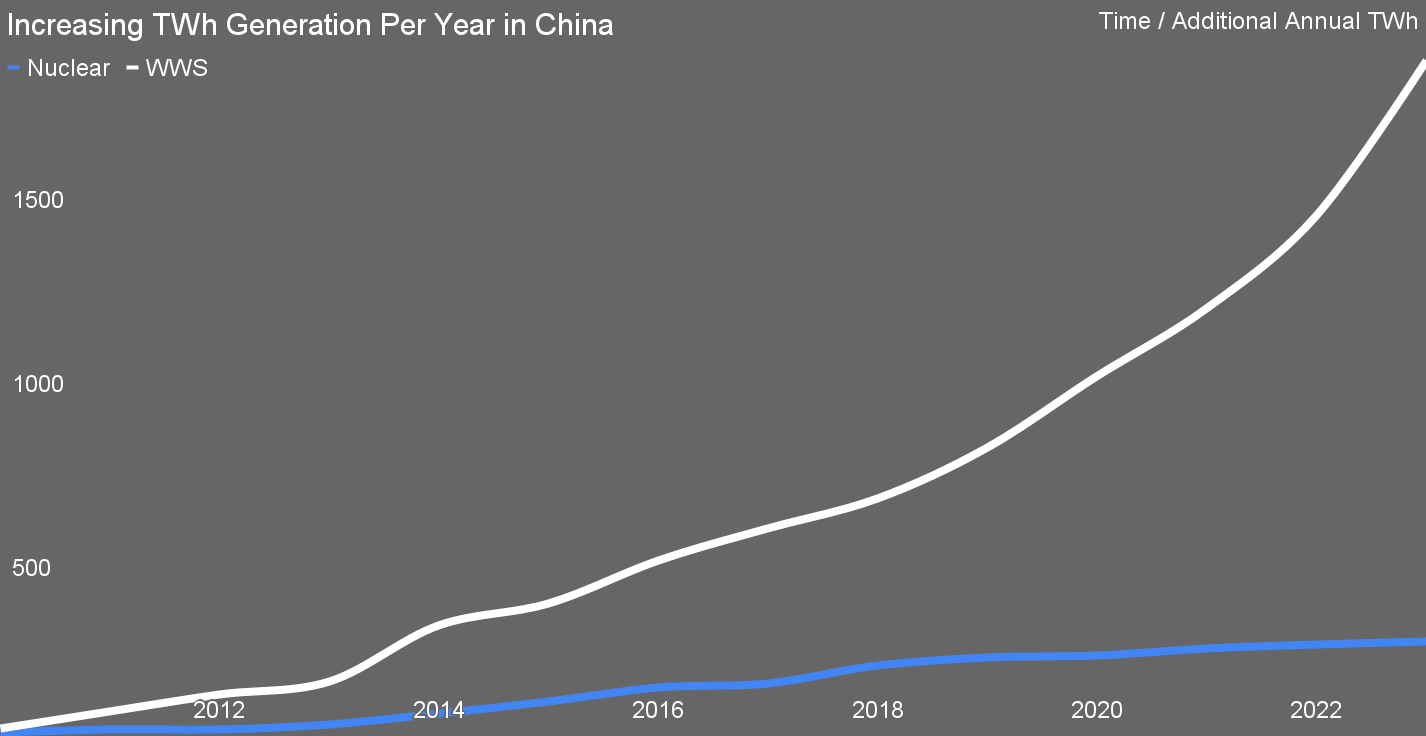
China is even more revealing. Breakthrough and the wider ecomodernist camp like to point to China’s nuclear approvals, and those approvals are real. But approvals are not the same thing as power plants connected to the grid. On grid connection, the pace is much slower than the approval headlines suggest. The World Nuclear Association’s 2025 performance report said three reactors were connected to the grid in China in 2024. Over the same period, China added more than 340 GW of solar and around 80 GW of wind in 2024 alone, according to the International Energy Agency. Chinese official figures said renewables were 56% of installed capacity at the end of 2024 and above 60% by early 2026. Again, this is not a close call. China is the one big economy that is doing some nuclear at scale, and even there the dominant build story is renewables. If your analysis keeps treating the technologies winning in deployment as secondary and the technologies winning in op-eds as central, you are not being realistic about the energy transition.
Breakthrough’s defenders could respond that none of this disproves the need for firm low-carbon power. Fair enough. High-renewables systems still require transmission, storage, demand management, flexible generation, and in some regions some firm supply. But that is not the argument under scrutiny. The issue is whether Breakthrough’s rhetoric and priorities still track the observable direction of the sector. They do not. The institute has become more skeptical of the technologies that have actually scaled and more attached to a “clean firm” politics that remains much easier to advocate than to deliver. That gap between rhetoric and build reality is not a minor analytical quibble. It is one reason the institute’s criticism of mainstream decarbonization now feels less like tough-minded realism and more like a refusal to update priors.
Then there is the political alignment problem. It is not necessary to claim that Breakthrough is now Republican in any formal sense. It is a 501(c)(3), not a party committee. Its funders are ideologically mixed. But there is a difference between not being formally Republican and increasingly behaving in ways that are useful to Trump’s worldview. The current Trump coalition is hostile to climate litigation, hostile to much of the climate movement, hostile to what it sees as renewables favoritism, eager to weaken environmental constraints, and eager to frame Democratic climate politics as elitist, coercive, or detached from everyday economic concerns. Breakthrough’s recent output overlaps with that politics on too many fronts to wave away. The amicus brief is the strongest example because it is not rhetorical shading. It is action in support of Trump administration interests in court.
One can object that overlap is not identity. That is true, but it is not enough. The relevant question for a funder is not whether Ted Nordhaus has registered as a Republican or whether Alex Trembath says nice things about some Democratic policy. The relevant question is what the institution is doing in the world. Is it helping build support for decarbonization, transmission, storage, electrification, and the actual technologies that are changing the grid? Or is it spending its limited resources on attacking Democrats, denouncing the climate movement, criticizing former collaborators, and siding with Trump administration positions in court? When a small think tank with roughly $5.54 million in annual expenses chooses to spend time and credibility on an amicus brief against a climate lawsuit, that is a strategic choice. It is a signal about priorities.
The staffing and compensation numbers underline that this is a compact shop with concentrated leadership. Breakthrough’s current staff page lists 19 staff members. Public tax records show that more than half of expenses are staff compensation, with about $1.32 million in executive compensation and about $1.76 million in other salaries and wages in fiscal 2024. Ted Nordhaus was reported at $260,777 in salary plus $44,729 in other compensation, numbers which rose significantly in recent years. Alex Trembath was reported at $213,540 in salary plus $46,925 in other compensation. In a $5.54 million expense organization, those choices matter. This is not a sprawling institution where leadership can plausibly distance itself from a rogue program. It is a small think tank whose tone and direction are set from the top.
Trembath deserves separate mention because he complicates the picture. He is not just the last survivor from the early years. He is now executive director and has been with Breakthrough since its earlier phase. He is less abrasive than Nordhaus in tone and more legible as an abundance and modernization advocate. But the difference is more style than substance. Trembath co-authored the amicus essay. He has helped translate Breakthrough from old ecomodernist branding into the newer abundance language, but he has not functioned as a public counterweight to the institute’s turn against the climate coalition. For donors hoping that Breakthrough remains salvageable because Trembath is steadier than Nordhaus, that is too hopeful. He may be the smoother face of the project, but he is still carrying much the same line.
That brings the focus back to the funders. Breakthrough’s current funders page lists the Pritzker Innovation Fund, Arnold Ventures, the Chicago Community Foundation at Builders Vision’s recommendation, the Bernard & Anne Spitzer Charitable Trust, Stand Together Trust, and others. This is not a cleanly right-wing donor roster. Many of these are progressive or center-left coded. Some are bipartisan or technocratic. Only one, Stand Together Trust, is tied to the Koch world. That mix matters because it means no simple donor-capture theory is needed to explain the current situation. Breakthrough can survive by being useful to different audiences for different reasons. It can offer pro-technology modernization language to one funder, anti-regulatory abundance politics to another, and anti-climate-movement polemic to a third. That cross-faction usefulness is part of what makes donor inertia possible. But it’s significant that the Koch-aligned Stand Together Trust is a recent addition to the donor list. Clearly Breakthrough was doing things that the Koch network liked.
Mixed funding is not an excuse for mixed accountability. The presence of conservative or libertarian-aligned money does not absolve progressive funders of responsibility for what they are helping legitimize. Nor can progressive funders hide behind the idea that their grants are too small to matter. If the grants are small, that makes review easier, not harder. A major institution might demand years of relationship repair, restricted funding, or leadership change. A small one can be re-evaluated with a simple question. Are we still funding the organization we thought we were funding? If the answer is no, the next question is even simpler. Why continue?
There is evidence that donor churn happens. Older Breakthrough funder lists included the William and Flora Hewlett Foundation and Breakthrough Energy. In late 2025 Nordhaus wrote that the institute had lost a significant grant renewal from Breakthrough Energy. That does not prove a donor revolt over ideology, because Breakthrough Energy was also retrenching more broadly. But it does show that funding relationships are not fixed and that major backers can decide the fit no longer works. If anything, that should increase the pressure on remaining progressive funders to ask whether they have actually examined the fit themselves.
The strongest case for those funders to act is not moral panic. It is basic governance. A progressive funder does not need to demand conformity from every grantee. It does not need to police every sharp essay or disagreement over climate policy design. But it should know when a grantee has crossed from heterodox criticism into a pattern of behavior that undermines the broader public-interest goals the funder claims to serve. Supporting a Trump-friendly amicus brief against a climate lawsuit is not a minor disagreement over carbon pricing versus tax credits. Publicly attacking former collaborators while dismissing the technologies that are doing most of the real work in deployment is not healthy contrarianism by itself. It is a warning sign that the institution’s center of gravity has moved.
It is possible that some of Breakthrough’s progressive funders still endorse the institute’s direction. If so, they should say that openly. They should explain why an institution that now spends so much of its energy attacking Democrats, climate advocates, climate litigation, and former allies still advances the public interest they exist to serve. They should explain why an institute whose energy analysis is misweighted against the observable build-out of wind, solar, batteries, and grids remains a useful guide to the transition. And they should explain why intervening on Trump’s side in a climate lawsuit was a prudent use of philanthropic capital. Silence looks less like confidence than like drift.
The more likely explanation is less dramatic and more embarrassing. Some grants are still flowing because Breakthrough’s brand has outlived its current reality. Some are still flowing because the money is minor enough that nobody has been forced to think hard. Some are still flowing because “technology and innovation” remains a flattering description for a donor file, even when the institution in question is spending a growing share of its public energy on antagonism, factional combat, and Trump-adjacent interventions. That is what makes the amicus brief such a useful test. It is difficult to wave away. It asks funders to choose whether they are backing a difficult but constructive thinker, or simply underwriting a small prestige platform that now punches left while telling itself it is still above politics.
If the Breakthrough Institute once deserved support as a provocative internal critic of environmentalism, that case should now be reopened from scratch. The burden is no longer on critics to prove that something has gone wrong. The burden is on the institute’s progressive funders to explain why they are still there. Pritzker Innovation Fund, Arnold Ventures, Builders Vision through the Chicago Community Foundation, and the Bernard & Anne Spitzer Charitable Trust should review their support and decide whether this is still the institution they intended to underwrite. What is no longer credible is benign neglect, institutional lag, or the hope that one more grant cycle can pass before anyone notices that the old Breakthrough story has ended.

