



Support CleanTechnica's work through a Substack subscription or on Stripe.
With many of us experiencing a very cold January, I’m sure millions of people were inclined to think, “Global warming? What global warming? Pfff!” However, just because the door to the Arctic was opened for a bit and sent a frost down our way, that doesn’t mean the world as a whole wasn’t warmer than usual. As it turns out, it was the hottest January on record. (Maybe that’s actually why the Arctic door opened up for a bit.)
Oh, by the way, that’s despite a global weather trend that normally cools things down. “A run of record-breaking global temperatures has continued, even with a La Niña weather pattern cooling the tropical Pacific,” The Guardian writes. “The Copernicus Climate Change Service said last month was the warmest January on record, with surface-air temperatures 1.75°C above preindustrial levels.”
Most striking, though, is simply looking at the following graph:
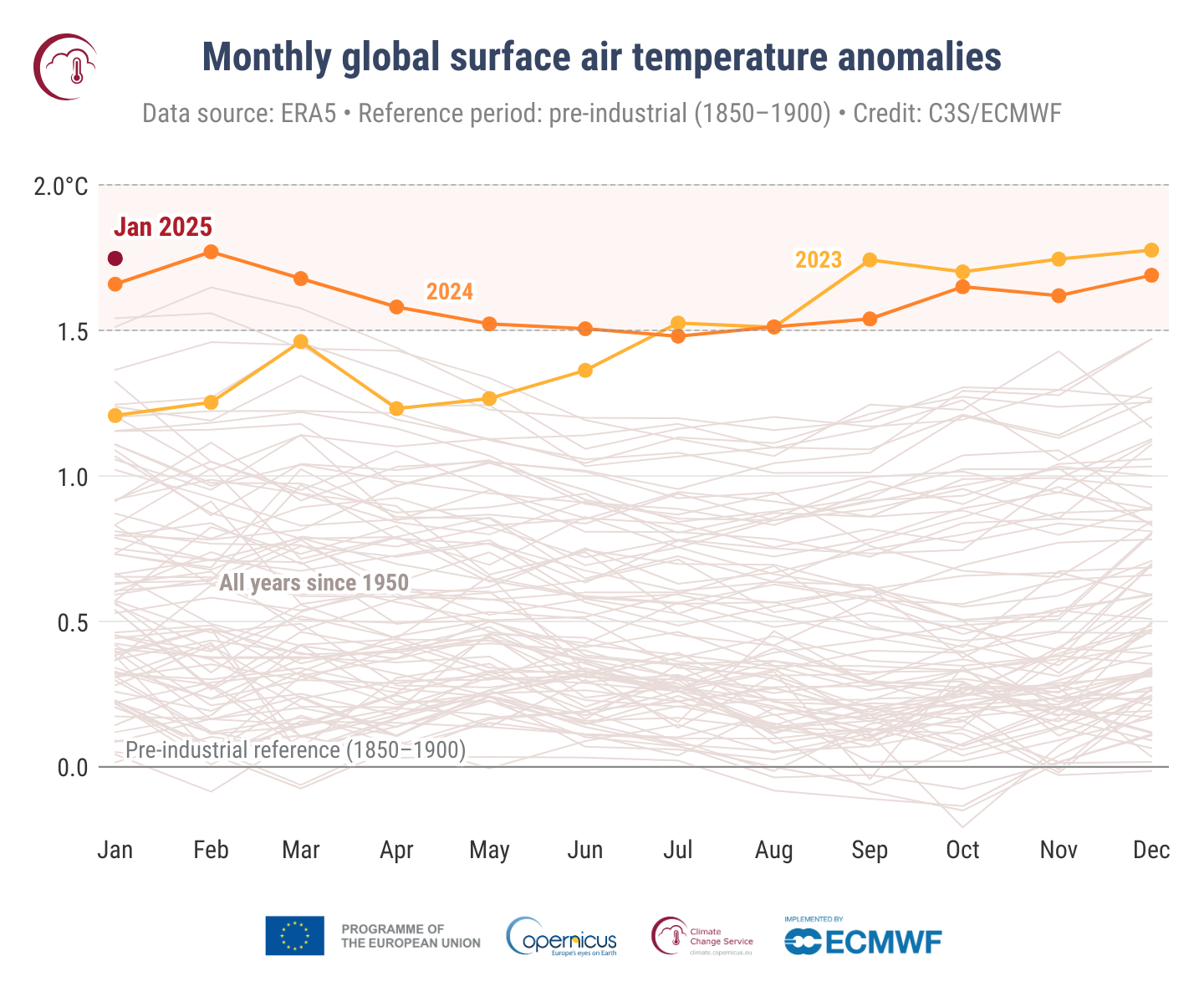
Not good. … Not good at all.
Where will we be in January 2030?
Aside from January setting a new record, it was the 18th month out of 19 that was more than 1.5°C above the preindustrial global average temperature for the month.
Again, the extra crazy thing about all of this is that El Niño peaked in January of last year, 2024, and we would normally see gradual cooling as we moved from El Niño into La Niña. The fact that the heat records keep hitting is extra concerning.
“The last 12-months period (February 2024 – January 2025) was 0.73°C above the 1991-2020 average, and 1.61°C above the estimated 1850-1900 average used to define the pre-industrial level,” Copernicus writes.
At the moment, 2025 is still not expected to be the hottest year on record, due to La Niña, instead falling third behind 2024 and 2023. But we’ll see what happens, as scientists were surprised January was so hot.
“Scientists say the current period is likely to be the warmest the planet has been in 125,000 years,” The Guardian adds. However, if we don’t cut fossil fuel use much faster (highly unlikely), we will soon have to go back much further in time to find a period that was as warm. And things will get more and more disruptive for agriculture, water supplies, and overall human livability.
Sign up for CleanTechnica's Weekly Substack for Zach and Scott's in-depth analyses and high level summaries, sign up for our daily newsletter, and follow us on Google News!
Have a tip for CleanTechnica? Want to advertise? Want to suggest a guest for our CleanTech Talk podcast? Contact us here.
Sign up for our daily newsletter for 15 new cleantech stories a day. Or sign up for our weekly one on top stories of the week if daily is too frequent.

CleanTechnica uses affiliate links. See our policy here.
CleanTechnica's Comment Policy