


Support CleanTechnica's work through a Substack subscription or on Stripe.
In my recent article on trucks in China, the shift to electrification is increasingly prevalent and seems inevitable. Jake also recently posted on an autonomous freight startup in the US. However, electrified, autonomous logistics is becoming increasingly common in Chinese cities and is rapidly commercializing in long haul applications. Based on what I saw at Auto Beijing, what may seem like an interesting idea to some is quickly becoming a reality in China.
There were multiple smaller logistics vehicles under the label “Robovan,” not to be confused with the Tesla prototype, which would be referred to as a “Robobus” by most of the companies at the show. The Robovan models are intended to replace vans for local cargo transportation and delivery.

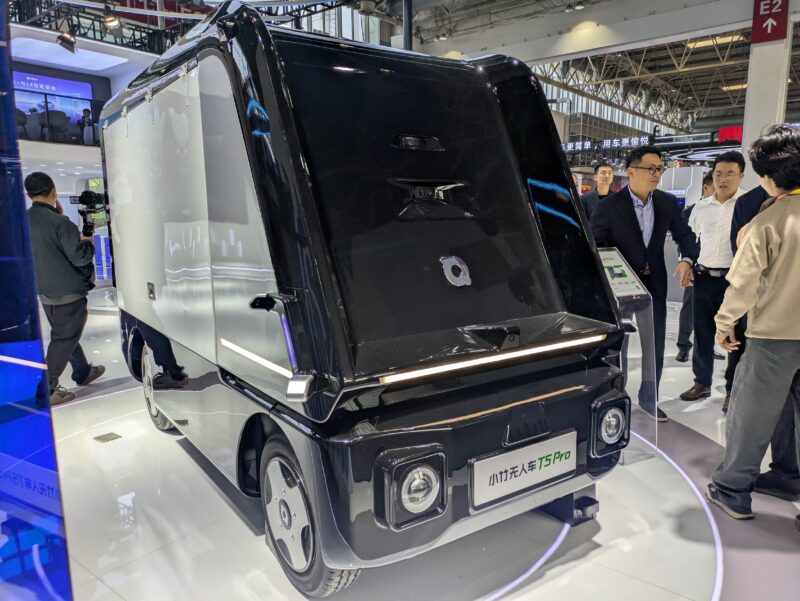
MINIEYE had on display its latest Bamboo Robovan T5 Pro, which it calls the industry’s first “true mapless” L4 unmanned logistics vehicle. This reduces the dependence on HD maps and improves operation in unpredictable road conditions. It also makes automated delivery more easily implemented in new areas, particularly where there are data concerns. The Robovan uses MINIEYE’s new iPilot 4 Max intelligent driving domain controller.
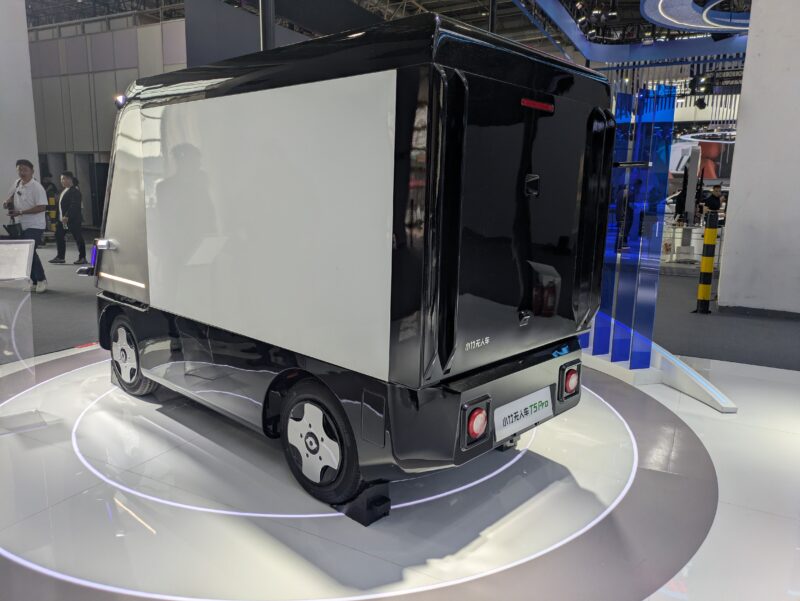
A previous version of the Robovan was launched in September of last year and is currently operating in 18 cities. Development of the latest version engaged multiple partners and started in 4Q 2025. The new model will begin deliveries in a few months. Welcome to “China Speed.”
This also brings up an important aspect of technological development in China. A wide range of suppliers and technology partners are available. Someone with an idea can engage with those partners and suppliers to bring that idea to market very quickly, bringing multiple generations of products to customers in the time it would take someone to develop a prototype in other countries. Protectionism doesn’t just isolate consumers from the most innovative products. It also isolates innovators from an ecosystem that would let them rapidly bring their ideas from the sketchpad to reality.
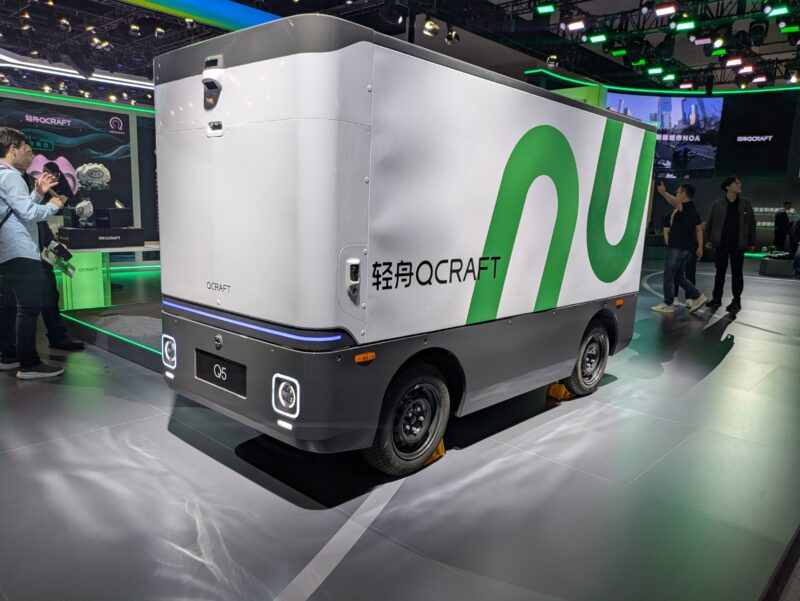
Speaking of innovators, QCRAFT also displayed a L4 Robovan at the show. QCRAFT was founded by former Waymo employees. However, as part of the Chinese innovation ecosystem, they seem to be moving very fast. Their L4 autonomous delivery vehicle also claims a “Map-Free” solution. Their “full-stack” technology uses a data closed loop to promote “rapid R&D and iteration of algorithms.”
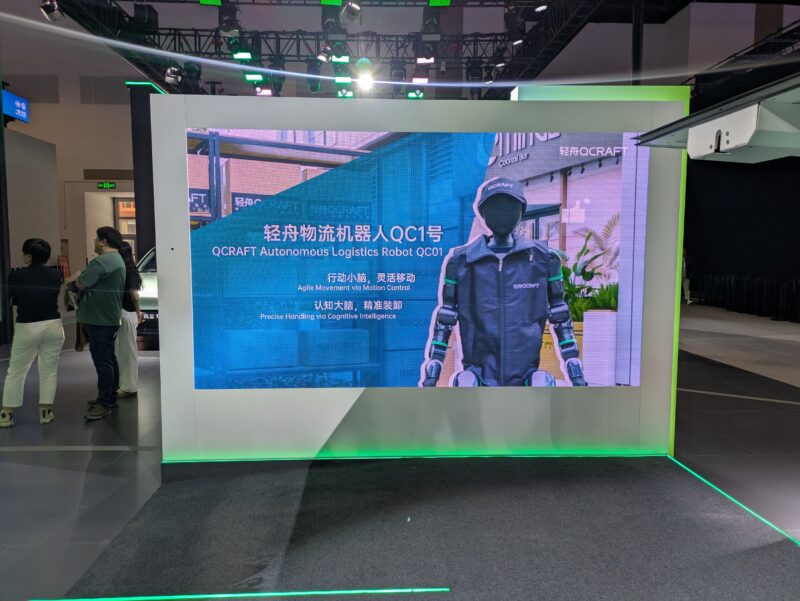
QCRAFT also showed a video of their QC01 Autonomous Logistics Robot loading and unloading packages. While the L4 Robovan serves last-mile delivery needs, the Robot covers the last few meters of delivery.
In general, the most prevalent models at the show had interior volumes of a little over 5 cubic meters and payloads of around 1,000 kg. Eliminating the driver means an impressive amount of cargo capacity in a compact footprint. Being focused on last-mile delivery, ranges of around 200 km seem more than sufficient for the application. Prices mentioned were less than $20k. While that may be a little more than electric 1-ton delivery trucks in China, by eliminating the need for a driver, the autonomous vehicles could rapidly recoup the cost on labor.


In addition, larger and smaller models were available. There were multiple brands at the show, although I wasn’t able to get into details on all of them.
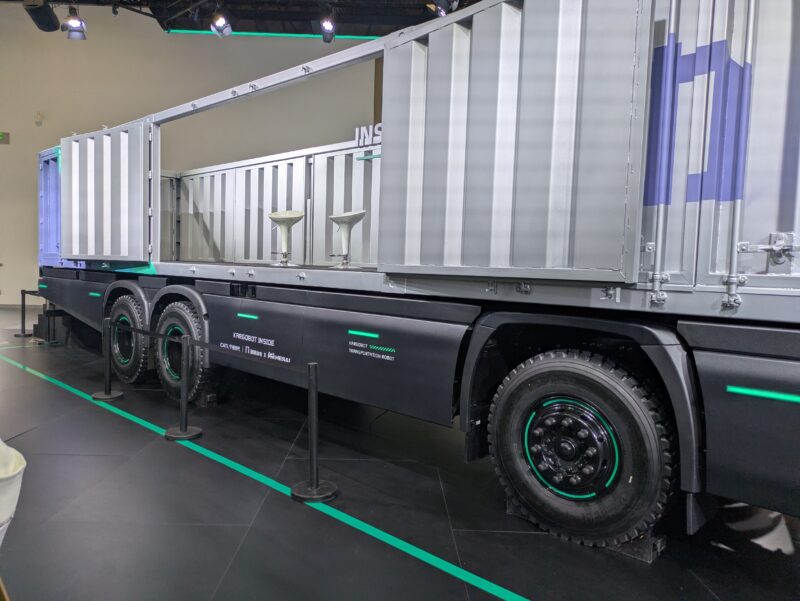
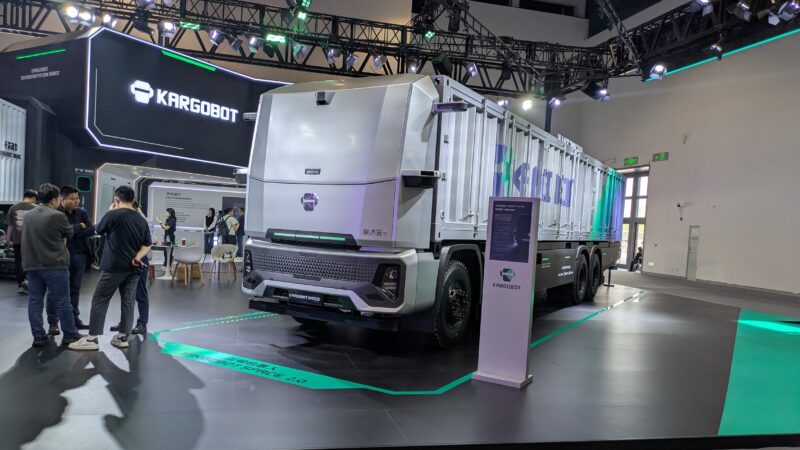
On the other side of the size spectrum, Carl Dynamics showed off the KargoBot Space, a 4-axle, semi-sized autonomous freight vehicle. They describe it as “transport robot + L4 autonomous driving system + logistics operation platform and services.” Carl Dynamics already has L4 electric autonomous trucks on the road in China and claims to be first “to achieve a closed-loop commercialization of autonomous driving for bulk commodity trunk logistics.” They claim to have hauled over 1.4 billion ton-km so far, but they are still just getting started.

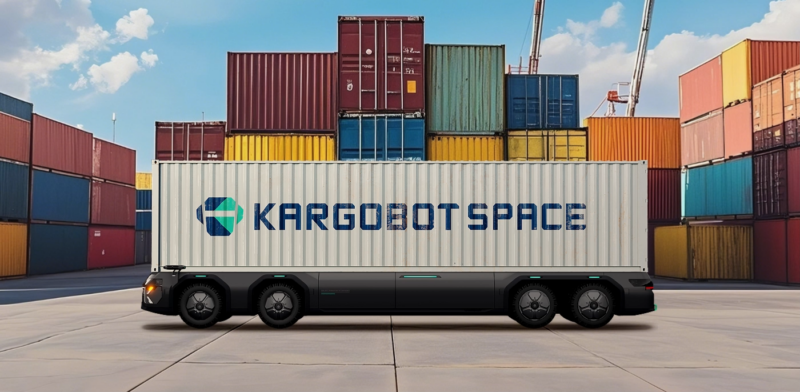
While their previous autonomous vehicles had a vestigial cab, the Space goes fully driverless, taking the concept to the next level. Not needing a driver means that a separate cab is not necessary, letting more cargo be transported in the same footprint. KargoBot claims a 25% improvement in cargo space and a 10% improvement in effective load lifting. As more vehicles are deployed, the ability to drive in formation offers further potential efficiency improvements by reducing aerodynamic drag. This vehicle was developed in collaboration with CATL, providing battery swap capabilities that enable up to 2000 km of daily L4 autonomous operating range. KargoBot claims an overall 35% reduction on logistics costs. While freight often travels by electrified rail along major corridors in China, there are still many applications where trucks are needed. In markets outside of China, the need is potentially even greater.

A Different Road To Autonomy
In addition to logistics, QCRAFT and MINIEYE also have Robobus models on the road, transporting passengers in China.
Yet, the focus on cargo models provides an interesting path to autonomous vehicle development. Development can happen faster. Regulations are less complicated for cargo models than they are for passenger vehicles. No need for crash testing, airbags, etc. Expectations for noise, vibration and harshness are much lower. The focus can be on development of the autonomous capability. Vehicles can be prototyped, produced, tested, and iterated much more quickly. The lessons learned from these vehicles can then be applied to autonomous vehicles with human passengers.
Compared to the excellent VLA 2.0 from XPENG, I have no doubt that these systems are far less smooth and assertive. However, the smoothness isn’t as important in these applications, and the assertiveness becomes less desirable when impatient passengers are not onboard. Some adaptation of the systems would undoubtedly be needed to comfortably transport passengers, but it represents an interesting development path.
However, even if the vehicles remain strictly for logistics, the potential economic and environmental impact of electric autonomous logistics is massive. Diesel trucks are some of the most polluting vehicles on the road. Computer chips do not get tired or distracted, potentially improving safety. Smaller footprints could reduce road congestion.
The change appears to be happening quickly now in China. It will be interesting to see when it reaches the rest of the world.
Sign up for CleanTechnica's Weekly Substack for Zach and Scott's in-depth analyses and high level summaries, sign up for our daily newsletter, and follow us on Google News!
Have a tip for CleanTechnica? Want to advertise? Want to suggest a guest for our CleanTech Talk podcast? Contact us here.
Sign up for our daily newsletter for 15 new cleantech stories a day. Or sign up for our weekly one on top stories of the week if daily is too frequent.

CleanTechnica uses affiliate links. See our policy here.
CleanTechnica's Comment Policy