


Support CleanTechnica's work through a Substack subscription or on Stripe.
To: Ms. Teresa Ribera, Executive Vice-President for a Clean, Just and Competitive Transition; Mr. Wopke Hoekstra, Commissioner for Climate, Net Zero and Clean Growth; Mr. Apoltolos Tzitzikostas, Commissioner for Sustainable Transport and Tourism.
We, the undersigned NGOs, trade unions, industry actors, industry associations and consumer associations, are joining forces to urge the European Commission to use the upcoming revision of the EU Emissions Trading System (EU ETS) to extend the scope of aviation ETS coverage to all departing flights from Europe.
The 2026 ETS review offers a critical opportunity to correct a longstanding gap in European climate policy and to ensure that aviation finally makes a fair contribution to Europe’s climate objectives. While aviation has been included in the EU ETS since 2012, the system still excludes the vast majority of emissions: extra-EEA flights that rely on CORSIA. As a result, the carbon market is still failing to cover most aviation emissions linked to Europe. Around 70% of EU aviation CO2 emissions remained outside the European carbon market.
This severely weakens the carbon price signal for aviation. Despite the start of the phase-out of free allowances in 2024, the effective carbon price actually paid by airlines was only around €22 per tonne of CO2 in 2025, compared with an average ETS carbon price of €73 across the system as a whole. Under these circumstances, European aviation growth remains unchecked and undermines the CO2 emission reduction targets adopted by the European Union. Indeed, aviation emissions have risen by more than 30% since 2005 — the start of the ETS — while emissions from other sectors have declined.
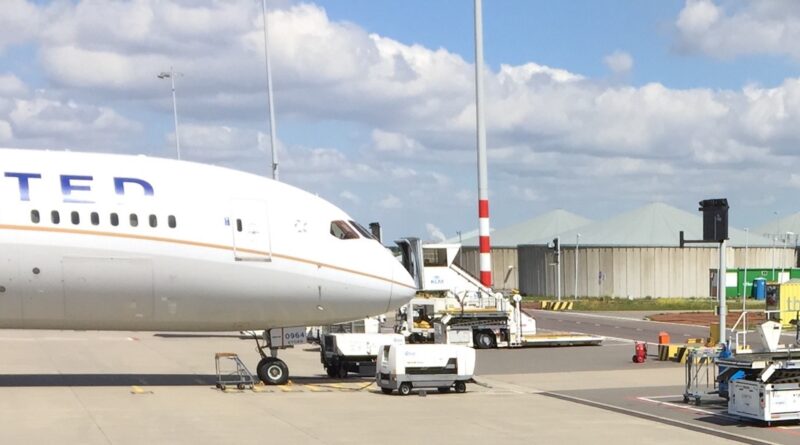
This current framework is also producing damageable distortions between carriers. Third-country airlines such as Emirates and United Airlines, despite emitting at levels comparable to major European carriers, face lower carbon costs because a larger share of their operations falls outside the current ETS scope. Extending the ETS to all departing flights would help restore a level playing field while giving proper effect to the polluter pays principle.
Likewise, continued reliance on the international offsetting scheme CORSIA to address the majority of Europe’s aviation emissions is deeply problematic:
- CORSIA is based on offsetting, including credits of questionable environmental integrity, and therefore does not guarantee real emissions reductions within the aviation sector;
- The scheme is projected to cover only around 26% of EU aviation CO2 emissions by 2035;
- Several key aviation markets, including Russia, China, Brazil, India, and the United States, have not implemented CORSIA into national law.
In practice, CORSIA risks allowing airlines and governments to claim progress at low cost while delaying investment in the real decarbonisation measures the sector urgently needs. Moreover, at the latest ICAO General Assembly in September 2025, no measures were adopted to strengthen CORSIA. In addition, the 126 Member States that committed to participate in CORSIA from 2024 account for only 66% of global CO2 emissions, below the threshold set in EU law. On both counts, the conditions for reliance on CORSIA have not been met.
The Commission should therefore act decisively in the upcoming ETS revision and propose the extension of the aviation ETS scope to all departing flights from Europe.
Extending the scope of the aviation ETS would also create a vital source of funding for the decarbonization of the economy, in particular transport, and to contribute to international climate finance.
With extended scope, Member States could receive nearly €14 billion from aviation by 2030. This would also make aviation decarbonization technologies and low-carbon alternatives, such as rail, more competitive. In the context of intensifying international competition for clean technology investment and manufacturing capacity, this is not only a climate imperative but an industrial one.
The EU has rightly positioned itself as a global leader on climate action and on the implementation of the polluter pays principle. The 2026 ETS review is the moment to close this loophole and ensure that aviation contributes credibly and fairly to Europe’s decarbonisation pathway.
Yours sincerely,

Download the full letter here. Article from T&E.
Sign up for CleanTechnica's Weekly Substack for Zach and Scott's in-depth analyses and high level summaries, sign up for our daily newsletter, and follow us on Google News!
Have a tip for CleanTechnica? Want to advertise? Want to suggest a guest for our CleanTech Talk podcast? Contact us here.
Sign up for our daily newsletter for 15 new cleantech stories a day. Or sign up for our weekly one on top stories of the week if daily is too frequent.

CleanTechnica uses affiliate links. See our policy here.
CleanTechnica's Comment Policy